
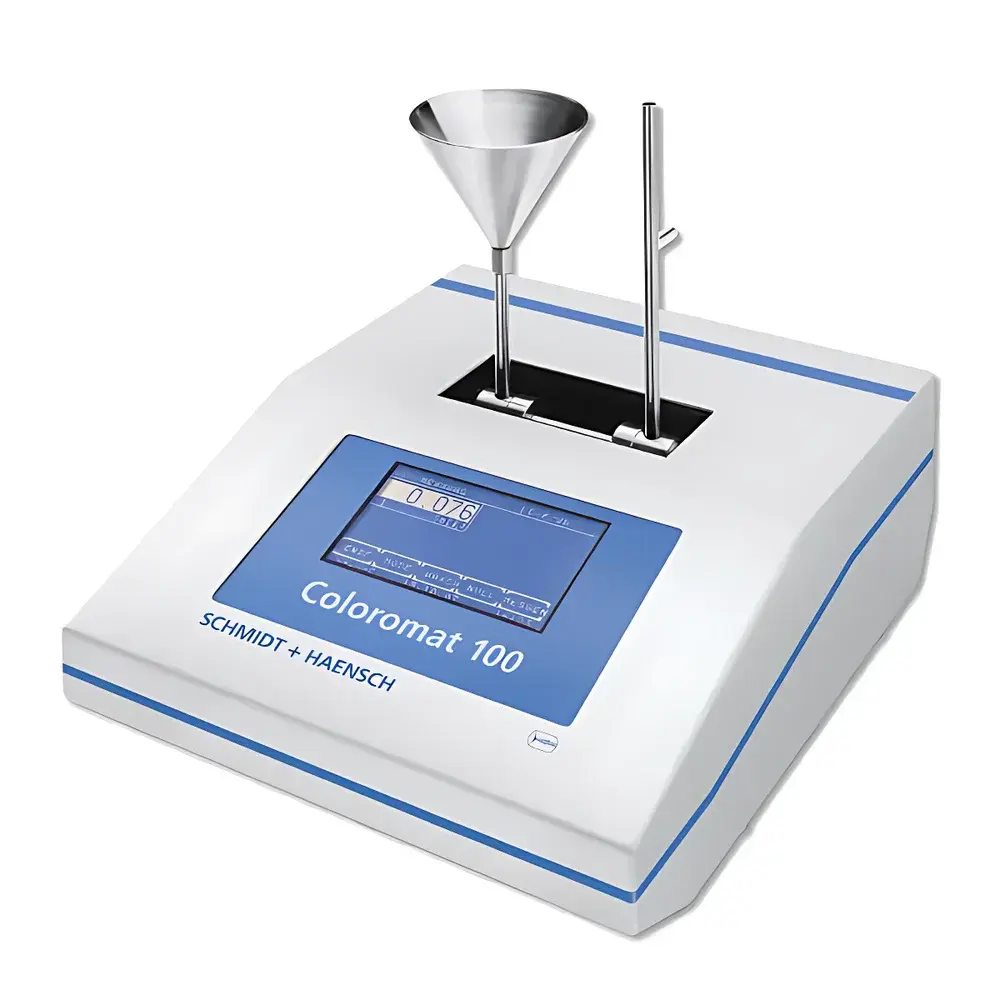
SCHMIDT + HAENSCH Coloromat 100 Spectrophotometric Colorimeter
| Brand | SCHMIDT + HAENSCH |
|---|---|
| Origin | Germany |
| Model | Coloromat 100 |
| Optical Principle | Single-beam spectrophotometry |
| Spectral Range | 420–900 nm |
| Fixed Wavelengths | 340, 420, 720 nm |
| Customizable Wavelengths | up to 6 additional (340–900 nm), total ≤9 |
| Extinction Accuracy | ±0.020 (340 & 420 nm), ±0.010 (720 nm), ±0.020 (other wavelengths) |
| ICUMSA Range | 0–16.000 IU |
| ICUMSA Accuracy | ±10% (<20 IU), ±5% (>20 IU) |
| Extinction Resolution | 0.001 |
| Light Source | 12 V / 20 W halogen lamp |
| Display | Graphical touchscreen interface |
| Interface | RS232C |
| Operating Temperature | 10–40 °C |
| Power Supply | 85–265 V AC, 47–63 Hz |
| Language Support | English & German (others on request) |
| Internal Method Storage | 250 pre-programmed methods (ROM), up to 230 user-defined methods (RAM) |
| Data Storage Capacity | 2970 measurements, 99 sample IDs |
| Compliance | GLP/GMP-compliant data handling, audit-trail-ready operation |
Overview
The SCHMIDT + HAENSCH Coloromat 100 is a precision-engineered single-beam spectrophotometric colorimeter designed for reliable, traceable color quantification in liquid samples across food, beverage, pharmaceutical, and industrial quality control laboratories. Its optical architecture is based on classical absorbance (extinction) measurement according to the Beer–Lambert law, with calibrated photometric detection across a defined spectral range of 420–900 nm. Unlike filter-based colorimeters, the Coloromat 100 employs a monochromator-based wavelength selection system—ensuring high spectral fidelity and minimizing stray light interference through optimized optical baffling and beam path geometry. This design delivers consistent photometric linearity and long-term stability, critical for regulatory compliance and inter-laboratory comparability. The instrument is explicitly validated for standardized color evaluation protocols including ICUMSA (International Commission for Uniform Methods of Sugar Analysis), EBC (European Brewery Convention), and general extinction-based color indexing used in soft drinks, wine, malt extracts, coffee infusions, and enzymatic assay media.
Key Features
- Triple fixed-wavelength capability at 340 nm, 420 nm, and 720 nm—optimized for ICUMSA color determination in sugar solutions and related matrices.
- Expandable wavelength configuration: up to six additional user-defined wavelengths within the 340–900 nm range, enabling method flexibility for non-ICUMSA applications such as EBC beer color or polyphenol-related absorbance assays.
- Touchscreen-driven interface supporting alphanumeric sample ID entry, batch naming, method selection, and real-time parameter adjustment—eliminating reliance on external keyboards or PC tethering during routine operation.
- Large sample compartment accommodating flow-through cells up to 100 mm pathlength and standard rectangular cuvettes, facilitating high-volume throughput and compatibility with automated liquid handling systems.
- Continuous monitoring mode with programmable sampling intervals (e.g., 1 s to 60 s), generating time-resolved extinction profiles for kinetic color development studies or process stream surveillance.
- Stray-light-resistant optical design certified via internal diagnostic routines, ensuring measurement integrity even under variable ambient lighting or extended operational duty cycles.
Sample Compatibility & Compliance
The Coloromat 100 supports aqueous and low-viscosity organic solutions in standard quartz or glass cuvettes (10–100 mm pathlength). Its sealed vertical sample chamber prevents spillage and cross-contamination while maintaining optical alignment integrity. All measurements adhere to ISO 7027 (turbidity-corrected absorbance) and ASTM D1209 (platinum-cobalt color scale) foundational principles, with built-in calibration verification routines aligned with NIST-traceable reference standards. Data management conforms to GLP and GMP requirements: each measurement record includes timestamp, operator ID, method version, wavelength, pathlength, and raw extinction value. Audit trails are retained internally and exportable via RS232C, satisfying FDA 21 CFR Part 11 readiness when paired with validated LIMS integration.
Software & Data Management
The embedded firmware hosts 250 preloaded analytical methods—including ICUMSA Method GS4/3-12, EBC 9.2, and custom extinction protocols—with capacity for 230 additional user-defined methods stored in volatile RAM. Firmware updates are performed via USB or RS232C using signed binaries downloaded from the manufacturer’s secure portal. Measurement results (up to 2970 entries) are indexed by sample ID (99 unique identifiers), with full metadata retention. Export formats include CSV and ASCII text compatible with Excel, LabArchives, and electronic lab notebooks. Optional PC software provides advanced curve fitting, trend analysis, statistical reporting (mean, SD, CV%), and PDF report generation compliant with ISO/IEC 17025 documentation standards.
Applications
- ICUMSA color grading of white sugar syrups, molasses, and refinery intermediates per GS4/3-12 and GS4/3-13.
- EBC color index determination in wort, beer, and malt extracts using 430 nm or 700 nm endpoints.
- Time-dependent color evolution in enzymatic browning assays (e.g., polyphenol oxidase activity in fruit juices).
- Quality control of liquid food colorants (caramel, anthocyanins, carotenoids) via extinction ratios at multiple wavelengths.
- Monitoring decolorization kinetics in activated carbon treatment or oxidative bleaching processes.
- Standardized extinction measurements for pharmacopeial excipient testing (e.g., USP color tests for solvents and APIs).
FAQ
Is the Coloromat 100 compliant with FDA 21 CFR Part 11 for electronic records?
Yes—when operated with enabled audit trail logging and password-protected user roles, its data storage and export functionality meet predicate rule requirements for electronic signatures and record integrity.
Can I import custom calibration curves from external spectrophotometers?
Yes—user-defined extinction-to-concentration or extinction-to-color-unit mappings can be loaded via RS232C using ASCII-formatted coefficient tables.
What is the recommended recalibration frequency for routine QC use?
SCHMIDT + HAENSCH recommends daily zeroing with deionized water and weekly verification using certified ICUMSA reference standards (e.g., SRM 1979); full optical recalibration is advised annually by authorized service personnel.
Does the instrument support automatic dilution correction?
No—the Coloromat 100 performs direct photometric measurement only; dilution factors must be applied post-acquisition in exported data or via integrated calculation templates.
Is remote firmware update possible over network connection?
Firmware updates require physical RS232C or USB connection to a host PC; no Ethernet/WiFi interface is provided in the base configuration.



