
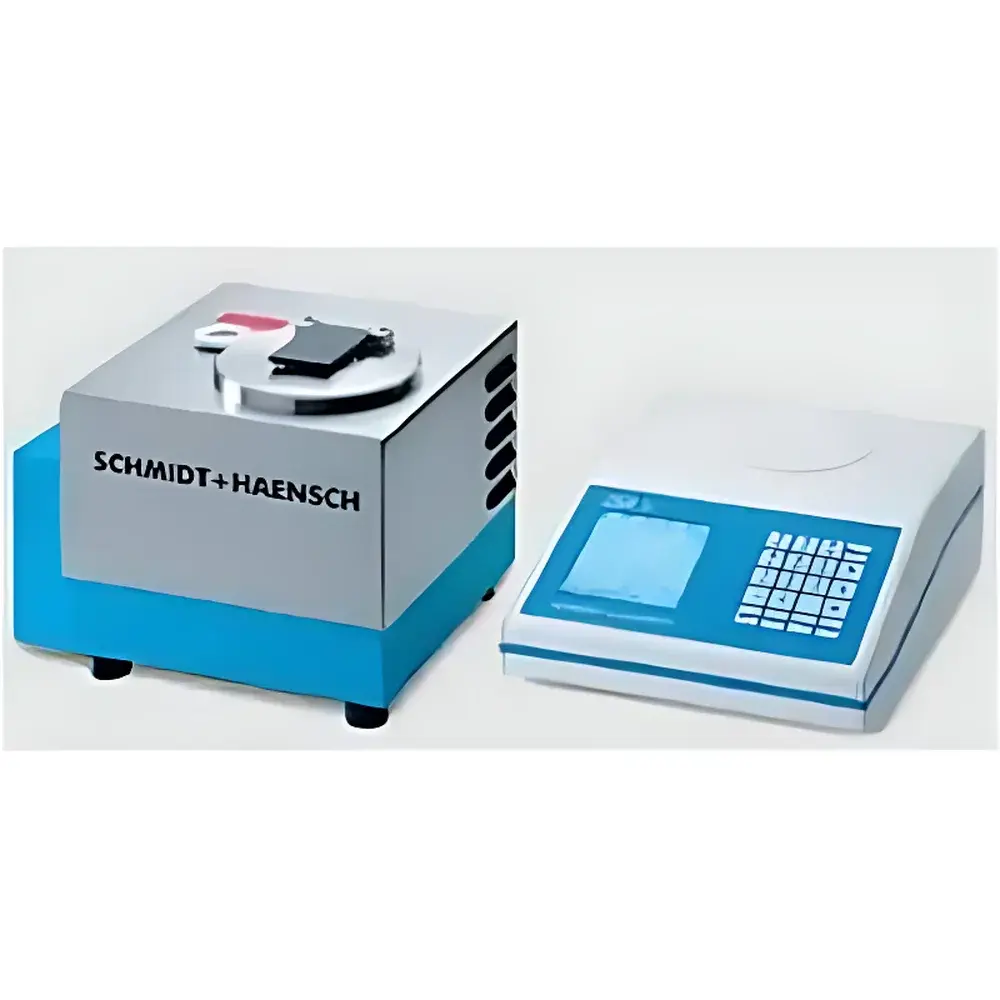
Schmidt+Haensh DSR-λ Multi-Wavelength Electronic Refractometer
| Brand | Schmidt+Haensch (S+H) |
|---|---|
| Country of Origin | Germany |
| Model | DSR-λ |
| Wavelengths | 400, 436, 486, 546, 589, 656, 707 nm |
| Refractive Index Range | 1.33200–1.70000 (at 589 nm) |
| Resolution | 0.00001 RI unit & 0.01°C |
| Accuracy | ±0.0001 RI (at 20°C) |
| Temperature Control | Peltier-based |
| Operating Temperature Range | +18°C to +30°C (extended ranges available on request) |
| Light Source | Stable LED array with seven discrete wavelengths |
| Compliance | ASTM standard methods built-in |
| Sample Compatibility | Liquids, solutions, transparent or slightly turbid homogeneous samples |
Overview
The Schmidt+Haensch DSR-λ is a high-precision, multi-wavelength electronic refractometer engineered for laboratories requiring rigorous optical characterization of liquid-phase materials across diverse scientific and industrial domains. Unlike conventional single-wavelength refractometers, the DSR-λ employs a thermally stabilized LED light source emitting at seven discrete, metrologically traceable wavelengths (400, 436, 486, 546, 589, 656, and 707 nm), enabling dispersion-corrected refractive index (RI) measurements and supporting advanced compositional analysis in multi-component systems. Its measurement principle is based on critical-angle detection via total internal reflection within a sapphire prism assembly, coupled with high-resolution angular position sensing and real-time temperature compensation. The instrument operates under strict thermal equilibrium conditions maintained by an integrated Peltier element, ensuring RI stability within ±0.0001 units at 20°C — a specification aligned with ISO 21147 and ASTM D1218 requirements for precision refractometry.
Key Features
- Seven independently selectable LED wavelengths for spectral dispersion profiling and wavelength-specific RI determination
- Peltier-controlled prism temperature regulation (±0.01°C stability) over a standard operating range of +18°C to +30°C, with optional extended-range modules available
- High-resolution digital readout: 0.00001 RI unit and 0.01°C temperature resolution
- Built-in implementation of ASTM standard test methods for refractive index measurement, including ASTM D1218 (petroleum products) and ASTM E1220 (pharmaceutical excipients)
- Sapphire measuring prism with chemical resistance to organic solvents, acids, and bases
- Automatic calibration verification using certified reference liquids (e.g., water, bromonaphthalene)
- Robust mechanical architecture with vibration-damped optical bench and hermetically sealed optical path
Sample Compatibility & Compliance
The DSR-λ accommodates clear to mildly turbid, non-volatile, and low-viscosity liquid samples — including aqueous solutions, hydrocarbon mixtures, glycerol-based formulations, essential oils, and pharmaceutical syrups. It is not intended for highly scattering, opaque, or volatile samples without vapor-tight cell adaptation. The instrument meets essential requirements of the EU Measuring Instruments Directive (MID 2014/32/EU) for legal metrology applications where RI serves as a primary quality parameter. Its firmware supports audit-trail functionality compliant with FDA 21 CFR Part 11 when deployed in GMP environments, and all measurement data include embedded timestamps, operator IDs, and environmental metadata (temperature, wavelength, calibration status). Routine operation adheres to GLP documentation standards for traceability in QC/QA workflows.
Software & Data Management
The DSR-λ interfaces via USB or Ethernet with Windows-based control software that provides full instrument configuration, method storage, and automated reporting. Users can define multi-point measurement protocols (e.g., temperature ramps, wavelength sweeps), export ASCII or CSV datasets with metadata headers, and generate PDF reports conforming to ISO/IEC 17025 documentation templates. The software includes embedded dispersion modeling tools to calculate Abbe numbers and estimate binary mixture concentrations using multi-wavelength RI interpolation. All raw sensor data are retained locally with versioned backups; no cloud storage or third-party telemetry is enabled by default. Data integrity is ensured through SHA-256 checksum validation during export and internal EEPROM logging of calibration events.
Applications
- Food & Beverage: Quantification of soluble solids (°Brix) in fruit juices, dairy concentrates, and syrup formulations; detection of adulteration in honey and olive oil via dispersion signature analysis
- Pharmaceuticals: Identity testing of active pharmaceutical ingredients (APIs) and excipients; monitoring of lyophilization endpoints via RI drift; assay of saline and dextrose IV solutions per USP
- Cosmetics & Fragrances: Refractive index fingerprinting of essential oils (e.g., limonene, linalool); fatty acid profile estimation in saponified surfactant blends
- Chemical Manufacturing: Real-time concentration tracking in solvent recovery streams; purity verification of monomers (e.g., styrene, vinyl chloride) and catalyst solutions
- Academic Research: Solvation studies, polymer solution thermodynamics, and development of empirical RI–concentration correlations for novel ionic liquids
FAQ
What is the minimum sample volume required for measurement?
Typical sample volume is 0.5 mL for standard prism loading; micro-cell options reduce this to 0.1 mL.
Can the DSR-λ be used for temperature-dependent RI studies?
Yes — the Peltier system enables programmable temperature ramps from +15°C to +50°C (with optional upgrade), with synchronized RI acquisition at user-defined intervals.
Is NIST-traceable calibration support available?
Schmidt+Haensch provides factory calibration certificates traceable to PTB (Physikalisch-Technische Bundesanstalt) standards; on-site recalibration services are offered globally.
Does the instrument support automated cleaning cycles?
No — manual prism cleaning with lint-free wipes and spectroscopic-grade ethanol is recommended between samples to maintain optical fidelity.
How is compliance with ISO 17025 documented during routine use?
The software logs every measurement with operator ID, timestamp, calibration status, ambient conditions, and method version — all exportable as auditable CSV archives.




