
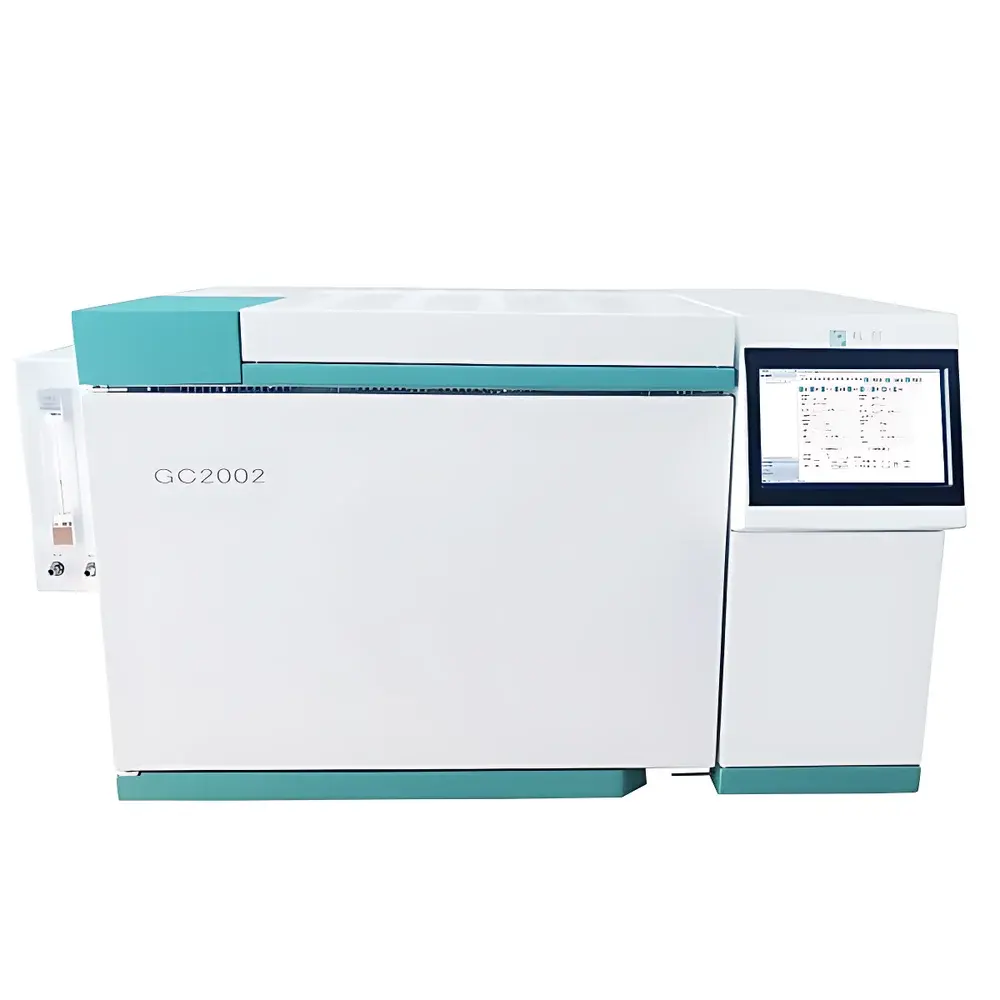
SCI-TECH GC2002 High-Purity Oxygen Analysis Dedicated Gas Chromatograph
| Brand | SCI-TECH |
|---|---|
| Model | GC2002 |
| Detection Principle | Gas Chromatography with Pulsed Discharge Helium Ionization Detection (PDHID) |
| Detector | VICI PDHID (Imported) |
| Column System | Dual Oven, Multi-Valve, Multi-Capillary Column Configuration |
| Temperature Control | 10 Independent Zones, Range: Ambient +3°C to 400°C, Stability: ±0.01°C |
| Cooling Rate | ≤5 min (350°C → 50°C) |
| Detection Limits (ppb) | H₂ (5), O₂ (5), N₂ (5), CO (2), CH₄ (5), CO₂ (5), Ne (5), Ar (5), Kr (5), Xe (10), H₂O (10) |
| Retention Time RSD | <0.01% |
| Peak Area RSD | <3.0% |
| Data Interface | RJ45 Ethernet, Embedded Chromatography Workstation, Remote Control up to 253 Units |
| Display | 10-inch Touchscreen, Real-time Baseline & Chromatogram Visualization |
| Power | 220 V ±10%, 50 Hz ±5%, Max 3000 W |
| Dimensions (W×D×H) | 890 × 570 × 500 mm |
| Weight | 55 kg |
| Operating Environment | 5–35°C, RH ≤85% |
| Compliance | Designed for ISO/IEC 17025-compliant labs |
Overview
The SCI-TECH GC2002 is a dedicated gas chromatograph engineered for ultra-trace impurity analysis in high-purity and ultra-high-purity oxygen streams—commonly required in semiconductor fabrication, photovoltaic manufacturing, medical gas production, and advanced materials synthesis. It employs pulsed discharge helium ionization detection (PDHID), a universal, non-destructive detection method offering exceptional sensitivity for permanent gases and light hydrocarbons without flame or radioactive sources. The instrument utilizes helium as both carrier and makeup gas, purified in-line via an integrated getter-based helium purifier to ensure baseline stability and eliminate background interference from ambient air contaminants. Its dual-oven architecture enables independent thermal programming of separation columns and guard/switching valves, supporting complex multi-dimensional analysis strategies including heart-cutting, back-flushing, and sequential elution—critical for resolving co-eluting species such as O₂/Ar, N₂/CO, and CH₄/Ne in oxygen matrices.
Key Features
- Dual independently programmable column ovens, each supporting up to 16 ramp segments (extendable to unlimited steps via firmware), with rapid cooling (<5 min from 350°C to 50°C) enabled by active air circulation and thermal mass optimization.
- VICI-manufactured PDHID detector with pulse-modulated discharge source, delivering sub-ppb detection limits across 10 target impurities—including H₂, O₂, N₂, CO, CH₄, CO₂, Ne, Ar, Kr, Xe, and H₂O—with documented baseline noise ≤0.1 mV and drift ≤0.5 mV/30 min.
- Multi-valve, multi-column configuration featuring automated pneumatic actuation with protective purge gas routing—eliminating carryover and enabling robust front-cut, center-cut, and tail-cut operations for selective impurity enrichment or removal.
- 10-zone precision temperature control system with ±0.01°C setpoint accuracy and <0.1°C thermal drift per 10°C ambient fluctuation—ensuring retention time reproducibility <0.01% RSD over extended runs.
- Fully embedded chromatography workstation on main controller board; communicates via standard RJ45 Ethernet interface; supports centralized remote monitoring, method deployment, and data acquisition across up to 253 instruments on a single network segment.
- 10-inch industrial-grade capacitive touchscreen with real-time base-line visualization, interactive method editing, and direct instrument reverse control—reducing dependency on external PCs during routine operation.
Sample Compatibility & Compliance
The GC2002 is validated for quantitative analysis of trace impurities in Grade 5.0–6.0 oxygen (≥99.9999% purity), as well as other high-purity specialty gases including helium, hydrogen, nitrogen, and argon. Sample introduction is compatible with stainless-steel gas sampling valves (e.g., VICI Valco), pressurized cylinders (up to 10 MPa), and continuous process lines via heated sample loops. All wetted parts are electropolished 316L SS or fused silica, minimizing adsorption and catalytic decomposition. The system meets mechanical and electrical safety requirements per IEC 61010-1 and supports laboratory quality management frameworks including ISO/IEC 17025, GLP, and GMP. When configured with time-stamped audit logs, user access controls, and electronic signatures, it satisfies data integrity expectations under FDA 21 CFR Part 11 for regulated environments.
Software & Data Management
Chromatographic data acquisition, integration, calibration, and reporting are handled by the embedded SCI-TECH ChromaLink™ software suite—fully integrated into the instrument’s ARM-based mainboard. Raw signal data (20 Hz sampling rate) is stored locally in vendor-neutral .CDF format compliant with ASTM E1947 and ASTM E2524 standards. Remote access is supported via HTTPS-enabled web interface or native Windows/Linux client. The platform supports automated calibration curve generation (linear, quadratic, or multipoint weighted), QC flagging based on retention time windows and peak symmetry thresholds, and export to LIMS-compatible CSV/XML templates. Audit trails record all method changes, injection events, detector parameter adjustments, and user logins—with immutable timestamps and operator IDs.
Applications
- Residual gas analysis in oxygen supply lines for semiconductor cleanrooms (per SEMI F57 and ASTM D7607).
- Verification of oxygen purity in cryogenic air separation units prior to distribution.
- Trace hydrocarbon and moisture monitoring in medical oxygen generators (ISO 8573-1 Class 0 compliance verification).
- Impurity profiling of oxygen used in fuel cell stack testing and catalyst evaluation.
- Quality release testing of electronic-grade oxygen cylinders (SEMI C10, JIS K0070).
- Method development support for ASTM D1946 (analysis of natural gas) and ISO 6974 (gas chromatographic determination of hydrocarbon components).
FAQ
What detection technology does the GC2002 use, and why is PDHID preferred for high-purity oxygen analysis?
The GC2002 uses pulsed discharge helium ionization detection (PDHID), which provides uniform, near-equimolar response for permanent gases and light organics without requiring hydrogen or radioactive sources—making it intrinsically safe, stable, and ideal for inert matrix analysis like oxygen.
Can the instrument separate oxygen and argon quantitatively?
Yes. The system is configured with high-resolution capillary columns and optimized temperature/volume programming to fully resolve O₂ and Ar, delivering independent, calibrated concentration results for both species.
Is remote diagnostics and software update capability supported?
Yes. Firmware updates, method pushes, and live diagnostic telemetry are supported over Ethernet using secure TLS-encrypted channels; no physical access is required for routine maintenance or troubleshooting.
Does the GC2002 meet regulatory requirements for pharmaceutical or medical gas testing?
When deployed with appropriate validation protocols (IQ/OQ/PQ), electronic signature modules, and audit trail activation, it fulfills data integrity and traceability requirements under USP , EP 2.2.46, and FDA 21 CFR Part 11 for regulated gas certification workflows.







