
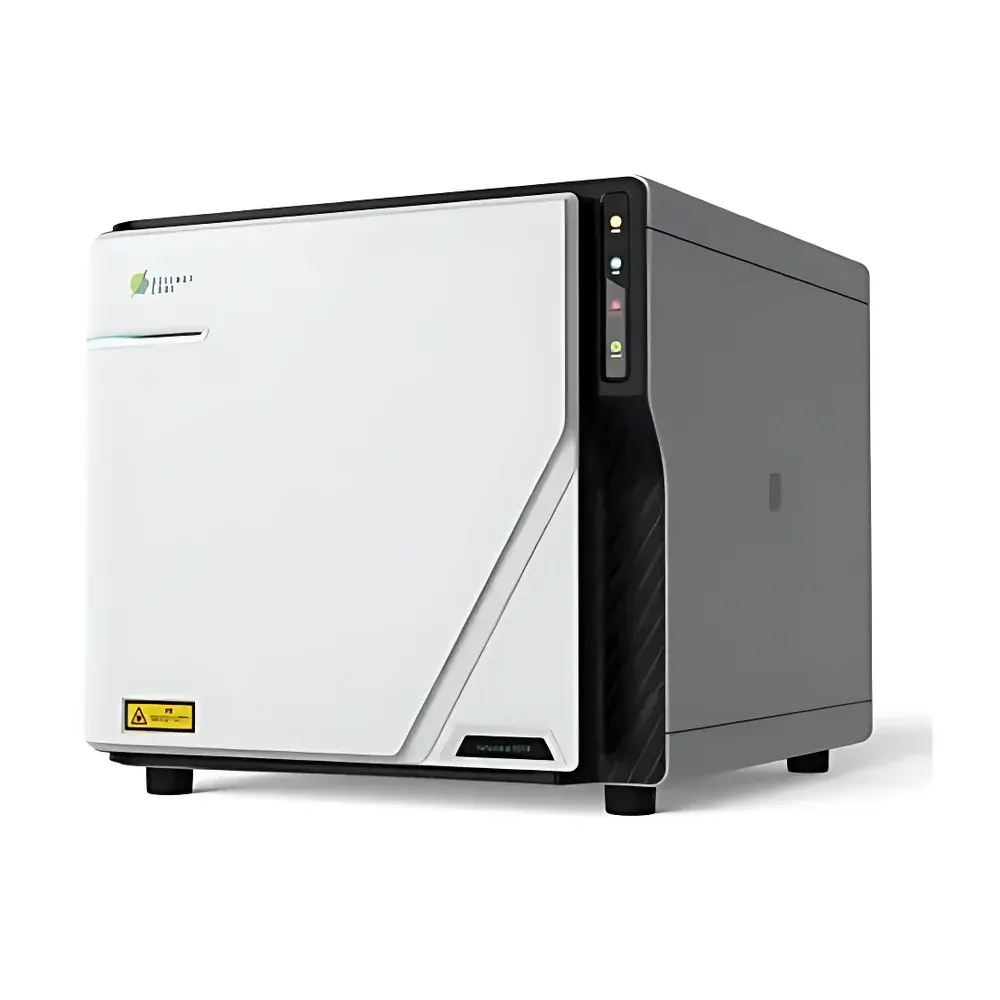
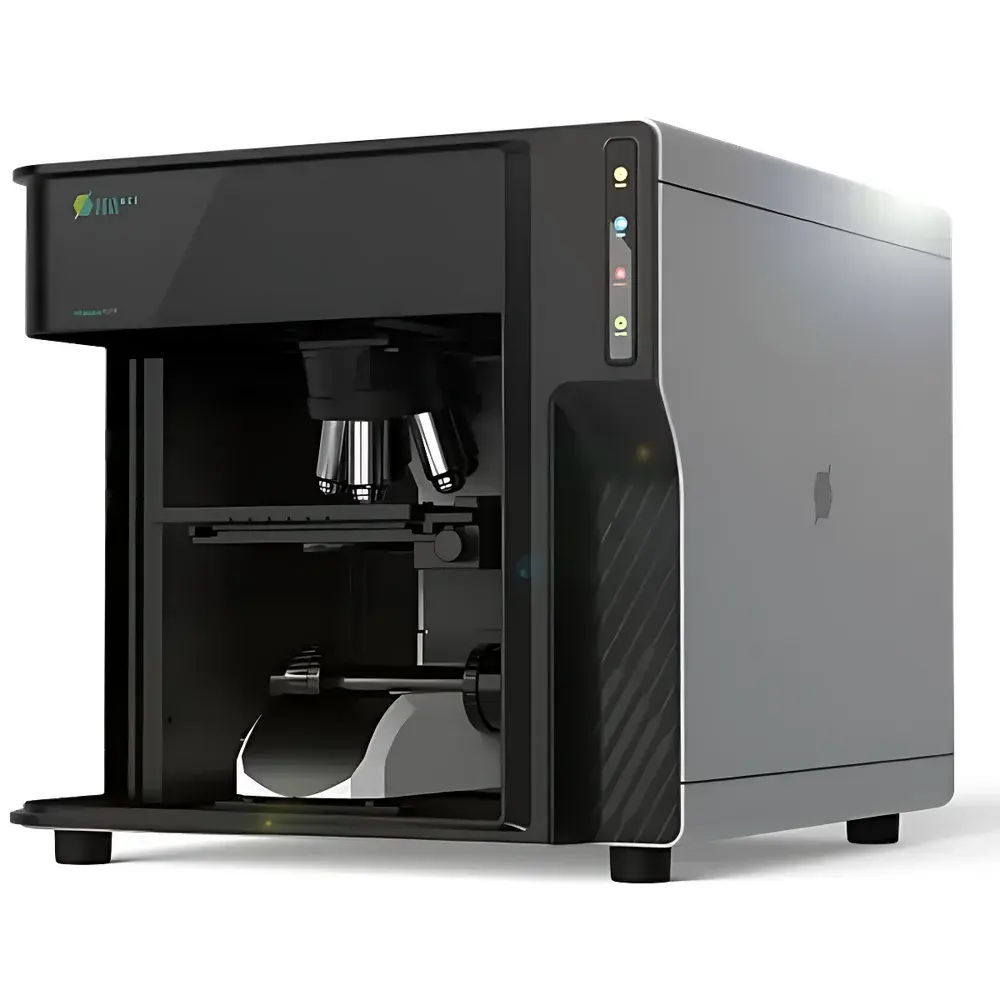
ScienceEdge InFocus κ FDTR Frequency-Domain Thermoreflectance Microscope
| Brand | ScienceEdge |
|---|---|
| Origin | Japan |
| Model | InFocus κ FDTR |
| Dimensions (W×D×H) | 505 × 560 × 480 mm |
| Pump Laser | 445 nm, ~2 μm spot (@20×, NA=0.45) |
| Probe Laser | 514 nm, ~1 μm spot (@20×, NA=0.45) |
| Transducer | Au |
| Modulation Frequency Range | 10 kHz – 50 MHz |
| Sample Types | Thin films, microstructures, particles (e.g., 18 μm single-crystal Al₂O₃), bulk materials |
| Weight | 70 kg |
Overview
The ScienceEdge InFocus κ FDTR is a high-resolution frequency-domain thermoreflectance (FDTR) microscope engineered for quantitative, spatially resolved thermal property characterization at the microscale. Unlike steady-state or time-domain approaches, FDTR employs phase-sensitive detection of thermally induced reflectivity changes under sinusoidal laser heating. A modulated pump laser (445 nm) generates periodic lattice heating, while a synchronized probe laser (514 nm) monitors the resulting thermoreflectance signal—proportional to local temperature oscillation amplitude and phase lag. By fitting the measured phase and amplitude responses across a broad modulation frequency range (10 kHz–50 MHz) to a rigorously derived 3D cylindrical heat diffusion model—including anisotropic thermal conductivity tensors and interfacial boundary resistance terms—the system delivers absolute, calibration-free thermal conductivity (κ) values with sub-micron lateral resolution. This physical modeling framework enables robust separation of in-plane (κ∥) and cross-plane (κ⊥) conductivities, making the InFocus κ FDTR uniquely suited for characterizing layered heterostructures, epitaxial thin films, and crystalline anisotropy without destructive sample preparation.
Key Features
- Sub-micron spatial resolution: Dual-laser optical path with diffraction-limited focusing (≤1 µm probe, ~2 µm pump) enables localized thermoreflectance mapping on features as small as individual 18 µm single-crystal Al₂O₃ particles or <100 nm amorphous GeSn films.
- Quantitative anisotropy analysis: Integrated 3D heat diffusion solver accounts for finite-layer geometry, thermal boundary conductance (TBC), and directional phonon transport—validated against benchmark substrates including sapphire (κ = 30.8 W/m·K) and diamond (κ = 2820 W/m·K).
- High-fidelity interface metrology: Direct quantification of thermal boundary conductance (TBC) at buried interfaces—for example, distinguishing PVD-deposited (138.0 MW/m²·K) from sputtered (306.5 MW/m²·K) Au transducer layers on Si.
- Efficient wideband acquisition: Full-phase curve acquisition completed in ≤10 minutes per measurement location, covering 10 kHz–50 MHz modulation frequencies to resolve both near-field and diffusive thermal transport regimes.
- Modular platform architecture: Optional integration with high-resolution Raman spectroscopy and cryogenic/variable-temperature stages (−180°C to +400°C) for correlative structural–thermal analysis under controlled environmental conditions.
Sample Compatibility & Compliance
The InFocus κ FDTR accommodates diverse solid-state samples without metallization or contact probes: continuous thin films (e.g., GeSn, MoS₂, h-BN), freestanding microstructures, polycrystalline or single-crystal particles, and bulk substrates (Si, SiO₂, sapphire, diamond). Its non-contact, all-optical methodology satisfies ISO 22007-2 (thermal conductivity by thermoreflectance) and ASTM E2585 (laser-based thermal diffusivity standards) requirements. Data acquisition and processing workflows support audit-ready documentation aligned with GLP and GMP environments, including full traceability of raw phase/amplitude spectra, model assumptions, fitting residuals, and uncertainty propagation metrics. All software modules comply with FDA 21 CFR Part 11 for electronic records and signatures when deployed in regulated QC/QA laboratories.
Software & Data Management
The proprietary InFocus Analysis Suite provides end-to-end data handling—from automated stage navigation and multi-frequency lock-in acquisition to physics-based nonlinear least-squares fitting using Levenberg–Marquardt optimization. Each measurement exports structured HDF5 files containing raw interferometric signals, calibrated thermoreflectance coefficients, fitted κ∥/κ⊥, TBC, and confidence intervals derived from covariance matrix analysis. Batch processing supports statistical mapping across user-defined grids (e.g., 100×100 µm² regions), with export options for CSV, MATLAB .mat, and TIFF-based thermal conductivity overlays compatible with industry-standard image analysis platforms. Audit logs record operator ID, timestamp, instrument configuration, and version-controlled fitting algorithms—ensuring full reproducibility and regulatory compliance.
Applications
- Thermal conductivity mapping of 2D material heterostructures and van der Waals interfaces
- Quantitative evaluation of phonon scattering mechanisms in alloyed thin films (e.g., Ge1−xSnx with x = 0.05–0.12)
- Interfacial thermal resistance screening for advanced packaging materials (TIMs, dielectrics, metal interconnects)
- Anisotropic κ profiling in layered oxides (e.g., La5Ca6Cu2O41) and hexagonal boron nitride
- Microscale thermal validation of TCAD simulations and ab initio lattice dynamics predictions
FAQ
What minimum feature size can the InFocus κ FDTR resolve?
The system achieves ~1 µm lateral resolution with the 514 nm probe laser under 20×/NA=0.45 optics; effective resolution depends on thermal diffusion length at the selected modulation frequency.
Does FDTR require optical absorption in the sample?
No—thermoreflectance relies on temperature-dependent change in reflectivity (dR/dT), not absorption; it works on highly reflective metals, transparent dielectrics, and semiconductors alike.
Can the system measure thermal diffusivity independently of conductivity?
Yes—by combining FDTR-derived κ with independently measured specific heat (e.g., via DSC or literature values), thermal diffusivity (α = κ/ρcp) is calculated with propagated uncertainty.
Is vacuum or inert atmosphere operation supported?
The base platform operates in ambient air; optional vacuum-compatible chamber and gas-purged enclosures are available for oxidation-sensitive or low-emissivity samples.
How is calibration performed?
The system uses first-principles modeling—no empirical calibration standards are required. Validation is performed against certified reference materials (e.g., NIST SRM 746) and published literature values for benchmark substrates.



