
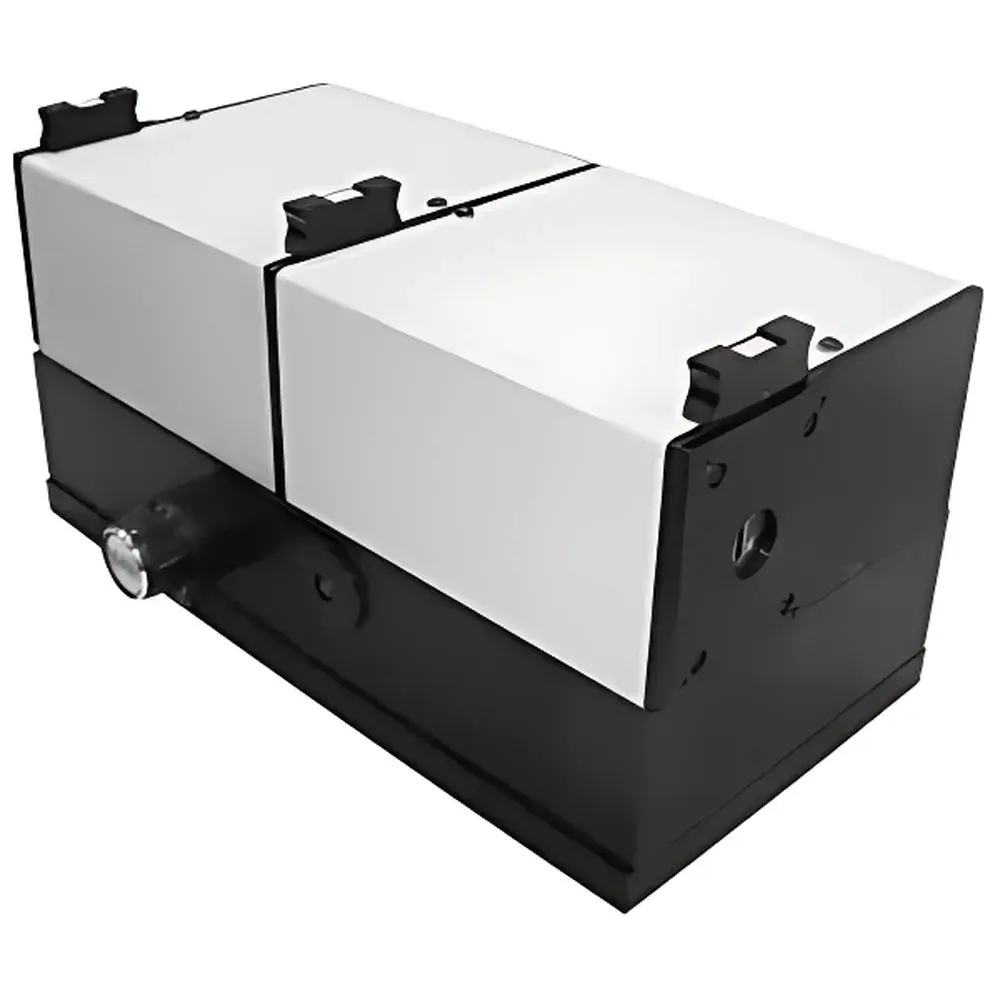
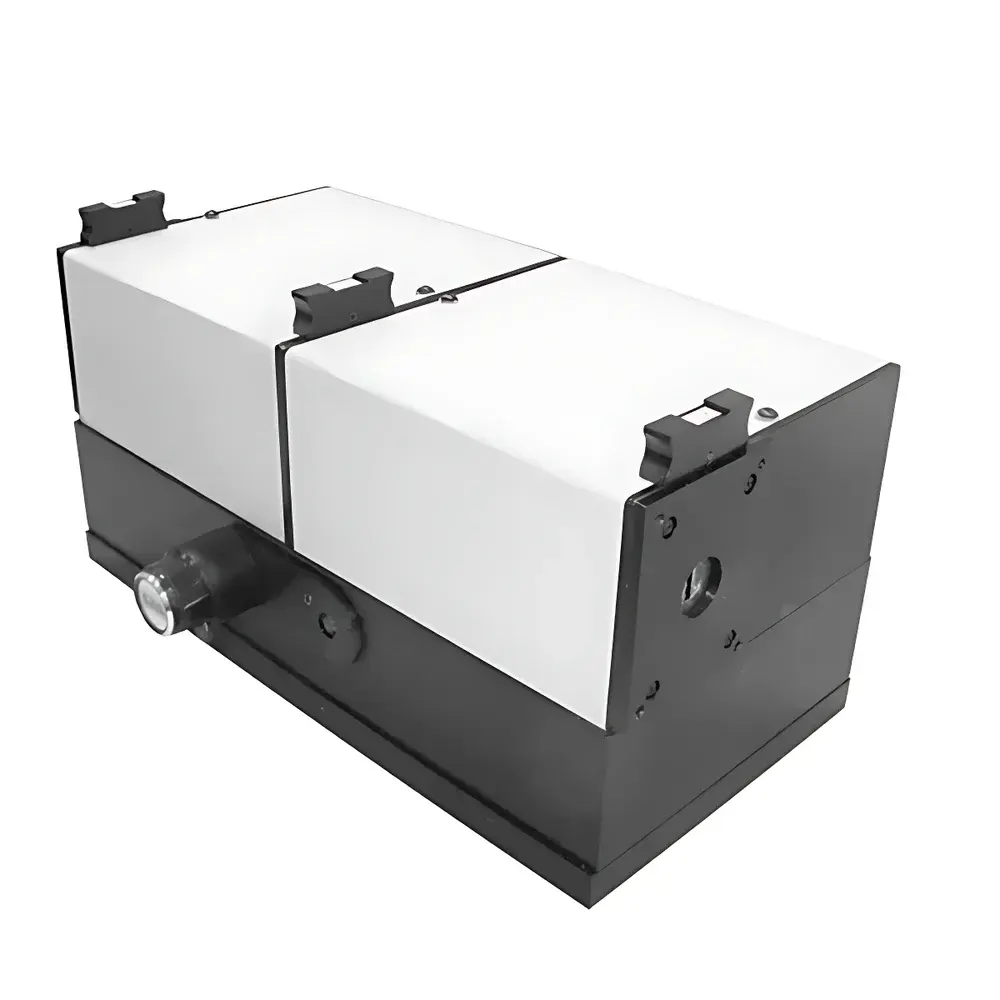
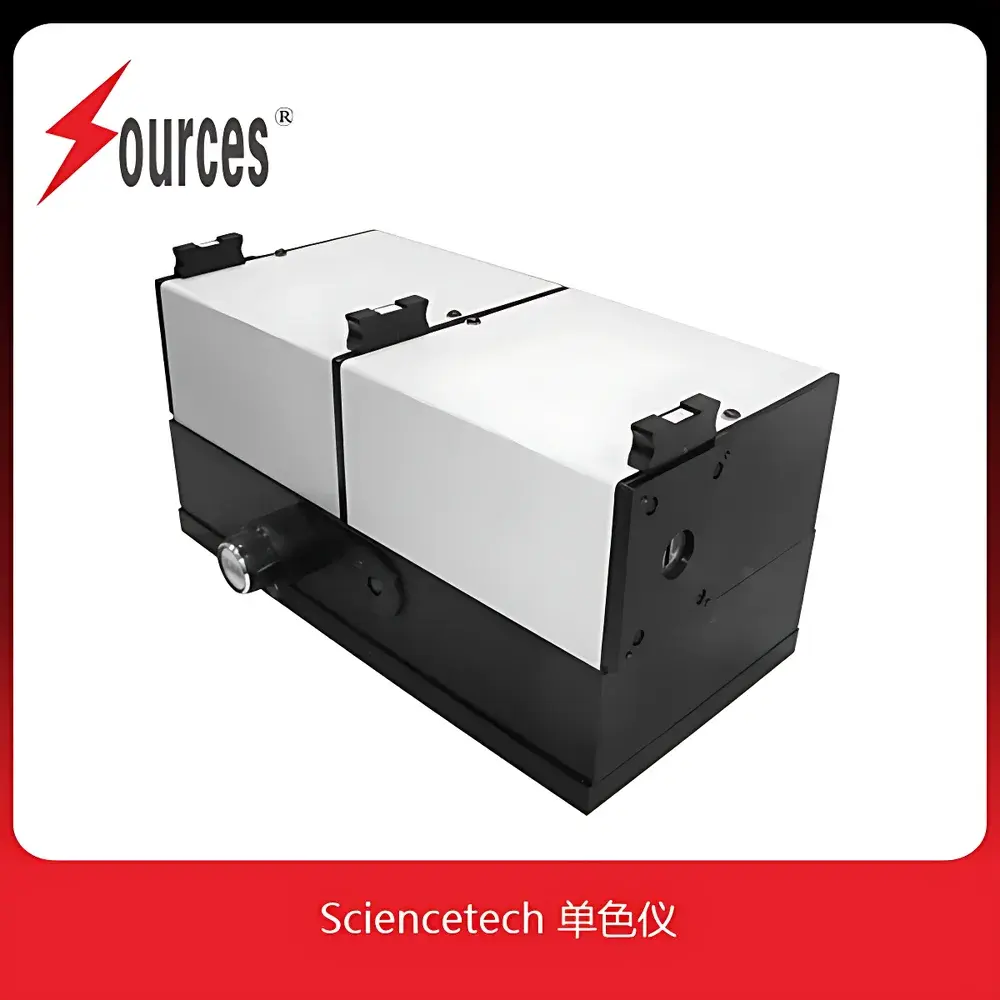
Sciencetech 9030 Series Dual-Subtractive 0.1 m Compact Monochromator
| Brand | Sciencetech |
|---|---|
| Origin | Canada |
| Model | 9030 Series |
| Spectral Range | 250–700 nm |
| Stray Light | 1.00E−03 |
| Grating Configuration | Dual Grating (Subtractive Mode) |
| Focal Length | 100 mm (Input & Output) |
| Optical Layout | Seya-Namioka |
| Grating Type | Concave Holographic |
| f-number | f/3.2 |
| Wavelength Accuracy | ±1 nm |
| Wavelength Repeatability | ±0.25 nm |
| Slit Options | Removable fixed-width slits (100 µm to 3 mm) |
| Detector Interface | Single-channel PMT-compatible output |
| Software Control | USB 2.0 (motorized version only) |
| Compliance | Designed for GLP/GMP-aligned spectroscopic workflows requiring traceable wavelength calibration and audit-ready operation |
Overview
The Sciencetech 9030 Series Dual-Subtractive 0.1 m Compact Monochromator is a precision-engineered optical instrument designed for high-fidelity spectral isolation in research-grade photonic systems. Unlike conventional single-stage monochromators, the 9030DS variant implements a subtractive dual-monochromator architecture—two independently tunable 100 mm focal length Seya-Namioka units aligned in series with opposing dispersion directions. This configuration enables precise bandpass tuning by algebraically subtracting the spectral contributions of each stage, resulting in a narrow, user-defined passband (e.g., 1 nm) with exceptional out-of-band rejection. The system operates on the principle of angular dispersion via concave holographic gratings, eliminating the need for refocusing optics and minimizing aberrations across the UV–VIS range (250–700 nm). Its compact footprint (260 × 126 × 104 mm), f/3.2 aperture, and rigid aluminum housing ensure mechanical stability under thermal drift and vibration—critical for long-duration scans in environmental chambers or optical tables. The monochromator is not a standalone spectrometer; it delivers collimated quasi-monochromatic output optimized for coupling to single-channel detectors such as photomultiplier tubes (PMTs), silicon photodiodes, or lock-in amplifiers.
Key Features
- Dual-subtractive optical design enabling tunable bandpass filtering with <1 nm resolution and <4 nm/mm dispersion (grating-dependent)
- Ultra-low stray light performance: ≤1.00×10⁻⁶ (typ.) in DS configuration—achieved through sequential order-sorting and optimized baffling between stages
- Modular grating compatibility: Five interchangeable concave holographic gratings (1200–800 l/mm), each with specified blaze wavelengths (250–450 nm) and active area (30 × 30 mm)
- Manual or motorized wavelength selection: Standard manual dial with 0.1 nm readout counter; optional USB 2.0–controlled stepper motor for automated scanning and repeatable positioning
- Fixed-width slit architecture: Three removable input/output slits per unit (100 µm, 200 µm, 500 µm, 1 mm, 2 mm, or 3 mm)—enabling throughput/resolution trade-off optimization without realignment
- UV-enhanced aluminum mirror coatings standard for 250–700 nm models, ensuring >85% reflectance across the operational band
- Integrated mechanical interface: 76.2 mm optical axis height, M4 and 8-32 threaded mounting points, and standardized flange dimensions for OEM integration into custom optical benches
Sample Compatibility & Compliance
The 9030DS is intended for use with free-space beam delivery in controlled laboratory environments. It accepts collimated input beams up to 12 mm diameter and outputs a near-collimated beam suitable for direct coupling to single-element detectors. No fiber-optic interfaces are included; however, optional SMA- or FC-coupled adapters are available upon request. The instrument complies with mechanical and optical safety standards relevant to Class 1 laser product integration (IEC 60825-1:2014). While not certified to ISO/IEC 17025, its wavelength scale is calibrated against NIST-traceable mercury–argon emission lines (e.g., 253.65 nm, 404.66 nm, 546.07 nm), supporting GLP documentation requirements. For regulated applications—including pharmaceutical UV-Vis method development per USP <857> or ASTM E308–22—the motorized version supports 21 CFR Part 11–compliant software logging (audit trail, electronic signatures, data integrity controls) when used with Sciencetech’s validated control suite.
Software & Data Management
Sciencetech provides a native Windows-based application (Monochromator Control Suite v4.x) with full USB 2.0 support for the motorized 9030DS. The software features real-time wavelength positioning feedback, programmable scan sequences (linear, step, dwell), and export of ASCII-formatted spectral logs (.csv, .txt). A comprehensive SDK (C++, Python, LabVIEW) is included, enabling integration into custom DAQ platforms (e.g., National Instruments PXI, Keysight PathWave). All firmware updates are delivered via signed binaries with SHA-256 checksum verification. Raw position encoder data (0.01 nm resolution) and motor current diagnostics are accessible for predictive maintenance logging. Data files embed metadata including grating ID, slit width, ambient temperature (via optional external sensor input), and timestamped calibration reference points—facilitating retrospective uncertainty analysis per GUM (JCGM 100:2018).
Applications
- Tunable excitation sources for fluorescence lifetime imaging (FLIM) and time-resolved spectroscopy
- High-dynamic-range absorbance/transmittance measurements where stray light limits detection of weak absorption bands (e.g., dilute chromophores, thin-film interference studies)
- Reference-grade calibration of CCD- or CMOS-based spectrometers via line-source mapping
- Photoelectrochemical cell characterization requiring stable, narrowband illumination at defined photon flux densities
- Raman excitation filtering to suppress Rayleigh scatter prior to dispersive detection
- OEM integration into portable gas analyzers or environmental monitoring platforms requiring low-power, high-rejection spectral prefiltering
FAQ
Can the 9030DS be operated as two independent monochromators?
Yes—each stage has fully decoupled drive mechanics and independent slit access ports, allowing standalone use or synchronized subtractive mode.
Is spectral calibration traceable to national standards?
Yes—factory calibration includes NIST-traceable Hg/Ar lamp lines; users may perform in-house recalibration using optional calibration kits (Cat. #CAL-9030).
What is the maximum input power density the optics can withstand?
For continuous-wave UV–VIS sources, the recommended limit is 1 W/cm² at the entrance slit plane; pulsed lasers require consultation with Sciencetech Engineering for damage threshold assessment.
Does the system support vacuum or purged operation?
The housing is sealed and rated for dry nitrogen purge (0.5 L/min); optional vacuum-compatible versions (10−5 Torr) are available with fused silica windows and stainless-steel hardware.
Are grating exchange tools and alignment fixtures included?
Yes—each unit ships with a magnetic grating holder, precision alignment jig, and torque-limited screwdriver set compliant with ISO 5355:2019 handling protocols.



