
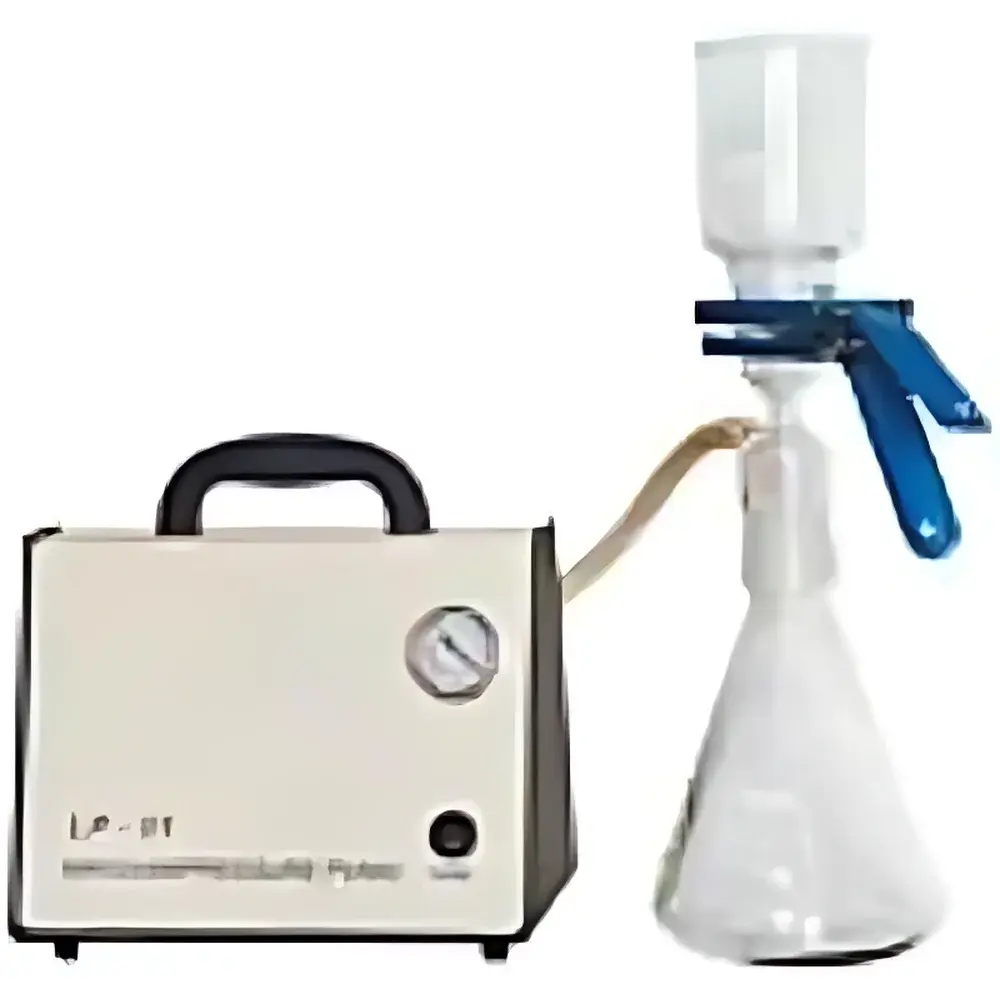
Scienhome Vacuum Filtration System (1L/2L)
| Brand | Scienhome |
|---|---|
| Origin | Tianjin, China |
| Manufacturer Type | Authorized Distributor |
| Product Origin | Domestic (China) |
| Model | 1L / 2L |
| Pricing | Available Upon Request |
| Filter Bottle Capacity | 1000 mL / 2000 mL |
| Funnel Capacity | 250 mL / 300 mL |
| Material | High-Strength Borosilicate Glass (Thermal Shock Resistant up to 270 °C) |
| Vacuum Pump Type | Oil-Free Diaphragm Pump |
| Sealing Design | Fully Enclosed Solvent Transfer Assembly |
| Compliance | Designed for ASTM D854, ISO 11926, USP <788>, and GLP/GMP-aligned laboratory workflows |
Overview
The Scienhome Vacuum Filtration System (1L/2L) is an engineered solution for solvent degassing, particulate removal, and sterile filtration in analytical and preparative laboratory environments. Based on the principle of pressure differential-driven liquid phase separation, the system applies controlled vacuum—typically in the range of 0.05–0.08 MPa absolute—to accelerate filtration through sintered glass frits or membrane filters. It is specifically optimized for HPLC and UHPLC mobile phase preparation, where dissolved gas elimination and sub-micron particle retention are critical to column longevity, baseline stability, and detector response fidelity. The system’s modular architecture supports both gravity-assisted pre-filtration and full vacuum-driven operation, enabling reproducible handling of low-volume, high-value samples across weight analysis, trace elemental determination, colloidal purification, and aseptic processing protocols.
Key Features
- High-integrity borosilicate glass assembly: Triangular collection flasks (1000 mL and 2000 mL) and funnel bodies (250 mL and 300 mL) manufactured to strict dimensional tolerances—ensuring consistent wall thickness, thermal shock resistance up to 270 °C, and mechanical robustness under repeated vacuum cycling.
- Precision-sintered glass frits (porosity grades G3–G4, nominal pore size 10–40 µm): Integrated into filter heads for uniform flow distribution and minimal channeling; compatible with standard 47 mm and 90 mm membrane filters via optional adapter kits.
- Dedicated oil-free diaphragm vacuum pump (Part No. 900148): Delivers stable vacuum down to ≤15 kPa (absolute), operates at <45 dB(A), requires no lubrication or maintenance, and eliminates hydrocarbon contamination risks in solvent-sensitive applications.
- Sealed solvent transfer module: Enables direct, closed-path transfer from reservoir to filter funnel—reducing atmospheric exposure, minimizing volatile loss, suppressing bubble reintroduction post-filtration, and enhancing degassing efficiency by up to 30% compared to open-system configurations.
- Interchangeable, standardized components: All glass parts conform to ISO 3585 specifications; flask necks follow ISO 2955 taper standards (24/29 and 29/32), ensuring compatibility with third-party clamps, stopcocks, and vacuum regulators.
Sample Compatibility & Compliance
The system accommodates aqueous, organic, and mixed-phase solvents—including acetonitrile, methanol, THF, and buffered saline solutions—without material degradation. All wetted surfaces are inert borosilicate glass (DIN ISO 3585) or PTFE-sealed stainless-steel fittings, eliminating leachables and ensuring compliance with USP particulate matter testing requirements. When operated with certified 0.22 µm or 0.45 µm PVDF or nylon membranes, the configuration meets ISO 13408-1 for aseptic processing and ASTM D854 for fine particle analysis in petroleum-derived solvents. Documentation packages support GLP audit trails, including calibration records for vacuum gauges and pump performance logs aligned with FDA 21 CFR Part 11 data integrity expectations.
Software & Data Management
While the base system operates manually, optional digital vacuum controllers (e.g., Scienhome VC-200 series) provide real-time pressure logging, programmable ramp profiles, automatic shut-off at set vacuum thresholds, and CSV-exportable datasets timestamped to UTC. These controllers integrate with LIMS platforms via RS-232 or USB-C virtual COM port emulation, supporting electronic signature capture and ALCOA+ data governance principles. Audit trails record all parameter changes, user logins, and event timestamps—fully traceable for regulatory submissions under ICH M7 and EU Annex 11.
Applications
- HPLC/UHPLC mobile phase preparation: Removal of sub-10 µm particulates and dissolved O₂/N₂ to prevent column clogging and baseline drift.
- Gravimetric analysis: Quantitative recovery of precipitates using pre-weighed, tared funnels with minimal adsorption loss.
- Colloidal nanoparticle isolation: Size-selective fractionation of TiO₂, SiO₂, or polymer nanoparticles via graded frit porosity.
- Sterile filtration of culture media: Validation-ready setup for ISO 13408-1-compliant bioburden reduction prior to autoclaving or direct use in cell culture.
- Environmental sample cleanup: Pre-concentration and clarification of soil extracts, wastewater filtrates, and air particulate washings prior to ICP-MS or GC-MS analysis.
FAQ
What vacuum level is recommended for optimal HPLC solvent degassing?
A stable vacuum between 10–15 kPa (absolute) is empirically validated for efficient microbubble removal without inducing solvent boiling or excessive foaming.
Can the system be used with aggressive solvents such as concentrated acids or halogenated organics?
Yes—provided appropriate membrane chemistry (e.g., PTFE for HF or chloroform) is selected; glass components remain chemically inert per DIN ISO 17762 corrosion resistance classifications.
Is the vacuum pump compliant with ISO 8573-1 Class 0 for oil-free air quality?
Yes—the diaphragm pump meets ISO 8573-1:2010 Class 0 certification for total oil content <0.01 mg/m³, verified via independent third-party testing reports.
How often should the sintered glass frit be cleaned and inspected?
Frits should undergo ultrasonic cleaning in 10% nitric acid followed by DI water rinse after every 10 filtration cycles; visual inspection for microfractures or pore occlusion is recommended before each high-value run.
Does the system support integration with automated liquid handlers?
Via optional vacuum manifold adapters and TTL-triggered relay modules, the system can synchronize with Hamilton STAR or Tecan Fluent platforms for unattended batch filtration sequences.



