
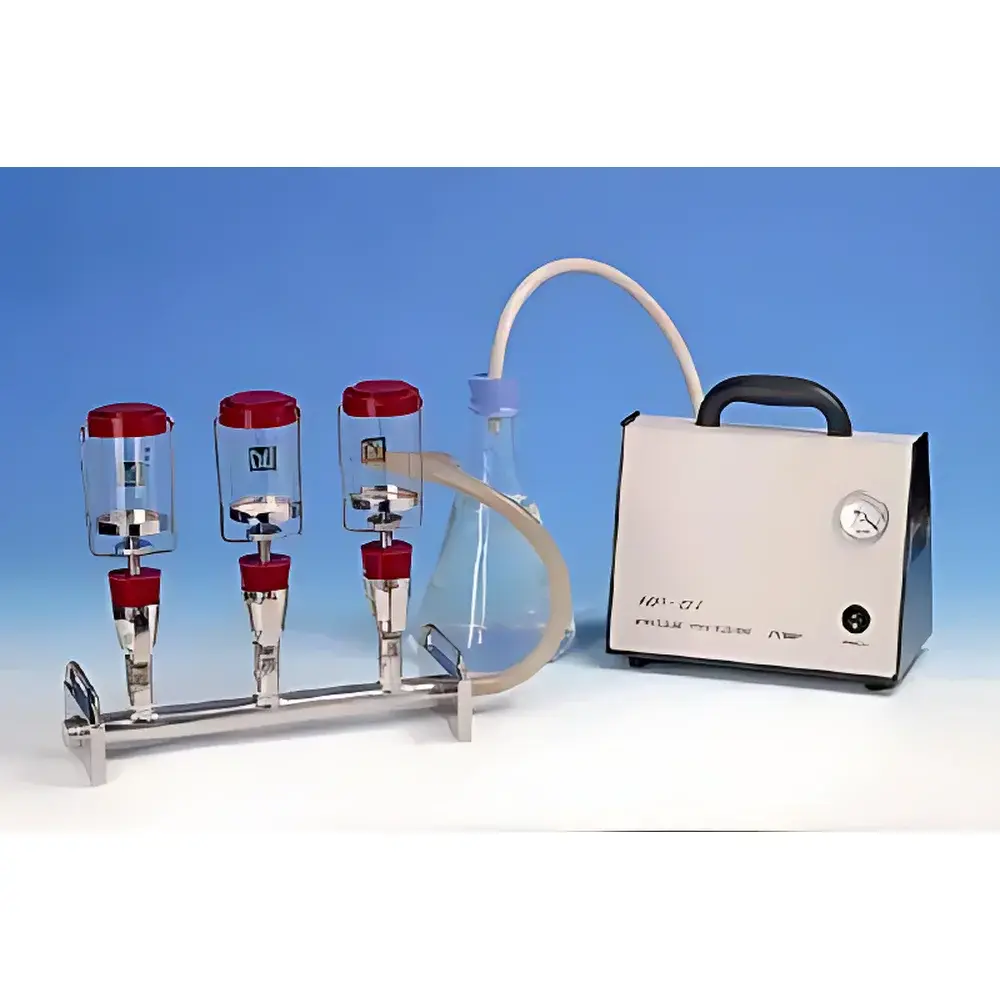
Scienhome WDG Series Multi-Station Filtration Assembly for Sterility and Microbial Limit Testing
| Brand | Scienhome |
|---|---|
| Model | WDG Series |
| Type | Sterile Filtration Manifold System |
| Compliance | Designed per Chinese Pharmacopoeia 2005 Edition, Appendix XIII-B (Sterility Testing) & XIII-C (Microbial Limits Testing) |
| Configuration Options | 1-, 3-, or 6-position stainless steel manifold |
| Filter Capacity | 100 mL per station |
| Vacuum Requirement | 6–20 L/min (model-dependent) |
| Construction | Borosilicate glass filter housings, food-grade silicone gaskets, 316L stainless steel support frame |
| Weight | 1.2–5.6 kg |
| Dimensions (W×D×H) | 110×110×280 mm (WDG-1) to 660×110×280 mm (WDG-6) |
| Optional Accessories | Sterile collection flasks, oil-free vacuum pump (≥10 L/min), incubator-compatible stainless steel mounting base |
Overview
The Scienhome WDG Series Multi-Station Filtration Assembly is an engineered solution for standardized membrane filtration in sterility testing and microbial limit assays, fully aligned with the procedural requirements of the Chinese Pharmacopoeia (2005 Edition), Appendix XIII-B and XIII-C. It implements both open-mode and closed-mode filtration protocols using replaceable membrane filter units mounted on a rigid stainless steel manifold. The system operates on vacuum-driven principle: sample fluid is drawn through a pre-sterilized microporous membrane (typically 0.45 µm or 0.22 µm pore size), retaining microorganisms on the membrane surface for subsequent cultivation and enumeration. Its modular architecture supports parallel processing of up to six independent samples under identical environmental and operational conditions—critical for assay reproducibility, regulatory audit readiness, and laboratory throughput optimization.
Key Features
- Modular stainless steel manifold available in 1-, 3-, and 6-position configurations, each station equipped with individual on/off vacuum control valves for selective or simultaneous filtration
- Borosilicate glass filter housings with high thermal and chemical resistance; compatible with autoclaving (121°C, 20 min) and ethylene oxide sterilization
- Interchangeable filter assemblies featuring dual-mode operation: open-mode (membrane exposed for direct inoculation) and closed-mode (sealed top port with four sterile injection sites for post-filtration culture medium addition)
- Integrated silicone gasket with embedded stainless steel reinforcement ensures consistent sealing pressure and long-term dimensional stability
- Universal mounting base options—including single, triple, and hexagonal stainless steel incubator-compatible fixtures—enable direct transfer of assembled filters into controlled-temperature environments without disassembly
- Designed for integration with standard oil-free vacuum pumps (≥6 L/min for WDG-1; ≥20 L/min for WDG-6), minimizing risk of hydrocarbon contamination in sensitive biological assays
Sample Compatibility & Compliance
The WDG system accommodates aqueous and low-viscosity non-aggressive solutions across pharmaceutical, biotechnology, food safety, environmental monitoring, and public health applications. It supports filtration of injectables, ophthalmic preparations, raw materials, purified water, wastewater effluents, beverage concentrates, and air sampling eluates. All wetted components comply with USP Class VI biocompatibility standards and ISO 10993-5 cytotoxicity requirements. The design enables full traceability per GLP and GMP frameworks: each filter unit permits unambiguous lot identification, and closed-mode operation satisfies requirements for aseptic manipulation under ISO 13408-1 and EU Annex 1. Documentation packages include material certifications, dimensional drawings, and validation support files for IQ/OQ protocol development.
Software & Data Management
While the WDG Series is a manually operated mechanical system (no embedded electronics or firmware), its operational workflow integrates seamlessly into digital quality management ecosystems. Each filtration event can be logged in electronic lab notebooks (ELN) or LIMS platforms using standardized metadata fields—including filter lot number, operator ID, sample ID, vacuum duration, applied pressure differential, and incubation parameters. Optional barcode-labeled collection flasks and serialized filter housings facilitate automated data capture. For regulated environments, the system supports 21 CFR Part 11-compliant audit trails when paired with validated ELN software, ensuring integrity of raw filtration records during FDA or EMA inspections.
Applications
- Sterility testing of parenteral drugs, vaccines, and medical device extracts per USP Chapter 71 and Ph. Eur. 2.6.1
- Microbial enumeration of non-sterile pharmaceuticals and excipients (USP Chapter 61)
- Coliform and total viable count (TVC) analysis in drinking water and wastewater (ISO 9308-1, EPA Method 1603)
- Yeast and mold detection in dairy, juice, and fermented products (AOAC 977.27, ISO 21527-2)
- Aerosol collection and microbial recovery from HVAC systems and cleanroom environments (ISO 14644-1, ISO 14698-1)
- Pre-filtration of cell culture supernatants prior to downstream concentration or chromatography
FAQ
What pore sizes are compatible with the WDG filter assemblies?
Standard configurations support 0.45 µm and 0.22 µm mixed cellulose ester (MCE), nylon, or PVDF membranes—selected based on target organism retention requirements and sample matrix compatibility.
Can the system be used for mycoplasma testing?
Yes—when configured with 0.1 µm pore size membranes (e.g., track-etched polycarbonate) and validated per ICH Q5B and USP Chapter 63, the WDG manifold meets filtration efficiency criteria for mycoplasma removal verification.
Is the stainless steel manifold autoclavable?
The manifold frame is not designed for autoclaving; however, it is corrosion-resistant to repeated alcohol wiping, hydrogen peroxide vapor (HPV) decontamination, and VHP cycles. Filter housings and silicone components are autoclavable separately.
How is cross-contamination prevented between stations?
Each station features isolated vacuum pathways and dedicated valve actuation; physical separation of filter cups (>30 mm center-to-center spacing) minimizes aerosol carryover. Validation studies confirm no detectable microbial transfer between adjacent positions under nominal operating conditions.
Does Scienhome provide installation qualification (IQ) documentation?
Yes—upon request, Scienhome supplies a customizable IQ template including dimensional verification, material traceability records, and assembly torque specifications for stainless steel fasteners.




