
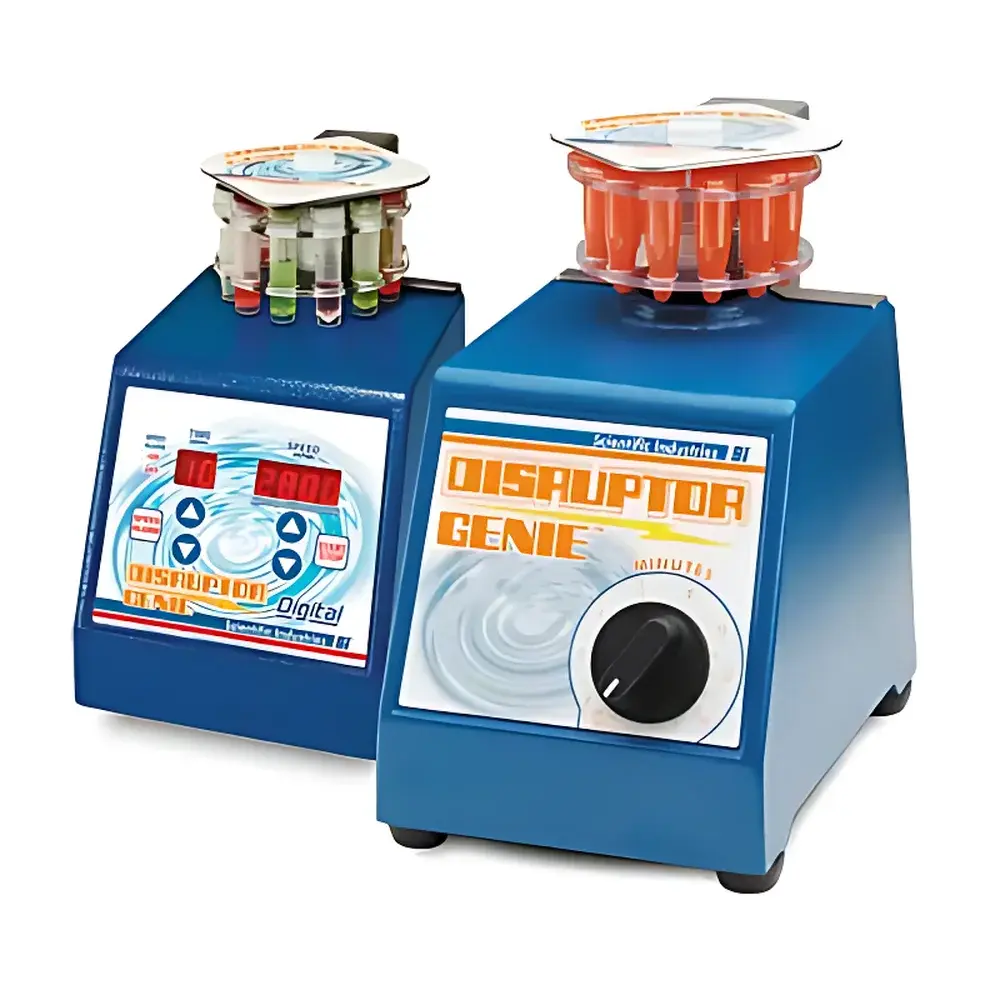
Scientific Industries Disruptor Genie Vortex Mixer
| Brand | Scientific Industries |
|---|---|
| Origin | USA |
| Model | Disruptor Genie |
| Speed Range | 1000–3000 rpm (3000 rpm @ 60 Hz / 2700 rpm @ 50 Hz) |
| Operating Modes | Continuous or Adjustable Speed |
| Motion Type | Circular Orbital |
| Amplitude | 3 mm |
| Display | LED Speed Indicator |
| Construction | Cast Iron Body with Silicone Non-Slip Feet |
| Weight | 4.3 kg |
| Timer Options | 0–15 min or continuous / 0–99 min or continuous |
| Included Accessories | 12-position 1.5/2 mL Tube Disruption Adapter, Single-Tube Oscillation Head |
| Compliance | Designed for GLP-compliant laboratories |
Overview
The Scientific Industries Disruptor Genie Vortex Mixer is an engineered solution for high-efficiency sample disruption and homogenization in molecular biology, microbiology, environmental, and pharmaceutical laboratories. Unlike standard vortex mixers, the Disruptor Genie employs a high-amplitude (3 mm), high-speed orbital motion optimized to drive mechanical lysis via bead-beating—enabling consistent cell wall rupture in bacteria, yeast, fungal spores, plant tissues, and soil matrices. Its cast iron chassis provides inert mass stability during aggressive agitation, minimizing resonance-induced drift or vibration transfer to adjacent instrumentation. The device operates on a robust electromagnetic drive system delivering repeatable torque across its full speed range (1000–3000 rpm), with frequency-dependent maximum speeds calibrated per regional power standards (60 Hz / 50 Hz). This architecture ensures reproducible shear stress profiles critical for downstream nucleic acid yield, protein solubilization, and metabolite extraction.
Key Features
- High-inertia cast iron housing with integrated silicone non-slip feet ensures mechanical stability during high-speed bead-based lysis—reducing operator-induced variability and benchtop displacement.
- Dual-mode operation: selectable continuous run or digitally timed cycles (0–15 min or 0–99 min), supporting both rapid screening and extended incubation-integrated protocols.
- LED speed display provides real-time rotational feedback without analog parallax error—essential for SOP adherence and audit-ready documentation.
- Modular accessory interface allows tool-free swapping between the 12-position microcentrifuge tube adapter (for parallel processing of 1.5/2 mL tubes) and the single-tube oscillation head—enabling seamless transition from bulk homogenization to targeted sample mixing.
- Orbital motion geometry (circular, not conical) generates uniform radial acceleration across all tube positions, eliminating dead zones and improving inter-sample consistency.
- No internal fan or moving parts beyond the motor shaft—minimizing maintenance requirements and extending service life under routine lab use.
Sample Compatibility & Compliance
The Disruptor Genie supports a broad range of biological and environmental matrices when used with appropriate grinding media (e.g., 0.1 mm zirconia/silica beads for bacterial lysis; 0.5 mm steel beads for soil or fibrous tissue). It accommodates standard polypropylene and PCR-grade microcentrifuge tubes (1.5 mL and 2.0 mL), including those fitted with leak-resistant screw-cap adapters. The system complies with foundational laboratory quality frameworks: its mechanical design aligns with ASTM D4097 (standard practice for mechanical homogenization of environmental samples), and its operational repeatability supports ISO/IEC 17025 method validation requirements. While not FDA 21 CFR Part 11–certified as a standalone unit, its timer and speed control functions are traceable and configurable to support GLP/GMP-aligned workflow documentation when integrated into validated laboratory information management systems (LIMS).
Software & Data Management
The Disruptor Genie operates as a hardware-controlled instrument without embedded firmware or network connectivity. All parameter settings—including speed selection and timer activation—are executed locally via front-panel controls. For laboratories requiring electronic recordkeeping, the device’s LED display enables manual entry into ELN platforms, and its consistent mechanical response permits correlation of time/speed inputs with analytical outcomes (e.g., DNA fragment size distribution post-lysis). Optional external digital timers with RS-232 output can be interfaced for automated logging in regulated environments. No proprietary software is required, reducing IT validation overhead and ensuring long-term operational continuity.
Applications
- Mechanical lysis of Gram-positive bacteria (e.g., Staphylococcus aureus, Bacillus subtilis) and yeast (Saccharomyces cerevisiae) prior to genomic DNA isolation.
- Soil metagenomic extraction where physical disruption outperforms enzymatic methods for recalcitrant microbial biomass.
- Homogenization of frozen tissue biopsies in TRIzol®-based RNA workflows, minimizing thermal degradation through short-cycle, high-intensity agitation.
- Pre-analytical preparation of environmental swabs and filter concentrates for qPCR-based pathogen detection.
- Dispersion of nanoparticle suspensions and polymer blends in material science R&D labs requiring reproducible shear history.
FAQ
What types of grinding beads are compatible with the Disruptor Genie?
Standard silica, zirconia, stainless steel, and tungsten carbide beads ranging from 0.1 mm to 2.0 mm diameter are mechanically compatible—selection depends on sample toughness and desired particle size reduction.
Can the Disruptor Genie be used for cryogenic lysis?
Yes—when equipped with pre-chilled adapters and cryo-rated tubes, it supports sub-zero lysis protocols; however, ambient condensation must be managed to prevent motor housing corrosion.
Is calibration required before first use?
No factory calibration is needed—the speed control circuitry is factory-trimmed and stable over time; users may verify rpm accuracy using an external optical tachometer per ISO 16281.
How does the 3 mm amplitude compare to conventional vortex mixers?
Conventional units typically operate at ≤1 mm amplitude; the Genie’s 3 mm excursion delivers ~9× greater kinetic energy per cycle (E ∝ A²ω²), significantly enhancing lysis efficiency in viscous or particulate-laden samples.
Does the device meet electrical safety standards for international use?
It conforms to UL 61010-1 (USA/Canada) and IEC 61010-1 (international) for laboratory equipment, with dual-voltage compatibility (100–240 VAC, 50/60 Hz) and Class I grounding protection.



