
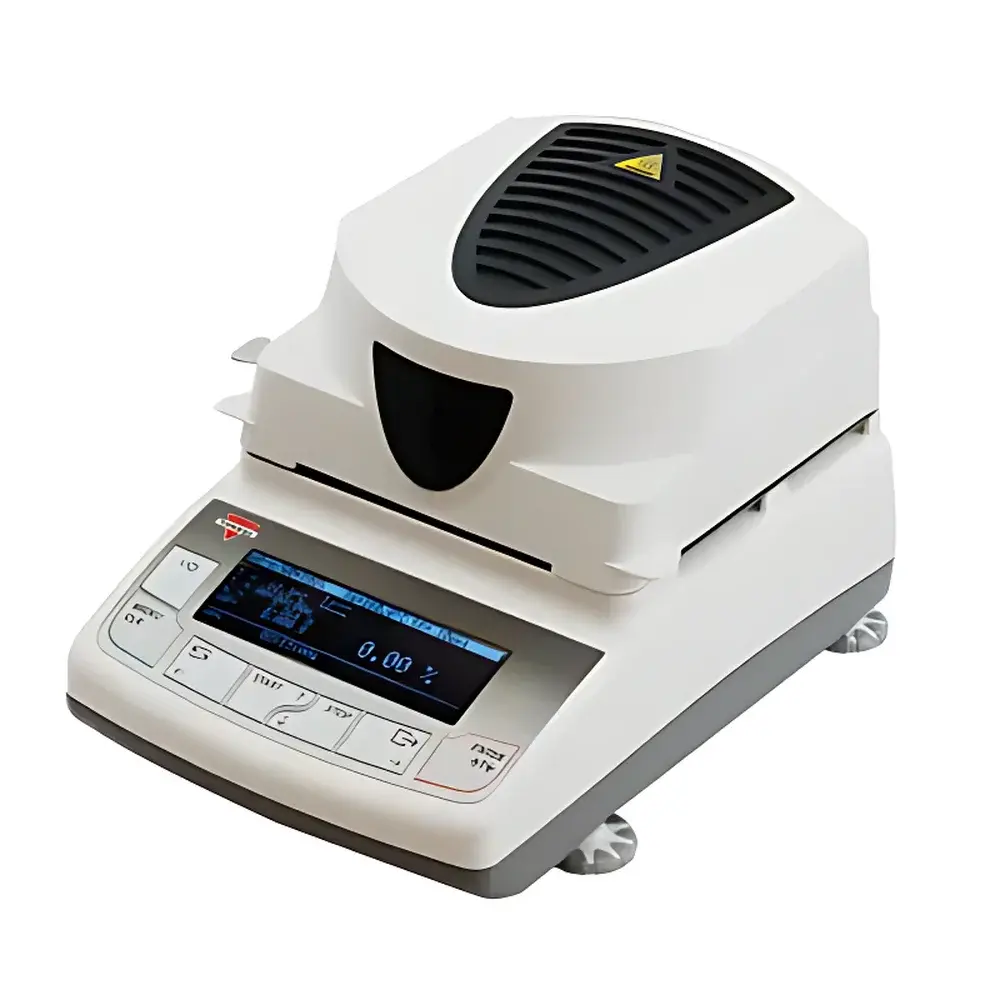
Scientific Industries Torbal BTS110 Precision Infrared Moisture Analyzer
| Brand | Scientific Industries |
|---|---|
| Origin | USA |
| Model | BTS110 |
| Heating Method | Halogen Lamp |
| Max Capacity | 110 g |
| Tare Range | –110 g |
| Readability | 0.01 g |
| Linearity | ±0.02 g |
| Accuracy Class | III |
| Moisture Measurement Accuracy | ±1% (2 g sample), ±0.4% (5 g sample), ±1% (0.02–0.5 g sample) |
| Moisture Resolution | 0.10% |
| Drying Temperature Range | Up to 160 °C |
| Drying Time Range | 1–180 s per step, up to 10 hr total |
| Drying Power | 200 W |
| Preheat Time | ~60 s |
| Sample Pan Diameter | 90 mm |
| Drying Chamber Dimensions | 108 × 20 mm |
| External Dimensions | 185 × 290 × 170 mm |
| Net Weight | 5.4 kg |
| Interfaces | USB, RS232C, PS2 |
| Display | Backlit Graphic LCD |
| Memory | 20 Custom Methods, 4 Drying Curves, 4 Analysis Modes |
| Data Output | Printable Drying Reports, Temperature Calibration, Power-On Self-Test |
Overview
The Scientific Industries Torbal BTS110 Precision Infrared Moisture Analyzer is an integrated thermogravimetric instrument engineered for rapid, repeatable, and traceable moisture content determination in solid and semi-solid materials. It operates on the principle of halogen-assisted infrared drying coupled with high-resolution electromagnetic force compensation weighing—enabling real-time mass loss monitoring during controlled thermal dehydration. Unlike conventional oven-drying methods requiring hours, the BTS110 delivers validated moisture results in minutes while maintaining compliance with internationally recognized reference procedures including ASTM D4442, ISO 712, and USP <921>. Its design targets laboratories engaged in quality control (QC), raw material verification, pharmaceutical stability studies, food ingredient certification, and polymer processing where batch-to-batch consistency and regulatory documentation integrity are critical.
Key Features
- Electromagnetic force compensation load cell delivering 0.01 g readability and ±0.02 g linearity across its full 110 g capacity range, certified to OIML R76 Accuracy Class III.
- 200 W halogen heating module with precise external temperature control (up to 160 °C), enabling reproducible drying profiles without thermal overshoot or cavity hot spots.
- Backlit graphic LCD interface supporting intuitive navigation, real-time drying curve visualization, and multi-step protocol execution.
- Onboard memory stores up to 20 user-defined methods—including four preconfigured drying curves (Standard, Rapid, Step, and Gentle) and four analysis modes (Auto, Time, Manual, and Moisture Target).
- Comprehensive connectivity suite: USB port for direct data export to PC-based LIMS or Excel, RS232C for legacy serial integration with lab information systems, and PS2 for optional keyboard input.
- Integrated self-diagnostic routines—including automatic zero calibration, temperature sensor validation, and load cell drift compensation—executed at power-on and configurable during operation.
Sample Compatibility & Compliance
The BTS110 accommodates a broad spectrum of sample types—including powders, granules, pellets, pastes, and thin films—with optimal performance for masses between 0.02 g and 50 g. For samples ≥50 g, measurement resolution remains stable at 0.01%; for smaller masses (0.02–0.5 g), moisture quantification maintains ±1% repeatability under controlled ambient conditions (23 ±2 °C, <60% RH). The instrument complies with Good Laboratory Practice (GLP) and supports audit-ready documentation through timestamped drying reports containing method ID, start/stop time, final moisture %, residual dry mass, and temperature profile summary. Optional firmware upgrades enable 21 CFR Part 11-compliant electronic signatures and secure user access levels when deployed in regulated GMP environments.
Software & Data Management
Data generated by the BTS110 is structured for seamless traceability and secondary analysis. Each drying cycle outputs a standardized CSV file containing time-stamped mass readings (every 0.5 s), corresponding chamber temperature values, and calculated moisture loss percentages. USB export enables direct ingestion into statistical process control (SPC) platforms or laboratory informatics systems. The RS232C interface supports ASCII command protocols for automated method triggering and result polling in high-throughput production QC workflows. All stored methods include editable metadata fields (e.g., analyst ID, sample lot number, SOP version), ensuring alignment with ISO/IEC 17025 documentation requirements. No proprietary software installation is required—raw data files are natively readable in spreadsheet applications and compatible with common ELN/LIMS import templates.
Applications
- Pharmaceutical manufacturing: Residual solvent and hydrate water quantification in active pharmaceutical ingredients (APIs) and excipients per ICH Q5C guidelines.
- Food & beverage QA/QC: Moisture specification verification in flour, dairy powders, coffee beans, spices, and pet food to ensure shelf-life stability and microbial safety.
- Chemical industry: Water content validation in catalysts, silica gels, ion-exchange resins, and lithium battery electrode slurries.
- Polymer & plastics: Determination of hygroscopic moisture in PET, nylon, and polycarbonate prior to extrusion or injection molding to prevent hydrolytic degradation.
- Agricultural testing labs: Rapid field-moisture assessment in grains, seeds, and forage crops aligned with AOAC 950.46 methodology.
FAQ
What calibration standards are recommended for routine verification?
Certified moisture reference standards (e.g., sodium tartrate dihydrate, USP Reference Standard) should be used weekly; internal calibration weights (10 g and 100 g) are provided for daily load cell verification.
Can the BTS110 be operated inside a fume hood?
Yes—its compact footprint (185 × 290 × 170 mm) and low-voltage halogen module permit safe use in ventilated enclosures; however, airflow must not impinge directly on the drying chamber opening to avoid convective mass drift.
Is temperature calibration traceable to NIST?
The built-in PT100 sensor is factory-calibrated against NIST-traceable reference thermometers; users may perform field verification using a calibrated digital probe inserted into the designated calibration port.
How does the instrument handle hygroscopic or volatile samples?
The “Gentle” drying curve and programmable ramp rates (0.1–5 °C/s) minimize surface hardening and volatilization artifacts; optional sample covers reduce ambient moisture reabsorption during cooling.
Does the BTS110 support GLP-compliant audit trails?
When connected to a compliant host system via RS232C or USB, all method changes, calibration events, and result exports are logged with operator ID, timestamp, and action type—meeting core GLP record-keeping expectations.





