
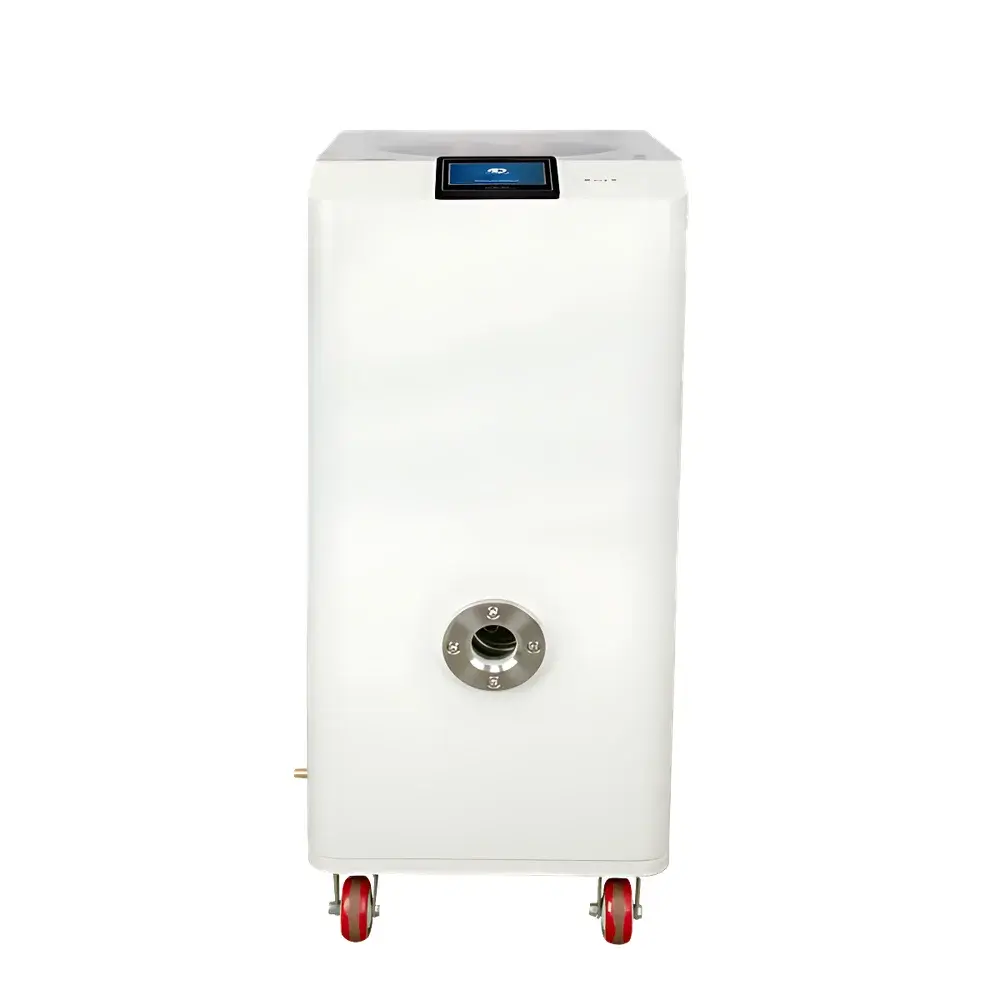
SCIENTZ-1LS Integrated Vacuum Centrifugal Concentrator
| Brand | SCIENTZ |
|---|---|
| Origin | Zhejiang, China |
| Manufacturer Type | Direct Manufacturer |
| Region Classification | Domestic (China) |
| Model | SCIENTZ-1LS |
| Instrument Type | Standard Shelf-Type |
| Scale | Pilot-Scale |
| Freeze-Drying Area | 0.21 m² |
| Ultimate Vacuum | ≤5 Pa (at no load) |
| Condensate Capacity | 4 kg/24 h |
| Cold Trap Temperature | ≤−70 °C (at no load) |
| Dimensions (L×W×H) | 750 × 640 × 1200 mm |
Overview
The SCIENTZ-1LS Integrated Vacuum Centrifugal Concentrator is an engineered solution for gentle, efficient, and contamination-free sample concentration under reduced pressure and controlled temperature. Unlike conventional lyophilizers or standalone centrifuges, this system combines vacuum-induced solvent evaporation with high-speed centrifugal force in a single integrated architecture—enabling simultaneous phase separation, vapor removal, and sample stabilization. Its operational principle relies on lowering the partial pressure of volatile solvents to depress their boiling points, thereby facilitating rapid evaporation at sub-ambient temperatures. The centrifugal field (up to 3,000 × g, depending on rotor configuration) counteracts bubble formation and prevents foaming or splashing during evaporation, while maintaining sample integrity across microvolume to mid-scale formats (0.2–50 mL per tube). Designed specifically for pilot-scale laboratory workflows, the SCIENTZ-1LS supports reproducible concentration of thermolabile biomolecules without denaturation or oxidation.
Key Features
- Integrated Cold Trap & Vacuum System: Equipped with a high-efficiency condenser operating at ≤−70 °C (no-load), capable of capturing up to 4 kg of water vapor over 24 hours—ensuring stable vacuum maintenance even during extended runs.
- Magnetic Levitation Drive Technology: Eliminates mechanical seals and reduces friction-induced heat generation, enabling precise rotational control and superior vacuum integrity in the centrifugal chamber.
- Modular Rotor Compatibility: Supports seven interchangeable rotors—including fixed-angle, swing-bucket, and microplate carriers—optimized for tubes (0.2–50 mL), PCR strips, and 96-well plates.
- Intelligent Vacuum Regulation: Closed-loop feedback control dynamically adjusts vacuum level based on real-time vapor pressure and sample thermal profile, minimizing bumping and maximizing recovery yield.
- Temperature-Controlled Chamber: Optional Peltier-based cooling/heating module maintains chamber temperature between −10 °C and +40 °C, critical for preserving labile analytes such as cytokines, oligonucleotides, or post-translational modifications.
- Safety-Centric Design: Automatic vacuum release upon power failure or emergency stop; corrosion-resistant 316 stainless steel chamber and fluid pathways; interlocked lid with pressure-sensing seal verification.
Sample Compatibility & Compliance
The SCIENTZ-1LS accommodates aqueous, organic, and mixed-solvent systems commonly used in molecular biology and pharmaceutical development—including ethanol, acetonitrile, chloroform, and trifluoroacetic acid (TFA) solutions. All wetted surfaces comply with ISO 8573-1 Class 2 compressed air purity standards for non-oil-contaminated environments. While not certified for GMP manufacturing, the instrument meets key design criteria referenced in USP Analytical Instrument Qualification and supports IQ/OQ documentation packages aligned with GLP and ISO/IEC 17025 laboratory accreditation requirements. Its vacuum performance conforms to ASTM F2339–22 for low-pressure drying equipment validation protocols.
Software & Data Management
The embedded control interface provides full programmability of time, vacuum ramp rate, rotational speed, and temperature setpoints via intuitive touchscreen navigation. All process parameters—including actual vacuum level (measured by Pirani + capacitance manometer), condenser temperature, chamber temperature, and rotor RPM—are logged at 1-second intervals and exportable in CSV format. Audit trail functionality records user login events, parameter changes, and alarm triggers—supporting compliance with FDA 21 CFR Part 11 when deployed with validated networked data archiving systems.
Applications
- Concentration and desalting of nucleic acids (genomic DNA, siRNA, CRISPR guide RNAs) prior to sequencing library preparation
- Preparative cleanup of metabolite extracts from LC-MS/MS analysis—removing residual solvents without thermal degradation
- Downstream processing of monoclonal antibodies and fusion proteins following affinity chromatography
- Rapid solvent exchange for MALDI-TOF matrix preparation and peptide mapping workflows
- Stabilization of enzyme inhibitors and kinase substrates during high-throughput screening assay development
- Concentration of environmental water samples containing trace pharmaceutical residues or endocrine disruptors
FAQ
What types of solvents are compatible with the SCIENTZ-1LS?
Aqueous buffers, methanol, ethanol, acetonitrile, acetone, ethyl acetate, and dichloromethane are routinely processed. Strongly acidic or halogenated solvents (e.g., concentrated HCl, chloroform) require optional chemical-resistant cold trap liners and extended purge cycles.
Can the SCIENTZ-1LS be used for lyophilization?
No—it is not designed for primary drying of frozen solids. It performs vacuum centrifugal concentration only; freezing must be conducted separately using ultra-low temperature freezers or cryo-concentrators.
Is remote monitoring supported?
Yes—via optional Ethernet or RS-485 interface with Modbus TCP protocol, enabling integration into centralized lab automation platforms and LIMS.
What maintenance is required for long-term reliability?
Daily: Empty condensate collection vessel and inspect O-rings. Quarterly: Calibrate vacuum sensors and verify cold trap cooldown performance. Annually: Replace vacuum pump oil and inspect magnetic drive coupling alignment.
Does it meet CE or UL safety standards?
The unit complies with IEC 61010-1:2010 for electrical safety in laboratory equipment and carries CCC certification for domestic Chinese markets. CE marking is available upon request for EU-distributed configurations with updated EMC and RoHS documentation.



