
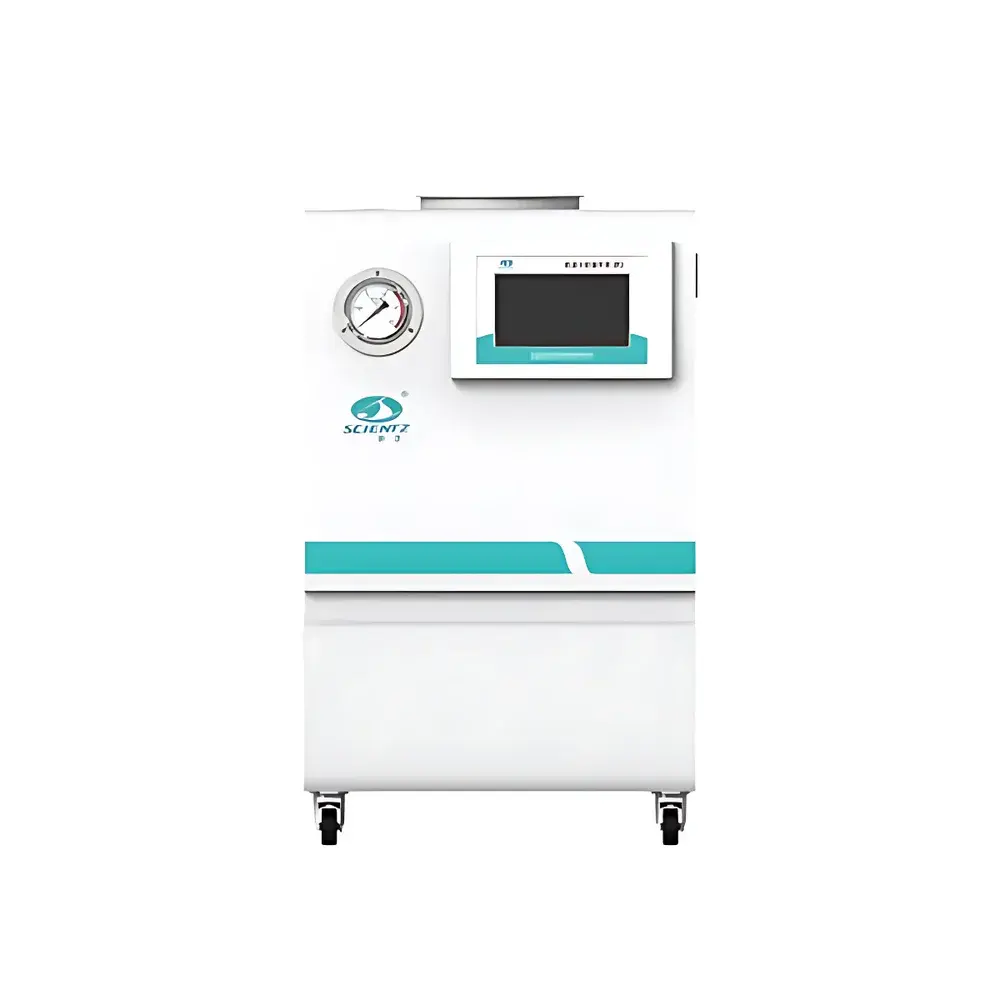
Scientz DLK-2007 Low-Temperature Circulating Chiller
| Brand | Scientz |
|---|---|
| Origin | Zhejiang, China |
| Manufacturer Type | Direct Manufacturer |
| Product Category | Domestic |
| Model | DLK-2007 |
| Instrument Type | Constant-Temperature Bath |
| Circulation Mode | Internal & External Circulation |
| Temperature Control | Refrigeration & Heating |
| Bath Volume | 7 L |
| Temperature Range | –20 °C to +95 °C (typical for DLK-2007 series) |
| Temperature Stability | ±0.1 °C (at setpoint, steady-state, 1 h) |
Overview
The Scientz DLK-2007 Low-Temperature Circulating Chiller is an engineered thermal management system designed to deliver precise, stable, and programmable temperature control for laboratory applications requiring both cooling and heating capabilities. Based on a closed-loop vapor-compression refrigeration cycle with integrated electric heating elements, the unit maintains a thermally uniform liquid medium—typically water or water-glycol mixtures—in its 7-liter stainless-steel bath reservoir. Its dual-mode operation enables seamless transition between sub-zero cooling (down to –20 °C) and elevated heating (up to +95 °C), with typical stability of ±0.1 °C under static load conditions. The chiller functions as both a self-contained constant-temperature bath and an external temperature source, supporting circulation to auxiliary equipment—including rotary evaporators, condensers, spectrometers, atomic absorption graphite furnaces, and reaction jackets—via high-head, corrosion-resistant magnetic drive pumps. All critical components—including the hermetic compressor (Panasonic or Tecumseh/Tecumseh-derived units), expansion valve, and PID-controlled heater—are selected for long-term reliability and minimal thermal drift.
Key Features
- 7-inch angled capacitive touchscreen interface with real-time display of bath temperature, setpoint, elapsed time, pump status, and system alarms
- Environmentally compliant refrigerant (R-404A or R-507, non-CFC, low ODP, subject to regional regulatory compliance)
- Programmable timer function: user-defined operational duration followed by automatic shutdown or standby mode
- Low-noise refrigeration system featuring sealed industrial-grade compressors (Panasonic or Tecumseh), optimized for continuous duty in shared laboratory environments
- Switchable internal/external circulation modes with adjustable flow pressure (up to 2.5 bar max head) and flow rate (0–20 L/min, dependent on system backpressure)
- Space-efficient footprint (W × D × H ≈ 360 × 420 × 620 mm) suitable for benchtop integration or under-bench mounting
- Comprehensive safety architecture: compressor overheat protection, high-pressure cut-off, low-level fluid alarm, dry-run prevention, and thermal runaway suppression
- Power-loss recovery: retains last configuration; configurable auto-restart mode with optional pre-cooling ramp or standby temperature hold
Sample Compatibility & Compliance
The DLK-2007 is compatible with aqueous, glycol-based, and low-viscosity organic heat-transfer fluids (e.g., ethanol/water mixtures) within its specified temperature and chemical resistance envelope. Its stainless-steel bath and wetted parts (304 SS reservoir, EPDM/NBR seals, brass fittings) resist corrosion from common solvents and buffer solutions. While not certified to ISO/IEC 17025 or GLP as a standalone analytical instrument, the unit supports GLP/GMP-aligned workflows when deployed in validated systems—for example, as part of ASTM E2912-compliant rotary evaporation setups or USP pharmaceutical compounding environments where temperature traceability and stability are documented. It meets CE electromagnetic compatibility (EMC) and low-voltage directives (LVD), and complies with RoHS 2011/65/EU material restrictions.
Software & Data Management
The embedded microcontroller executes a deterministic PID algorithm with adaptive tuning parameters, enabling rapid thermal equilibration and minimal overshoot across wide setpoint ranges. Though the DLK-2007 does not include Ethernet or USB data logging as standard, its RS-485 port (Modbus RTU protocol) allows integration into centralized lab monitoring platforms (e.g., LabVantage, Thermo Fisher SampleManager) for remote setpoint adjustment, alarm forwarding, and audit-trail generation. Optional firmware upgrades may support 21 CFR Part 11–compliant electronic signatures and audit logs when paired with validated third-party middleware—particularly relevant for QC laboratories operating under FDA-regulated quality systems.
Applications
- Rotary Evaporation: Simultaneous cooling of up to four rotary evaporators at stable condenser temperatures (e.g., 10 °C), independent of ambient fluctuations—enabling reproducible solvent recovery in synthetic chemistry and natural product isolation
- Solid-Liquid Extraction: Temperature-controlled Soxhlet and accelerated solvent extraction (ASE) systems, ensuring consistent fat and lipid quantification per AOAC 991.36 or ISO 1443 standards
- Atomic Absorption Spectroscopy (AAS): Continuous cooling of graphite furnace assemblies and flame atomizers, maintaining optimal detector thermal equilibrium and reducing baseline noise during trace metal analysis (e.g., Pb, Cd, As in food or environmental samples)
- Reaction Calorimetry & Process Development: Jacketed reactor temperature control in pilot-scale synthesis, supporting exothermic/endothermic reaction profiling under controlled thermal boundary conditions
- Material Testing: Thermal conditioning of viscometers, rheometers, and thermal conductivity analyzers per ASTM D2196 or ISO 2555 protocols
FAQ
What is the maximum allowable working pressure for external circulation?
The DLK-2007 supports up to 2.5 bar (36 psi) static discharge pressure at the outlet fitting; system backpressure must remain below this threshold to ensure pump longevity and flow stability.
Can the unit operate continuously at –20 °C with full external load?
Yes, provided ambient temperature remains ≤30 °C and ventilation clearance (≥150 mm rear/side) is maintained; continuous operation at extreme low setpoints reduces compressor duty cycle efficiency but remains within design specifications.
Is glycol mixture recommended for sub-zero operation?
Yes—use 30–40% propylene glycol in deionized water to prevent freezing and minimize viscosity rise; avoid ethylene glycol in life science labs due to toxicity concerns.
Does the chiller support external temperature feedback control?
No—the DLK-2007 regulates based solely on internal bath sensor input; for process-critical external load control, integrate with an external PID controller using its analog voltage output (0–10 V) signal.
How often should the refrigerant circuit be serviced?
Under normal use, no scheduled refrigerant recharge is required; annual inspection of condenser coil cleanliness and electrical connections is recommended per Scientz preventive maintenance guidelines.



