
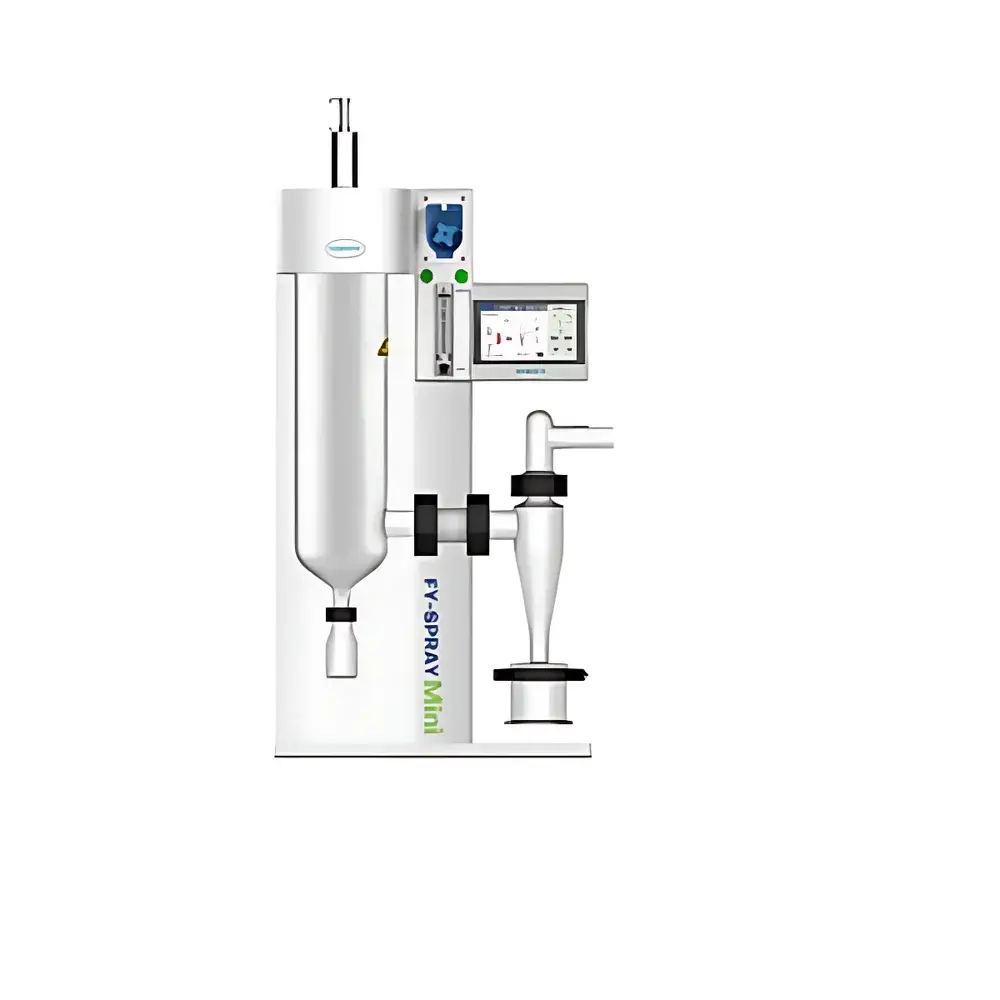
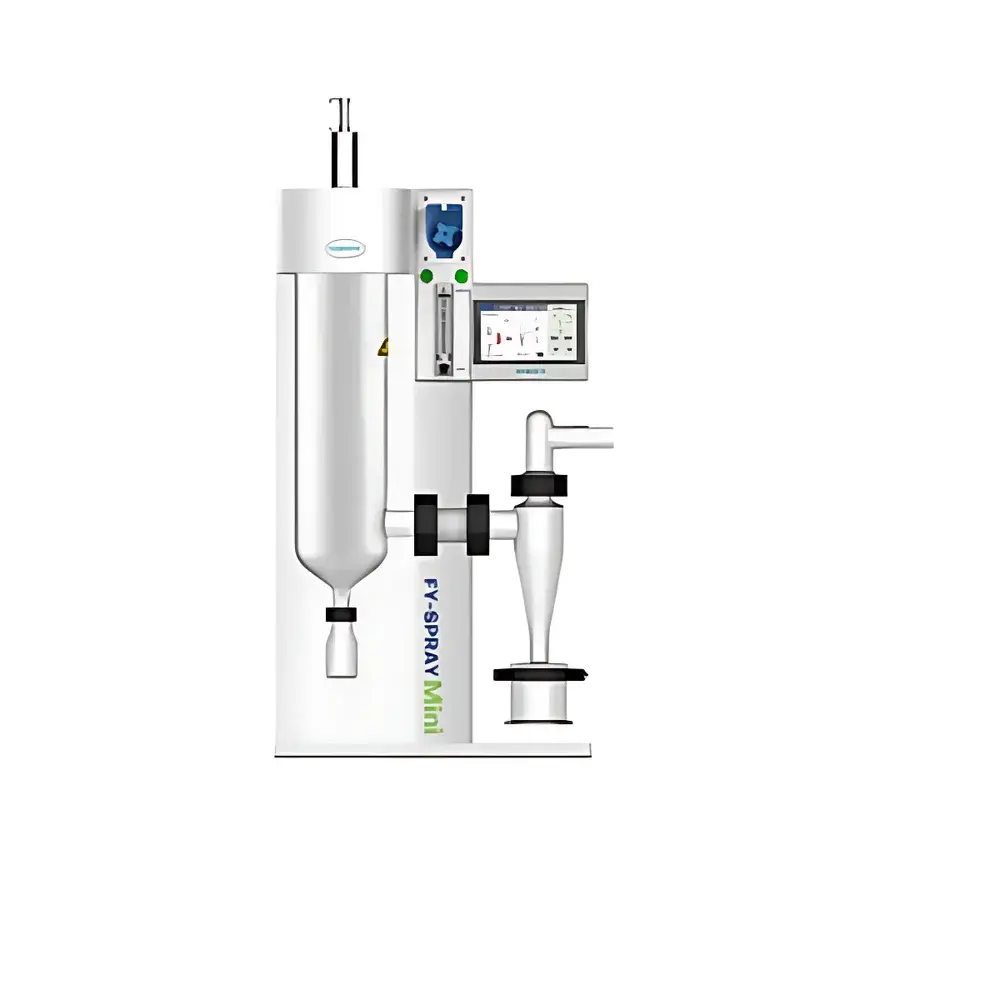
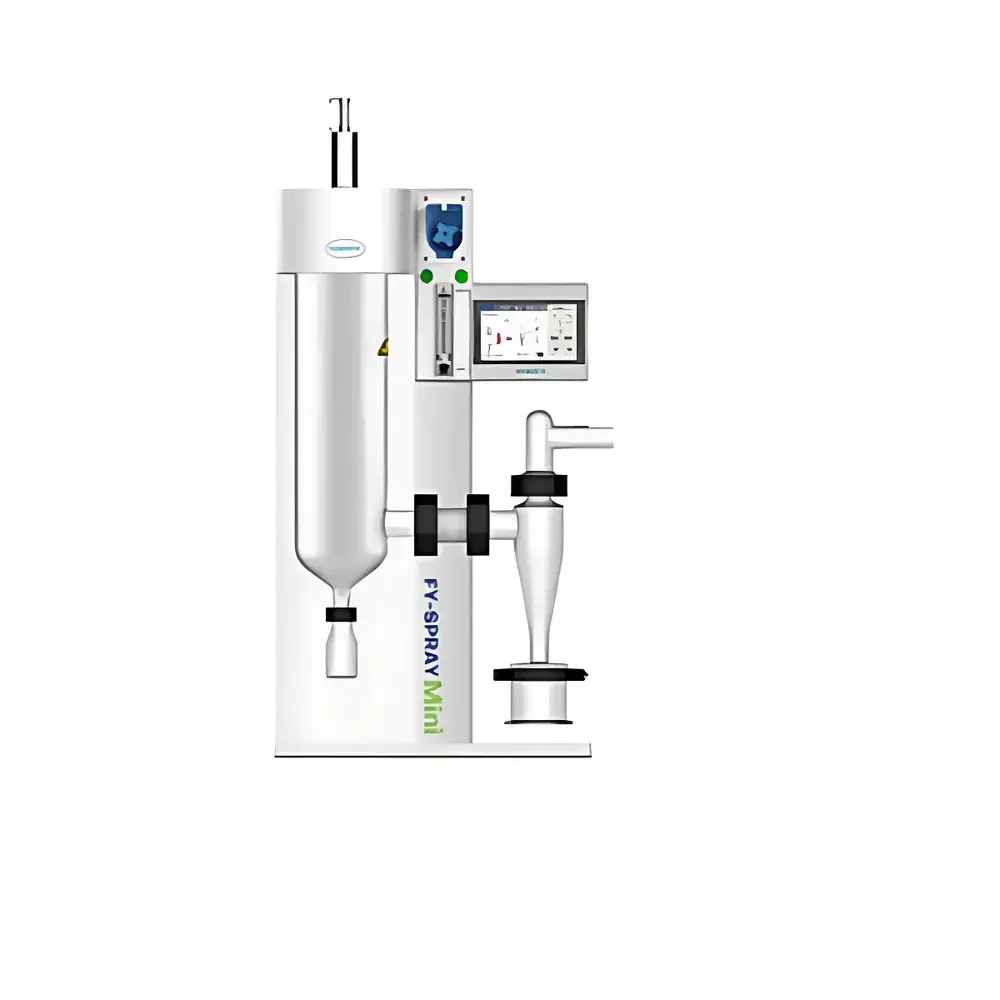
SCIENTZ FY-SPRAY Mini Benchtop Spray Dryer
| Brand | SCIENTZ |
|---|---|
| Origin | Zhejiang, China |
| Model | FY-SPRAY Mini |
| Max. Feed Rate | 1800 mL/h |
| Inlet Temp. Range | 30–250 °C ±1 °C |
| Outlet Temp. Range | 30–150 °C ±1 °C |
| Particle Size Range | 5–50 µm |
| Heating Power | 3.0 kW (220 V) |
| Dryer Tower Material | Borosilicate Glass & AISI 316L Stainless Steel |
| Atomizer | Imported Dual-Fluid Nozzle (0.7 mm Orifice) |
| Drying Time | 1.0–1.5 s |
| Automatic Needle Clearing Cycle | 0–60 s Adjustable |
| Dimensions (H×W×D) | 922 × 570 × 470 mm |
| Weight | 58 kg |
| Power Supply | 220/230 V, 50–60 Hz |
| Total Rated Power | 3.6 kW |
Overview
The SCIENTZ FY-SPRAY Mini is a compact, benchtop-scale spray dryer engineered for precision drying of heat-sensitive and high-value liquid feedstocks in research laboratories. It operates on the principle of flash evaporation: a liquid sample is atomized into fine droplets via a dual-fluid nozzle, then rapidly dried by concurrent-flow hot air within a borosilicate glass drying chamber. This process achieves solid powder formation in 1.0–1.5 seconds—minimizing thermal degradation while preserving structural integrity of biologics, polymers, APIs, and nanostructured materials. Designed for low-volume, high-variability R&D workflows, the FY-SPRAY Mini supports iterative formulation development in pharmaceuticals, functional foods, nanomaterials synthesis, traditional Chinese medicine (TCM) extract processing, and catalyst precursor preparation.
Key Features
- Benchtop footprint (922 × 570 × 470 mm) with ergonomic access and integrated casters for lab mobility
- High-precision temperature control: Pt-100 sensors monitor both inlet and outlet air streams; intelligent PID algorithm maintains ±1 °C stability across full 30–250 °C inlet range
- Dual-fluid atomization system featuring an imported U.S.-sourced nozzle (0.7 mm orifice), enabling consistent droplet generation and reproducible particle morphology
- Robust construction: drying tower fabricated from high-purity borosilicate glass (≤1.0 mm wall thickness tolerance); contact surfaces made of electropolished AISI 316L stainless steel; non-contact zones use 2520 heat-resistant alloy
- Automated needle clearing mechanism with user-adjustable cycle interval (0–60 s), preventing nozzle clogging during viscous or particulate-laden feed applications
- Full electrical compliance to IEC 61000-6-3 (EMC) and IEC 61000-6-2 (immunity); Schneider-certified control components ensure long-term operational reliability
Sample Compatibility & Compliance
The FY-SPRAY Mini accommodates aqueous and organic solvent-based solutions, colloidal suspensions (e.g., silica nanoparticles, liposome dispersions), emulsions, and polymer melts—provided viscosity remains below 500 mPa·s at feed temperature. It has been validated for drying TCM extracts (e.g., astragalus polysaccharide solutions), protein-loaded PLGA nanoparticles, food-grade maltodextrin–vitamin C blends, and industrial precipitated silica slurries. All wetted parts comply with USP Class VI biocompatibility standards. The system supports GLP-aligned documentation through optional audit-trail-enabled data logging (requires SCIENTZ DataBridge v3.2+). While not certified for GMP manufacturing, its design meets critical elements of ISO 22000 (food safety), ASTM E2912 (spray drying performance verification), and FDA guidance for early-phase formulation studies under 21 CFR Part 11-compliant configurations.
Software & Data Management
The embedded touchscreen HMI provides real-time visualization of inlet/outlet temperatures, feed rate (via calibrated peristaltic pump: 0–72 mL/min), airflow, and drying chamber pressure. All parameters are timestamped and exportable as CSV files via USB interface. Optional SCIENTZ LabLink software enables remote monitoring, multi-unit fleet synchronization, and automated report generation compliant with ALCOA+ principles (Attributable, Legible, Contemporaneous, Original, Accurate, Complete, Consistent, Enduring, Available). Data integrity safeguards include user-level access control (admin/operator/guest), electronic signatures, and immutable log history—facilitating internal QA audits and regulatory submissions.
Applications
- Pharmaceutical R&D: Production of amorphous solid dispersions, inhalable dry powders, and nanoparticle carriers for controlled release
- Food Science: Encapsulation of probiotics, flavors, and omega-3 oils using wall materials such as gum arabic or whey protein isolate
- Materials Engineering: Synthesis of spherical ceramic precursors (e.g., LiFePO₄ cathode powders), metal oxide nanoparticles, and aerogel precursors
- Biotechnology: Stabilization of enzymes, antibodies, and viral vectors without cryoprotectants
- Chemical Process Development: Rapid screening of surfactant–polymer interactions, co-precipitation kinetics, and solvent removal efficiency
FAQ
What types of solvents are compatible with the FY-SPRAY Mini?
The system supports water, ethanol, methanol, acetone, and ethyl acetate. Chlorinated and highly flammable solvents (e.g., diethyl ether, hexane) require optional explosion-proof retrofitting and are not covered under standard warranty.
Can the FY-SPRAY Mini handle feed suspensions containing >5 wt% solids?
Yes—up to 15 wt% solids loading is achievable with optimized nozzle pressure and reduced feed rate; however, suspension stability and particle settling must be pre-verified to avoid nozzle abrasion.
Is the drying chamber temperature uniform throughout the chamber volume?
Temperature gradients are limited to ≤±3 °C radially and ≤±5 °C axially under steady-state operation, verified by thermocouple mapping per ASTM D1557.
Does the system meet CE or UL certification requirements?
The FY-SPRAY Mini carries CE marking (2014/30/EU EMC Directive & 2014/35/EU LVD Directive); UL 61010-1 listing is available upon request for North American deployment.
How often does the dual-fluid nozzle require maintenance or replacement?
Under typical aqueous feed conditions, nozzle service interval exceeds 500 operational hours; inspection is recommended after every 200 hours when processing abrasive slurries or high-salt formulations.



