
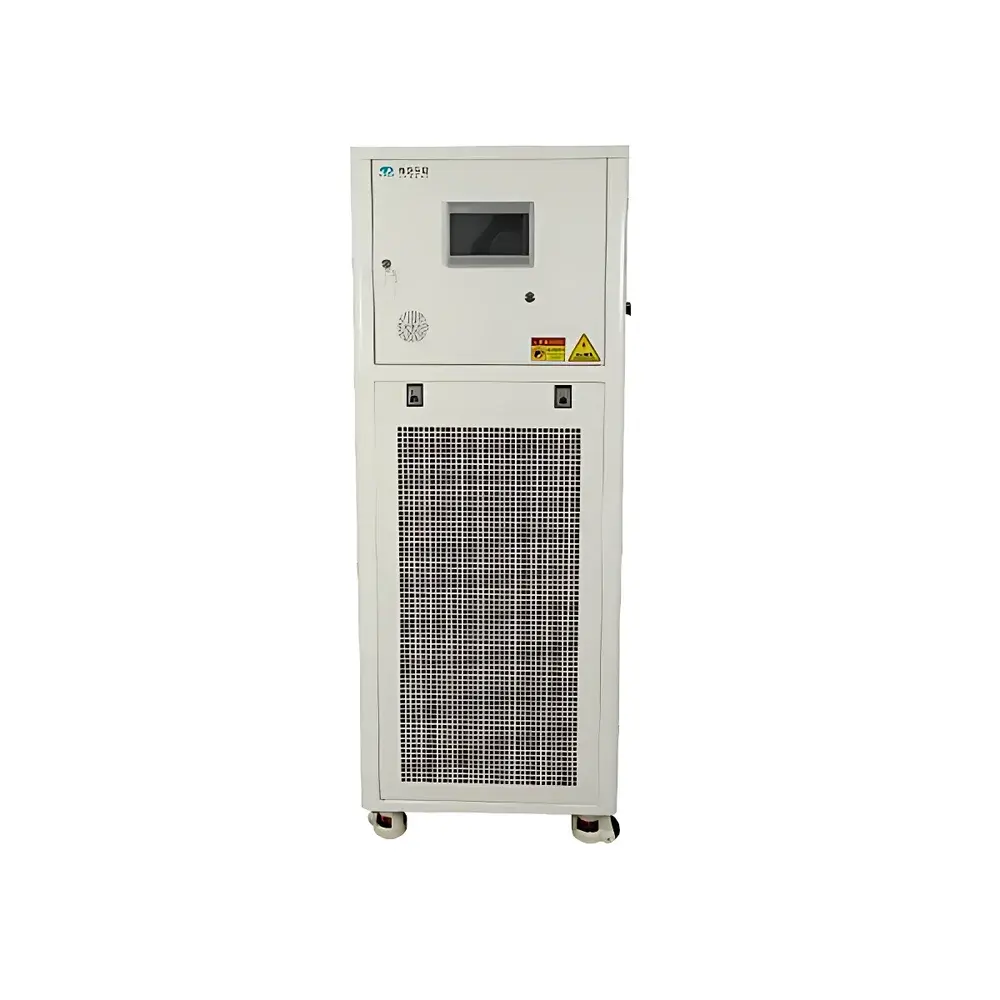
Scientz HL25-420 Series Low-Temperature to High-Temperature Circulating Temperature Control System (-40 °C to 200 °C)
| Brand | Scientz |
|---|---|
| Origin | Zhejiang, China |
| Manufacturer Type | Direct Manufacturer |
| Country of Origin | China |
| Model | HL25-420 Series |
| Temperature Range | -40 °C to 200 °C |
| Temperature Accuracy | ±0.5 °C |
| Control Algorithm | PID Fuzzy Control |
| Communication Protocol | MODBUS RTU over RS-485 |
| Display | 7-inch color touchscreen with real-time temperature curve plotting and logging |
| Programmability | Up to 5 programs, each with up to 30 segments |
| Temperature Feedback Points | Three PT100 sensors (unit internal temp, outlet fluid temp, external process material temp) |
| Safety Protections | Compressor overload protection, high-pressure switch, thermal relay, overtemperature sensor fault detection, low-fluid-level alarm, dual-stage overtemperature cutoff |
| System Design | Fully sealed closed-loop circulation |
Overview
The Scientz HL25-420 Series is an engineered circulating temperature control system designed for precise, stable, and wide-range thermal management in demanding laboratory and pilot-scale applications. Operating across a continuous range from –40 °C to +200 °C, it utilizes a single-fluid, fully sealed closed-loop architecture to eliminate evaporation losses at high temperatures and moisture ingress at low temperatures—ensuring long-term fluid integrity and operational consistency. Its core thermodynamic performance is based on a dual-stage refrigeration-compression cycle coupled with electric resistance heating, enabling rapid ramp rates and tight thermal regulation without media switching. The system implements adaptive PID fuzzy logic control to dynamically compensate for load variations—particularly critical when interfacing with exothermic or endothermic reaction vessels—thereby maintaining setpoint stability within ±0.5 °C for the heat transfer fluid and ±1.0 °C for the process material under typical operating conditions.
Key Features
- Wide operational span: –40 °C to 200 °C using a single synthetic silicone or glycol-based heat transfer fluid—no manual fluid change required between cryogenic and high-temperature regimes.
- Triple-point temperature monitoring via calibrated PT100 sensors: internal reservoir temperature, outlet fluid temperature, and externally mounted process temperature (user-supplied probe).
- Intelligent differential temperature control: independent setpoints and hysteresis management for jacket-to-material ΔT—essential for safe scale-up of highly exothermic reactions such as nitration or hydrogenation.
- Programmable thermal profiles: five user-defined programs, each supporting up to 30 time-temperature segments with hold, ramp, and soak functions; all stored internally with timestamped execution logs.
- Industrial-grade human-machine interface: 7-inch capacitive touchscreen with real-time multi-curve overlay (fluid outlet, reactor core, ambient reference), historical trend playback, and CSV export capability.
- Robust safety architecture: integrated diagnostics including refrigerant pressure monitoring, compressor current sensing, fluid level verification, redundant overtemperature cutouts, and sensor fault detection per IEC 61508 SIL-2 functional safety principles.
Sample Compatibility & Compliance
The HL25-420 interfaces seamlessly with jacketed glass or stainless-steel reactors (1–100 L), microstructured flow reactors (e.g., Corning AFR, Chemtrix systems), battery cell environmental test chambers, and material characterization platforms (DSC, TGA, rheometers). Its MODBUS RTU (RS-485) interface supports integration into centralized SCADA or LIMS environments compliant with ISA-88/ISA-95 frameworks. All electrical components meet CE/EMC Directive 2014/30/EU and RoHS 2011/65/EU requirements. The sealed circulation loop conforms to ASTM E2847-21 guidelines for thermal stability testing of heat transfer fluids and supports GLP-compliant audit trails when paired with validated data acquisition software.
Software & Data Management
Local operation requires no external PC—full control, logging, and visualization occur onboard. For networked deployment, optional Scientz TC-Link software enables remote configuration, real-time dashboarding, automated report generation (PDF/CSV), and secure role-based access (admin/operator). Audit trail functionality includes user ID, timestamp, parameter change, and reason code—fully traceable per FDA 21 CFR Part 11 Annex 11 requirements when deployed in regulated QC/QA laboratories. Data export supports ISO/IEC 17025 calibration documentation workflows and third-party analysis tools (MATLAB, Python Pandas, LabVIEW).
Applications
- Chemical Process Development: Precise thermal control during batch and continuous-flow synthesis—including sulfonation, oxidation, photochemical activation, and catalytic hydrogenation—where ΔT management prevents runaway reactions.
- Pharmaceutical R&D: USP and compliant temperature staging for sterile API crystallization, lyophilization cycle development, and dissolution testing under controlled thermal gradients.
- Advanced Materials Testing: Thermal cycling of lithium-ion battery modules (–40 °C to +85 °C), polymer curing kinetics (DMA support), and composite resin post-cure profiling per ASTM D696 and ISO 11359.
- Bioprocess Support: Jacket temperature stabilization for fermenters and bioreactors during seed train expansion, where thermal deviation >±0.8 °C may impact metabolic yield or plasmid stability.
- Instrument Integration: Primary temperature source for calorimeters (e.g., TA Instruments Q2000), rheometers (Anton Paar MCR series), and spectroscopic cells requiring active thermal conditioning.
FAQ
What is the maximum allowable pressure drop across the system’s fluid circuit?
The HL25-420 is rated for ≤3.5 bar backpressure at the outlet port; exceeding this may trigger flow restriction alarms and reduce thermal response fidelity.
Can the unit operate continuously at 200 °C without degradation of the heat transfer fluid?
Yes—when filled with certified high-temp silicone oil (e.g., Dow Corning 200 Fluid 50 cSt), continuous operation at 200 °C is supported for ≥12 months before scheduled fluid analysis per ASTM D6560.
Is external temperature feedback mandatory for material temperature control mode?
Yes—a user-installed Class A PT100 sensor must be immersed in the process medium; the system will not infer material temperature from jacket readings alone.
Does the system support NIST-traceable calibration reporting?
Calibration certificates (including as-found/as-left data for all three PT100 channels) are available upon request and comply with ISO/IEC 17025:2017 via accredited third-party labs.
How is firmware updated, and is version rollback supported?
Updates are performed via USB flash drive using Scientz-signed binaries; full version history and rollback capability are retained in non-volatile memory for audit compliance.




