
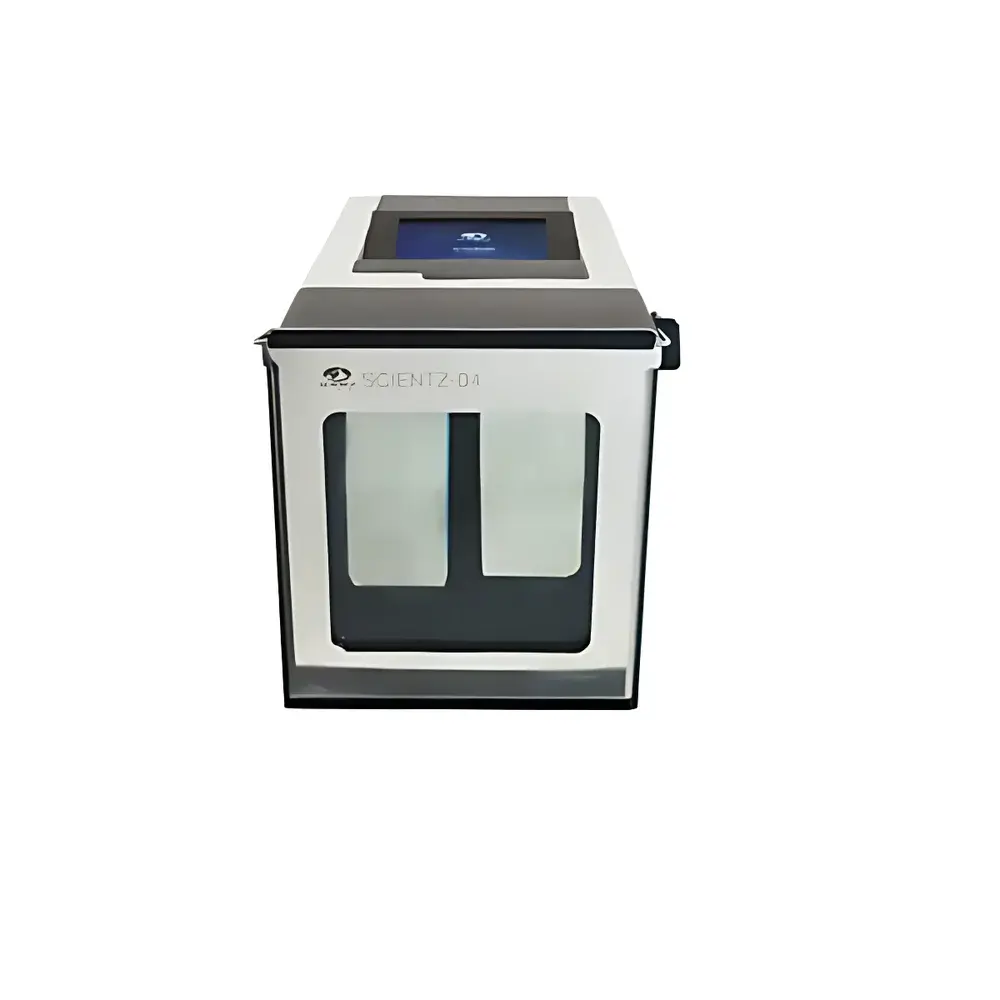
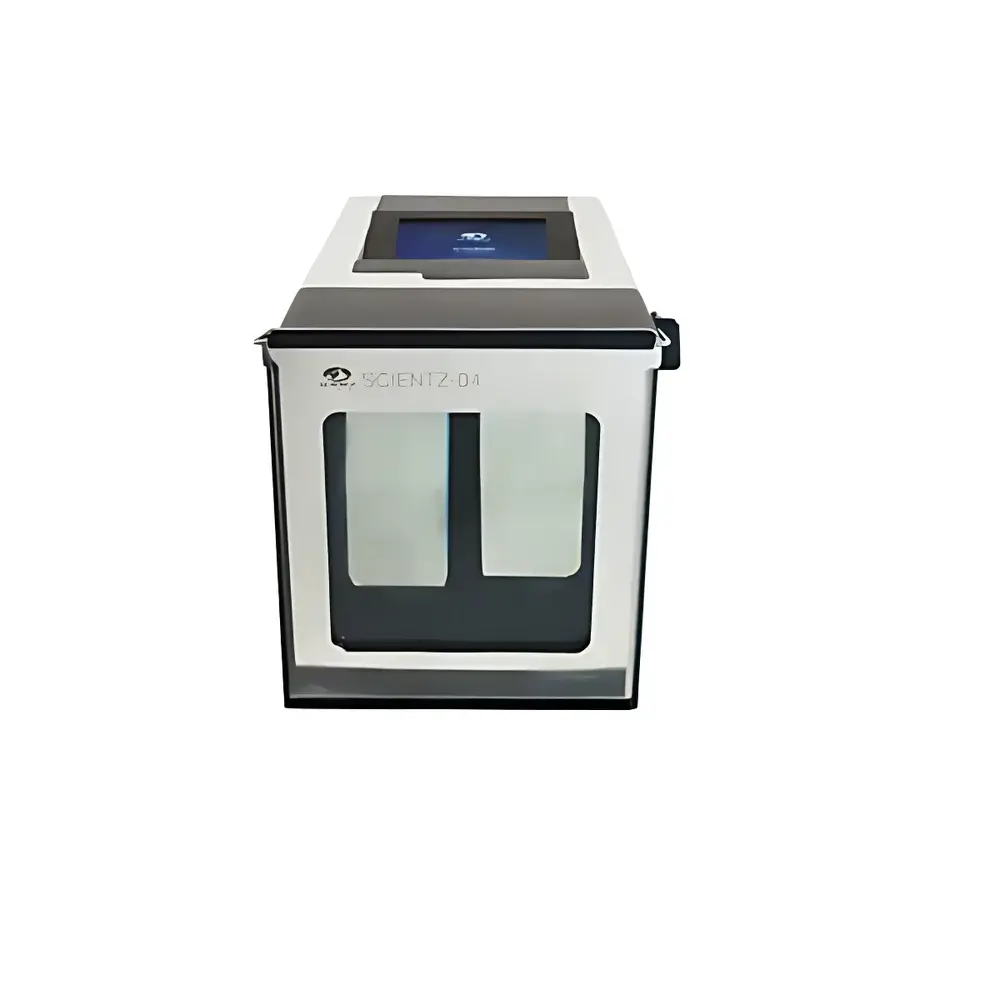
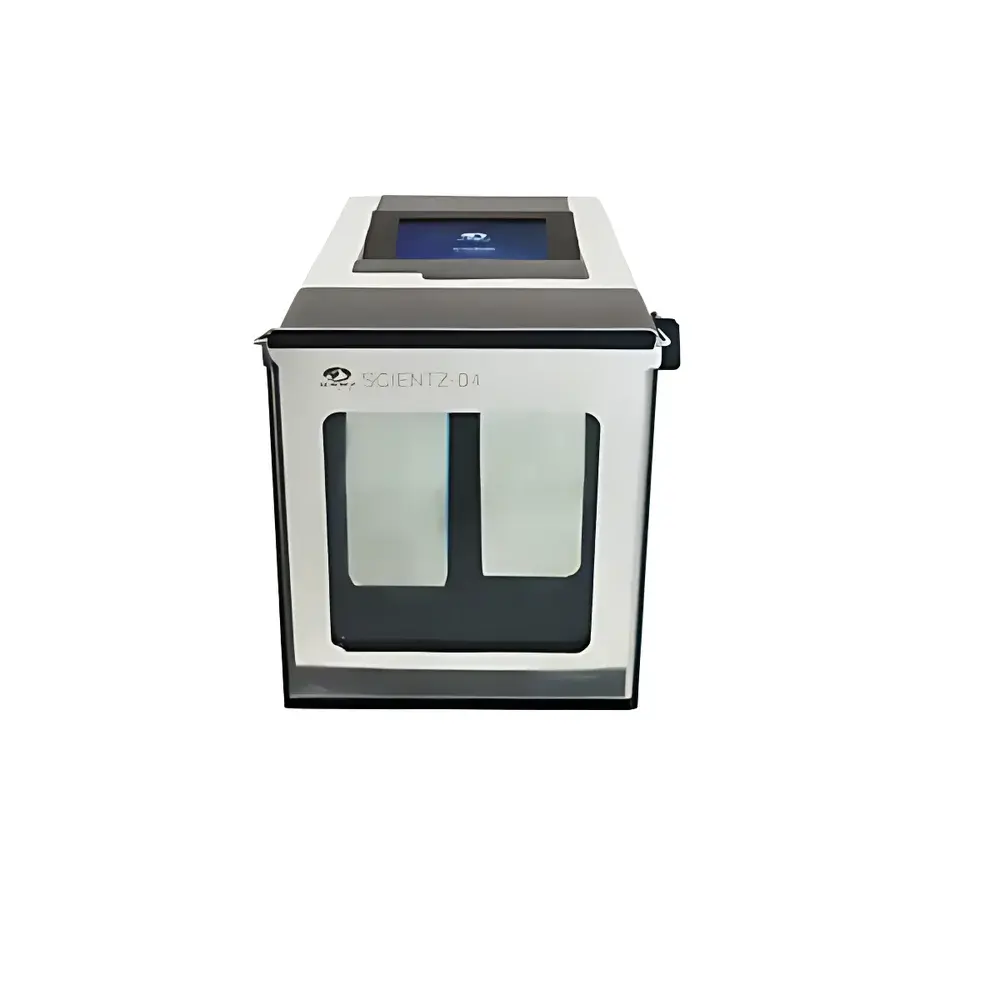
Scientz SCIENTZ-04 Sterile Stomacher Homogenizer
| Brand | Scientz |
|---|---|
| Origin | Zhejiang, China |
| Instrument Type | Stomacher-type (Paddle-beating) Homogenizer |
| Dimensions (W×D×H) | 430 × 245 × 280 mm |
| Sample Volume Range | 3–400 mL |
| Display | 5-inch Touchscreen |
| Timer Options | 30 / 180 / 600 s or ∞ |
| Beating Frequency | 6–9 beats/sec |
| UV Disinfection | No |
| Leak Protection | Yes |
| Quick-release Beating Plate | Yes |
| Parameter Storage | 10 Presets |
| External Stroke Adjustment | 0–20 mm |
| Power Rating | 150 W |
| Input Voltage | 220 V / 50 Hz |
Overview
The Scientz SCIENTZ-04 Sterile Stomacher Homogenizer is a precision-engineered paddle-beating homogenization system designed for gentle yet effective microbial liberation from solid and semi-solid biological samples under aseptic conditions. Operating on the principle of controlled mechanical shearing—where repetitive, calibrated impacts from stainless-steel beating plates transmit kinetic energy through a sealed sterile sample bag—the instrument achieves uniform dispersion without direct contact between sample and equipment surfaces. This non-invasive approach preserves microbial viability and integrity, making it especially suitable for quantitative microbiological analysis where cell lysis must be minimized and colony-forming unit (CFU) recovery maximized. The SCIENTZ-04 complies with standard laboratory workflows aligned with ISO 6887-1 (microbiology of food and animal feeding stuffs), ASTM D6913 (soil particle size analysis via wet sieving), and USP / (microbiological examination of non-sterile products), supporting GLP-compliant data generation in regulated environments.
Key Features
- Glass-front transparent viewing window enables real-time visual monitoring of homogenization progress without interrupting operation or compromising sterility.
- Adjustable beating frequency (6–9 beats per second) and programmable cycle duration (30 s, 180 s, 600 s, or continuous mode) allow precise optimization for diverse sample matrices—from soft tissues to fibrous plant material or particulate foodstuffs.
- Integrated leak detection and automatic shutdown prevent operational hazards and ensure containment integrity during high-volume processing (up to 400 mL).
- Quick-release stainless-steel beating plate facilitates rapid, tool-free disassembly for cleaning or replacement—reducing turnaround time between runs and minimizing cross-contamination risk.
- Ten user-defined parameter sets are stored in non-volatile memory, enabling reproducible method recall across shifts or operators without manual reconfiguration.
- External stroke adjustment (0–20 mm range) permits fine-tuning of impact amplitude to accommodate variable bag thicknesses or viscosity profiles, enhancing consistency across heterogeneous sample types.
Sample Compatibility & Compliance
The SCIENTZ-04 accommodates a broad spectrum of sample formats—including animal tissues (liver, kidney, spleen, brain), food products (meat, fish, fruits, vegetables, baked goods), environmental swabs, clinical biopsies, and pharmaceutical raw materials—when placed within certified sterile stomacher bags (typically polyethylene or nylon-laminated). Its design eliminates metal-to-sample contact, preventing catalytic degradation of sensitive analytes and ensuring compliance with FDA 21 CFR Part 11 requirements when paired with validated electronic record systems. All structural components meet IP22 ingress protection standards; the housing is constructed from corrosion-resistant anodized aluminum and medical-grade polycarbonate, facilitating routine decontamination using ethanol, hydrogen peroxide vapor, or low-temperature sterilants.
Software & Data Management
While the SCIENTZ-04 operates via embedded firmware rather than PC-connected software, its 5-inch capacitive touchscreen interface supports full audit trail functionality: each run logs timestamp, selected program ID, actual beating count, elapsed time, and operator ID (if configured via external network integration). Parameter changes are recorded with versioned metadata, satisfying basic ALCOA+ principles (Attributable, Legible, Contemporaneous, Original, Accurate) for QC/QA documentation. When deployed in GMP-regulated laboratories, the device may be integrated into broader LIMS or ELN platforms via RS-232 or optional USB-to-serial adapters—enabling centralized method validation, electronic signature capture, and automated report export compliant with Annex 11 and ISO/IEC 17025 requirements.
Applications
- Microbiological testing in food safety labs (e.g., Salmonella, Listeria, E. coli O157:H7 enumeration per ISO 11290 or FDA BAM protocols).
- Preparation of single-cell suspensions from tumor or lymphoid tissues for flow cytometry or cell culture expansion.
- Homogenization of veterinary feed samples for mycotoxin extraction and subsequent HPLC or LC-MS analysis.
- Routine processing of environmental water concentrates or biofilm scrapings prior to membrane filtration or qPCR-based pathogen detection.
- Standardized dilution and dispersion of cosmetic formulations containing botanical extracts or emulsified actives for stability assessment.
FAQ
What types of sample bags are compatible with the SCIENTZ-04?
Standardized 400-mL sterile stomacher bags (polyethylene or nylon-laminated, ISO-certified) are recommended; bag dimensions must conform to 120 × 180 mm nominal footprint to ensure proper seating and uniform force transmission.
Can the SCIENTZ-04 be used for RNA/DNA extraction workflows?
Yes—its low-shear, non-thermal homogenization mechanism minimizes nucleic acid fragmentation; however, downstream lysis buffer compatibility and cold-chain maintenance remain the user’s responsibility.
Is the instrument suitable for BSL-2 or higher containment applications?
When operated inside a certified biosafety cabinet and paired with appropriate PPE and bag-handling protocols, the SCIENTZ-04 meets primary containment requirements for BSL-2 agents; no internal recirculation fans or exhaust pathways are present.
How is calibration verified for regulatory submissions?
Calibration is performed using traceable stopwatch timing and calibrated digital tachometers for beat frequency verification; annual performance qualification (PQ) documents are available upon request and align with ISO/IEC 17025 clause 6.5.2.
Does the SCIENTZ-04 support remote monitoring or IoT connectivity?
Not natively—but third-party hardware gateways (e.g., Modbus TCP converters) can enable integration into building management systems or predictive maintenance platforms via its serial communication port.



