
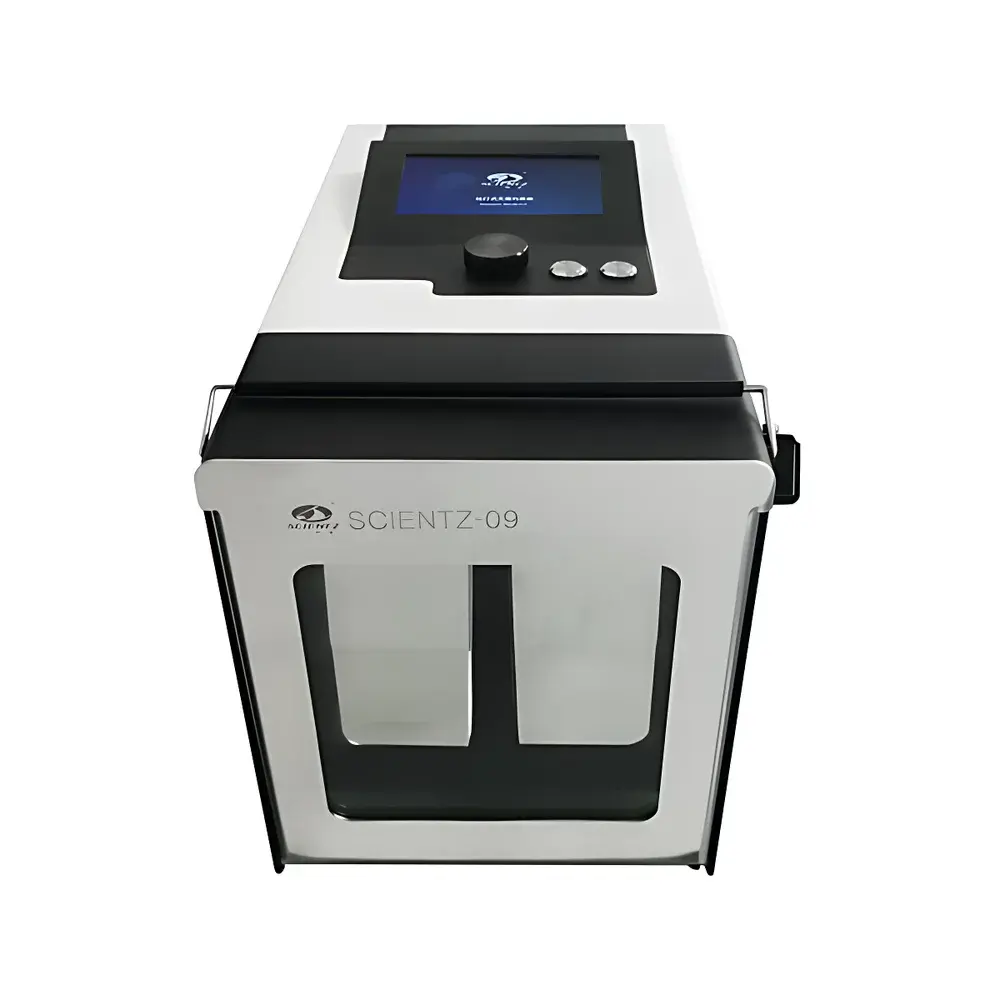
Scientz SCIENTZ-09 Sterile Stomacher Homogenizer
| Brand | Scientz |
|---|---|
| Origin | Zhejiang, China |
| Manufacturer Type | Direct Manufacturer |
| Region Category | Domestic (China) |
| Model | SCIENTZ-09 |
| Instrument Type | Stomacher-Style (Paddle-Beating) Homogenizer |
| Dimensions (W×D×H) | 420 × 245 × 340 mm |
| Sample Volume Range | 3–400 mL |
Overview
The Scientz SCIENTZ-09 Sterile Stomacher Homogenizer is a precision-engineered paddle-beating homogenization system designed for controlled, reproducible microbial recovery from solid and semi-solid biological matrices. Operating on the principle of mechanical shear via reciprocating paddle impact against a sealed sterile sample bag, the SCIENTZ-09 generates consistent hydrodynamic stress without introducing external contamination or thermal degradation—critical for viable microorganism enumeration in regulatory-compliant workflows. Unlike rotor-stator or probe-based homogenizers, the stomacher design isolates the sample within a single-use, gamma-sterilized polyethylene bag, eliminating cross-contamination risk and simplifying cleaning validation. Its architecture supports ISO 6887-1, ASTM D5603, and USP microbiological testing protocols, making it suitable for laboratories operating under GLP, GMP, or ISO/IEC 17025 quality systems.
Key Features
- Stomacher-style dual-paddle beating mechanism with adjustable speed (typically 3–12 cycles/sec, configurable per application protocol)
- Integrated safety interlock: automatic shutdown when chamber door is opened during operation
- Sealed stainless-steel homogenization chamber with smooth, crevice-free interior for rapid decontamination
- Programmable timer (0–10 min, 1-sec resolution) and cycle count control to ensure inter-laboratory reproducibility
- Ergonomic, low-noise design (<65 dB(A)) compliant with ISO 11201 for routine use in shared laboratory environments
- CE-marked electrical safety and EMC compliance (EN 61000-6-2, EN 61000-6-3)
Sample Compatibility & Compliance
The SCIENTZ-09 accommodates a broad spectrum of sample types—including animal tissues (liver, spleen, kidney, brain), food matrices (meat, dairy, produce), environmental swabs, and cosmetic raw materials—within sterile, leak-tested sample bags (standard 80 × 120 mm or custom sizes). Each homogenization cycle delivers uniform mechanical energy distribution across the entire sample volume (3–400 mL), minimizing particle aggregation and preserving microbial viability. The system conforms to ISO 7218:2017 (microbiology of food and animal feeding stuffs), ISO 11133:2014 (culture media preparation), and FDA Bacteriological Analytical Manual (BAM) Chapter 3 requirements for sample preparation prior to plating or membrane filtration. All contact surfaces are autoclavable or compatible with validated disinfectants (e.g., 70% ethanol, 0.5% sodium hypochlorite).
Software & Data Management
While the SCIENTZ-09 operates via intuitive front-panel controls (no embedded OS), its operational parameters—duration, speed setting, and cycle count—are fully documentable for audit trails. Laboratories implementing electronic lab notebooks (ELN) or LIMS can record instrument usage metadata manually or via optional RS-232/USB interface (available on SCIENTZ-09 Pro variants). For regulated environments requiring 21 CFR Part 11 compliance, users may integrate the device into broader workflow management platforms using timestamped log files generated by external data acquisition software. Full traceability is supported through batch-specific run logs, operator ID entry, and instrument serial number documentation.
Applications
- Microbial load determination in food safety testing (Salmonella, Listeria, E. coli O157:H7 enumeration)
- Pathogen isolation from clinical tissue specimens in hospital microbiology and public health labs
- Environmental monitoring of water, soil, and surface swabs per EPA Method 1603
- Preparation of homogenates for PCR-based pathogen detection and MALDI-TOF MS identification
- Standardized sample processing in contract testing laboratories serving FDA, CFIA, and EFSA-regulated markets
FAQ
What sample bag specifications are recommended for optimal performance?
Standard gamma-irradiated polyethylene bags (80 × 120 mm, 3–400 mL capacity, thickness ≥ 0.12 mm) are validated for use. Custom bags must maintain structural integrity under cyclic impact and resist solvent permeation.
Is the SCIENTZ-09 suitable for mycobacterial or spore-containing samples?
Yes—when paired with extended homogenization cycles (e.g., 2–4 min at high-speed setting), it achieves effective disruption of resilient structures while maintaining culture viability for subsequent isolation.
Can the instrument be validated for IQ/OQ/PQ protocols?
Yes. Scientz provides factory calibration certificates and mechanical verification templates aligned with ISO/IEC 17025 Annex A.3; users may perform periodic performance checks using standardized latex bead suspensions or reference tissue homogenates.
Does the device support GLP-compliant electronic signatures?
The base SCIENTZ-09 does not include built-in electronic signature capability, but its operational parameters are fully exportable for integration into validated ELN or LIMS platforms meeting 21 CFR Part 11 requirements.



