
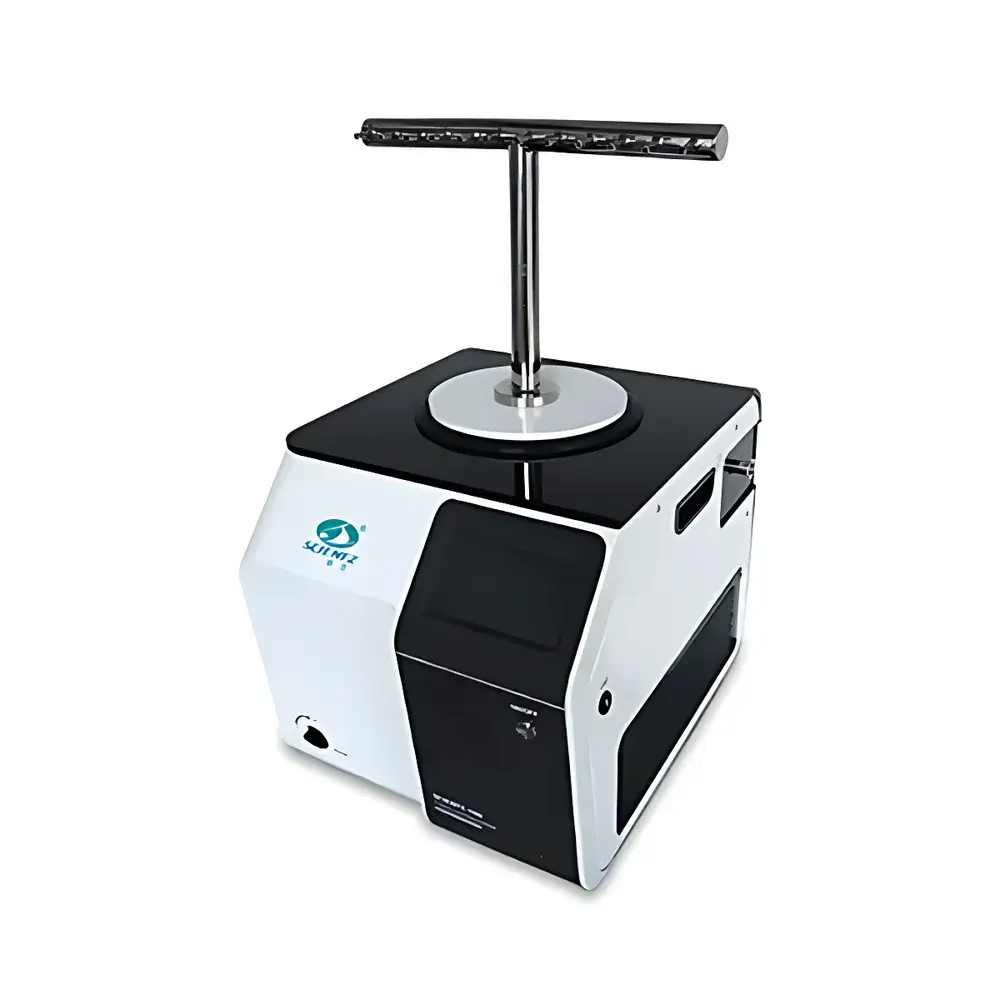
Scientz SCIENTZ-10N/E T-Frame Ampoule Freeze Dryer
| Brand | Scientz |
|---|---|
| Origin | Zhejiang, China |
| Manufacturer Type | Direct Manufacturer |
| Instrument Type | Standard Shelf-Type Freeze Dryer |
| Application Scope | Laboratory Use |
| Lyophilization Area | 0.12 m² |
| Ultimate Vacuum | ≤5 Pa |
| Condensate Capacity (24 h) | 3 kg/batch |
| Cold Trap Temperature | ≤−56 °C (optional −80 °C) |
| Dimensions (L×W×H) | 590 × 460 × 450 mm + 440 mm (height with chamber) |
Overview
The Scientz SCIENTZ-10N/E T-Frame Ampoule Freeze Dryer is a compact, laboratory-scale lyophilization system engineered for precise, reproducible freeze drying of heat-sensitive biological and pharmaceutical samples in ampoules or vials. It operates on the principle of sublimation under controlled vacuum and low-temperature conditions—solid-phase solvent (typically water or organic solvents) transitions directly to vapor without passing through the liquid phase. This process preserves structural integrity, bioactivity, and chemical stability of labile compounds such as proteins, enzymes, vaccines, nucleic acids, microbial cultures, and botanical extracts. Designed for small-batch, multi-sample workflows, the SCIENTZ-10N/E integrates a high-efficiency dual-stage refrigeration circuit, intelligent vacuum management, and real-time process monitoring—making it suitable for R&D, quality control, and preclinical sample preparation in compliance with GLP and early-stage GMP environments.
Key Features
- Compact T-frame architecture with integrated bell-jar chamber—optimized footprint (590 × 460 × 450 mm + 440 mm total height) for space-constrained laboratories.
- Imported high-reliability compressor system delivering cold trap temperatures ≤−56 °C (standard); optional −80 °C configuration available for low-eutectic-point formulations.
- 7-inch true-color capacitive touchscreen interface with industrial-grade embedded OS; supports real-time display of cold trap temperature, chamber pressure, shelf temperature (if equipped), and vacuum status.
- Automated vacuum control logic: vacuum pump activation is gated by cold trap temperature—preventing oil backstreaming and extending pump service life.
- Optically transparent, one-piece polycarbonate drying chamber—chemically resistant, shatter-resistant, and fully sealable; enables full visual monitoring of sublimation progression and ice formation dynamics.
- Integrated inert gas inlet valve (N₂ or Ar compatible) for post-drying purging and oxygen-sensitive sample handling.
- Data logging capability: automatic storage of complete lyophilization profiles (time-stamped temperature/pressure data); exportable via USB to PC for audit-ready documentation.
Sample Compatibility & Compliance
The SCIENTZ-10N/E accommodates standard 10–20 mL ampoules, serum vials, and custom T-frame-mounted sample holders—ideal for low-volume, high-value biologicals including monoclonal antibodies, viral vectors, bacterial spores, and lyophilized reference standards. Its ≤5 Pa ultimate vacuum and ≤−56 °C cold trap meet minimum operational thresholds for primary drying of most aqueous-based formulations per ISO 22055 (lyophilization terminology) and ASTM F2373 (freeze-drying equipment qualification). While not certified for commercial manufacturing, its design aligns with FDA 21 CFR Part 11 data integrity expectations when used with validated SOPs and electronic signature protocols. The system supports co-lyophilization studies, eutectic point mapping (via optional probe), and controlled ramp-rate drying—facilitating DOE-based process development aligned with QbD principles.
Software & Data Management
The embedded control firmware records all critical process parameters at user-configurable intervals (default: 10 s), storing up to 100 complete freeze-drying cycles internally. Historical data can be exported in CSV format via USB flash drive for offline analysis in MATLAB, Python (Pandas), or commercial statistical software. Optional PC-based upper-computer software provides graphical overlay of multiple runs, deviation alerts, and annotated event marking (e.g., “annealing initiated”, “secondary drying started”). Audit trail functionality includes operator ID tagging, timestamped parameter changes, and write-protected log files—supporting traceability requirements under GLP and internal QA frameworks.
Applications
- Academic & Government Research: Lyophilization of plant tissues (agricultural institutes), soil microbiomes (environmental labs), insect specimens (entomology), and cryopreserved cell lines (biomedical centers).
- Pharmaceutical Development: Formulation screening of protein therapeutics, vaccine candidates, and oral disintegrating tablets; preparation of analytical reference materials for HPLC/MS quantification.
- Food & Agricultural Science: Stabilization of probiotics, enzymes, flavor volatiles, and functional food ingredients while retaining sensory and nutritional profiles.
- Diagnostics & Biobanking: Long-term preservation of clinical isolates, serum panels, and RNA/DNA extraction kits without thermal degradation.
- Materials Science: Drying of nanoparticle suspensions, aerogel precursors, and catalytic colloids—minimizing aggregation via pore-structure retention.
FAQ
What is the maximum batch capacity for ampoules on the T-frame?
Standard configuration supports up to 8 ampoules (10–20 mL each) mounted on the T-frame; custom fixtures may accommodate alternative geometries.
Is the system compatible with sterile processing or cleanroom use?
The unit itself is not ISO Class 5 rated, but its polycarbonate chamber and inert gas port enable integration into laminar flow hoods or isolators for aseptic loading.
Can the SCIENTZ-10N/E perform controlled-rate freezing?
No—this model lacks programmable shelf cooling; freezing must be performed externally (e.g., in a −80 °C freezer or controlled-rate freezer) prior to loading.
What vacuum pump options are supported?
Dual-stage oil-lubricated rotary vane pumps (e.g., Edwards RV8, Welch 1402) are recommended; optional oil mist filter and auto differential valve prevent back-contamination.
Does the system support validation documentation (IQ/OQ)?
Scientz provides factory calibration certificates and basic OQ templates; full GMP-compliant validation requires third-party protocol development and execution.



