
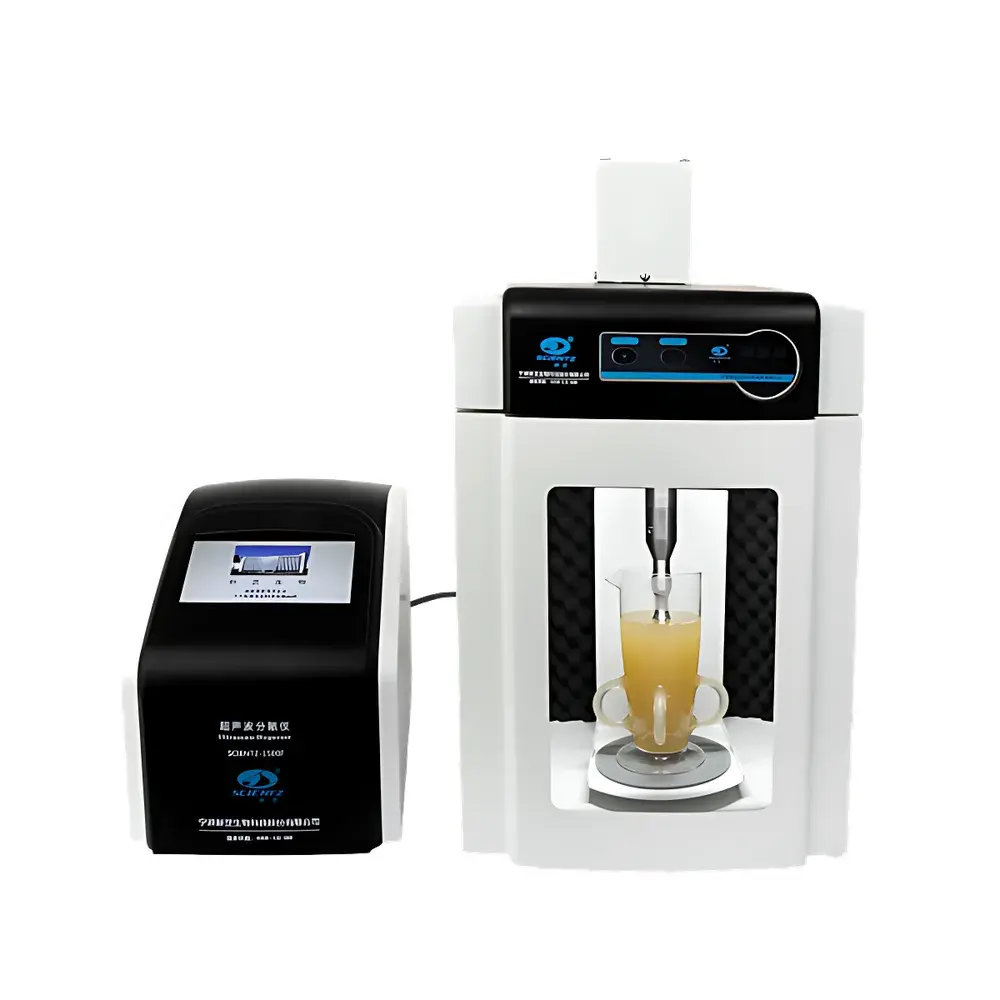
Scientz SCIENTZ-1500F High-Power Ultrasonic Disperser
| Brand | Scientz |
|---|---|
| Origin | Zhejiang, China |
| Manufacturer Type | Direct Manufacturer |
| Instrument Type | Ultrasonic Probe-Type Disperser |
| Dimensions (W×D×H) | 416 × 244 × 300 mm |
| Sample Volume Range | 10–40,000 mL |
| Operating Frequency | 20–25 kHz |
| Power Output | Adjustable, High-Efficiency Amplification Circuitry |
| Probe Material | Titanium Alloy (Grade 5) |
| Cooling | Air-Cooled Generator with Thermal Protection |
Overview
The Scientz SCIENTZ-1500F is a high-power ultrasonic disperser engineered for laboratory-scale liquid-phase dispersion, deagglomeration, and nanomaterial homogenization. It operates on the principle of acoustic cavitation—where high-intensity ultrasonic waves (20–25 kHz) induce rapid formation and violent collapse of microscopic vapor bubbles in liquids, generating localized transient pressures exceeding 1000 atm and temperatures above 5000 K. This hydrodynamic phenomenon imparts intense shear forces, microturbulence, and shockwaves that effectively disrupt particle aggregates, break down emulsions, and stabilize colloidal suspensions. Unlike rotor-stator or high-pressure homogenizers, the SCIENTZ-1500F delivers energy directly into the sample via a titanium alloy probe, enabling precise spatial control over energy delivery and minimizing thermal mass effects—critical for heat-sensitive biologicals and thermolabile nanomaterials.
Key Features
- Adjustable Digital Control Interface: Independent, linearly calibrated controls for ultrasonic power (0–100% full scale) and treatment time (0.1–999.9 s), supporting both continuous and pulsed modes (duty cycle adjustable from 10% to 90%) to manage thermal load and optimize dispersion efficiency.
- Titanium Alloy Sonotrode (Probe): Precision-machined Grade 5 titanium probe with optimized horn geometry—including the proprietary “gourd-shaped” radiating tip—designed to enhance lateral and axial wave propagation for uniform energy distribution across heterogeneous samples.
- Integrated Safety & Monitoring System: Real-time temperature monitoring via external PT100 sensor input; automatic shutdown triggered by over-temperature, over-current, or probe overload conditions; audible and visual alarm indicators compliant with IEC 61010-1 safety standards.
- Robust Generator Architecture: Solid-state RF power amplifier with adaptive impedance matching ensures stable output under variable load conditions (e.g., viscosity shifts during dispersion), maintaining consistent amplitude stability (< ±2% deviation over 30 min).
- Modular Design for Reproducibility: Interchangeable probe diameters (3mm to 25mm) available as optional accessories; standardized threading (M14×1.5) enables traceable calibration and replacement without system recalibration.
Sample Compatibility & Compliance
The SCIENTZ-1500F accommodates aqueous, organic, and mixed-solvent systems across a wide viscosity range (up to 10,000 mPa·s). It supports dispersion of nanoparticles (e.g., graphene oxide, SiO₂, TiO₂, Fe₃O₄), liposomes, protein complexes, microbial cell lysates, and polymeric micelles. The instrument meets CE marking requirements and conforms to ISO/IEC 17025-relevant operational rigor when used with documented SOPs. While not certified for GMP production environments, its programmable parameters, audit-ready operation logs (via optional RS232/USB data export), and configurable alarm thresholds support GLP-aligned workflows in R&D and QC laboratories. It is routinely employed in protocols aligned with ASTM D7855 (nanoparticle dispersion stability testing) and USP (light scattering assessment of lipid emulsions).
Software & Data Management
The SCIENTZ-1500F operates as a standalone instrument with embedded firmware—no proprietary software installation required. All operational parameters are stored in non-volatile memory with timestamped session records. Optional data logging via RS232 or USB interface allows integration with LabArchives, ELN platforms, or custom Python-based acquisition scripts. Exported CSV files include power %, duration, pulse settings, real-time temperature (if sensor connected), and fault event codes—enabling traceability per FDA 21 CFR Part 11 Annex 11 principles when paired with validated user access controls and electronic signature workflows.
Applications
- Preparation of stable nanofluids for thermal conductivity enhancement studies
- Disruption of bacterial biofilms and fungal hyphae for microbiological assay standardization
- Homogenization of vaccine adjuvants (e.g., aluminum hydroxide gels) prior to immunogenicity testing
- Dispersion of carbon nanotubes in polymer matrices for conductive composite development
- Emulsification of waxy excipients (e.g., cetyl alcohol, stearyl alcohol) in topical pharmaceutical formulations
- Deagglomeration of pigment dispersions in inkjet and display coating R&D
- Stabilization of oil-in-water nanoemulsions for nutraceutical delivery systems
FAQ
What is the maximum recommended viscosity for effective dispersion?
For optimal cavitation efficiency, samples should not exceed 10,000 mPa·s at processing temperature. Higher viscosities require reduced probe immersion depth and lower duty cycles to maintain energy transfer efficacy.
Can the SCIENTZ-1500F be used with corrosive solvents such as chloroform or DMF?
Titanium Grade 5 offers excellent resistance to most organic solvents, but prolonged exposure to strong fluorinated or halogenated acids is not recommended. Always verify chemical compatibility using ASTM G128 guidelines before extended use.
Is probe calibration traceable to national standards?
While the instrument does not include built-in NIST-traceable calibration, Scientz provides optional third-party calibration services with uncertainty reporting per ISO/IEC 17025, covering amplitude linearity, frequency accuracy, and power output verification.
How is temperature rise controlled during long-duration sonication?
Use pulsed mode (e.g., 5 s ON / 5 s OFF), immerse the vessel in an ice-water bath, and monitor temperature via the external PT100 port. For critical thermal management, integrate with a recirculating chiller (recommended flow rate: ≥1 L/min).
Does the device support automated protocol sequencing?
No native multi-step sequencing is embedded; however, external programmable logic controllers (PLCs) or LabVIEW-compatible triggers can be interfaced via the digital I/O port for unattended batch processing.



