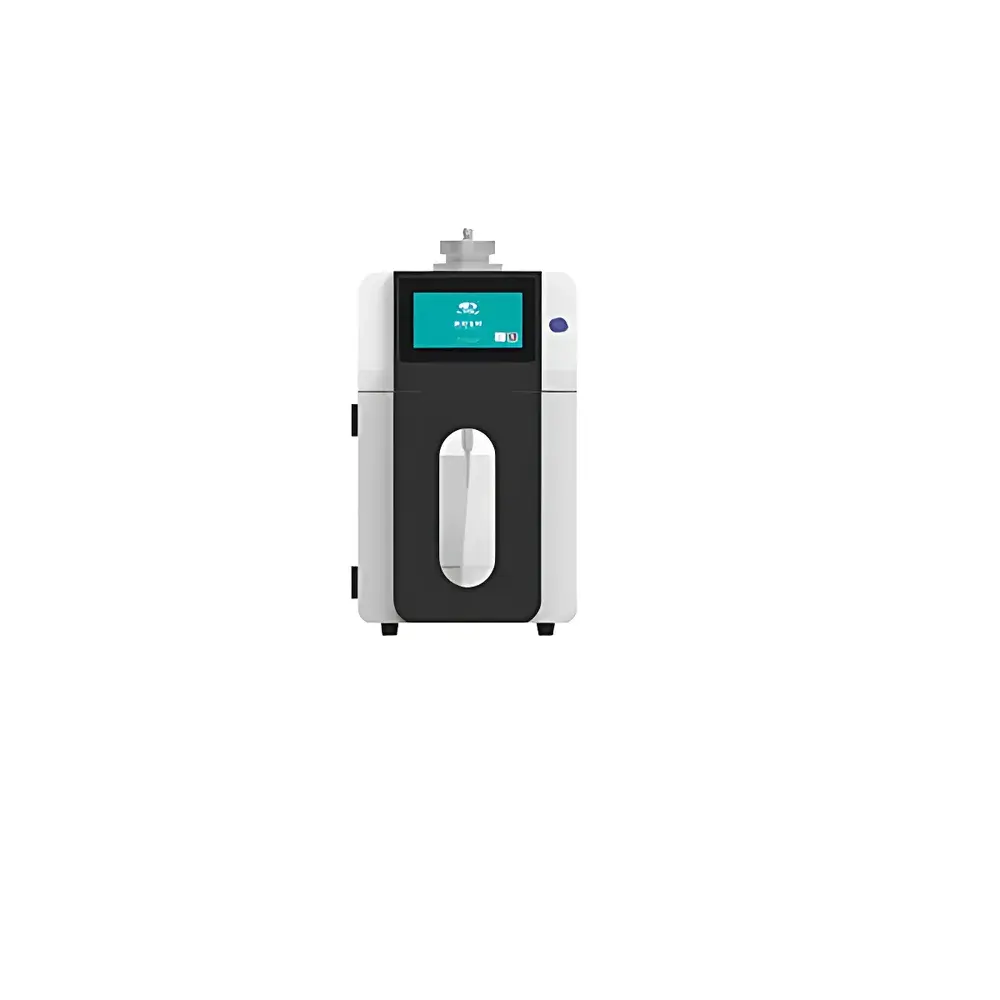
Scientz SCIENTZ-650J Integrated Ultrasonic Cell Disruptor
| Brand | Scientz |
|---|---|
| Origin | Zhejiang, China |
| Manufacturer Type | Authorized Distributor |
| Country of Origin | China |
| Model | SCIENTZ-650J |
| Instrument Type | Ultrasonic Cell Disruptor |
| Temperature Range | 0–99.9°C |
| Operating Frequency | 20–25 kHz |
| Ultrasonic Power Output | 650 W (adjustable from 1% to 100% in 1% increments) |
| Sample Volume Capacity | 100 µL – 250 mL |
| Display | 7-inch capacitive touchscreen |
| Probe Options | Standard 6 mm tapered probe |
| optional probes | 2, 3, 8, 10, and 13 mm diameter |
| Probe Material | TC4 titanium alloy (aerospace-grade α+β titanium alloy) |
| Cooling Mode | External circulating chiller compatible / internal temperature monitoring with auto-shutdown |
| Safety Features | Overload protection, overtemperature cutoff (user-definable threshold), real-time thermal monitoring, timed operation with ±0.1 s resolution |
| Control Modes | Continuous and pulsed ultrasonication (pulse on/off ratio programmable) |
| Enclosure | Acoustically damped steel chassis with integrated sound-absorbing panels |
| Dimensions (W×D×H) | 312 × 334 × 510 mm |
| Weight | Approx. 28 kg |
| Internal Illumination | LED lighting for sample chamber visibility |
| Sanitization | UV-C lamp integrated into lid assembly (optional activation cycle) |
Overview
The Scientz SCIENTZ-650J Integrated Ultrasonic Cell Disruptor is an engineered platform for controlled mechanical lysis of biological cells, subcellular organelles, and microbial cultures via high-intensity focused ultrasound. It operates on the principle of acoustic cavitation—where rapid pressure fluctuations generated by piezoelectric transduction at 20–25 kHz induce transient microbubble formation, growth, and violent collapse within the liquid medium—resulting in localized shear forces sufficient to disrupt membranes and release intracellular components. Designed for reproducible, scalable, and thermally managed lysis, the SCIENTZ-650J integrates transducer actuation, real-time thermal feedback, programmable pulse sequencing, and ergonomic sample handling into a single compact footprint. Its TC4 titanium alloy probe ensures high acoustic transmission efficiency, corrosion resistance, and mechanical durability under repeated high-power duty cycles—critical for GMP-aligned bioprocessing workflows and academic labs requiring long-term operational stability.
Key Features
- Integrated electromechanical architecture: Combines ultrasonic generator, transducer, motorized vertical probe positioning system, and environmental monitoring in one self-contained unit—eliminating external cabling, alignment complexity, and spatial fragmentation common in modular systems.
- Motorized probe elevation: Precision stepper-driven vertical movement (±0.1 mm repeatability) with IR remote control and touchscreen-initiated auto-positioning—enabling consistent immersion depth across variable vessel geometries and minimizing operator-induced variability.
- Acoustic containment system: Multi-layered steel enclosure lined with broadband sound-absorbing composite panels reduces ambient noise to ≤55 dB(A) at 1 m distance—meeting ISO 15710:2020 laboratory noise guidelines for shared research environments.
- Fine-resolution power modulation: Ultrasonic output adjustable from 1% to 100% of 650 W maximum in 1% increments—supporting low-energy applications such as chromatin shearing or exosome isolation without probe erosion or thermal overshoot.
- Programmable pulse logic: User-defined duty cycles (e.g., 5 s ON / 3 s OFF) with independent timing resolution of 0.1 s—essential for heat-sensitive targets including membrane proteins, enzymes, and RNA-binding complexes.
- Real-time thermal management: Built-in Pt100 sensor monitors sample temperature continuously; triggers automatic power reduction or shutdown if user-set limit (0–99.9°C) is exceeded—ensuring compliance with USP analytical instrument qualification protocols for temperature-critical extractions.
Sample Compatibility & Compliance
The SCIENTZ-650J accommodates volumes from 100 µL (microcentrifuge tubes, using 2 mm probe) to 250 mL (wide-mouth beakers or jacketed vessels, using 13 mm probe), supporting standard labware including Eppendorf tubes, glass vials, stainless-steel cryo-vessels, and disposable polypropylene containers. Probe interchangeability enables optimization for viscosity, particulate load, and target integrity—e.g., 3 mm probes for bacterial lysates, 8 mm for mammalian tissue homogenates. The unit conforms to IEC 61010-1:2012 safety standards for laboratory electrical equipment and includes CE marking. Its UV-C sanitization cycle (254 nm, 15-min exposure) supports GLP-compliant cleaning between runs per ISO 14644-1 Class 7 cleanroom practices when used in biosafety cabinets.
Software & Data Management
Operation is fully managed via a 7-inch capacitive touchscreen interface running embedded Linux OS. All parameters—including power %, duration, pulse profile, temperature setpoint, and probe ID—are stored with timestamp and operator ID in non-volatile memory (≥10,000 run logs). Export options include CSV via USB-A port for integration with LIMS or ELN platforms. Audit trail functionality meets FDA 21 CFR Part 11 requirements when paired with network-authenticated user accounts (role-based access control: Admin, Technician, Viewer). No cloud dependency or proprietary software installation is required.
Applications
- Nucleic acid extraction: Shearing genomic DNA to 200–500 bp fragments for NGS library prep (compatible with Illumina TruSeq and NEBNext workflows).
- Protein solubilization: Release of inclusion bodies from E. coli without denaturant addition, preserving native folding for downstream refolding assays.
- Virus purification: Disruption of enveloped viral particles for antigen recovery in vaccine R&D settings.
- Subcellular fractionation: Selective lysis of mitochondria or nuclei using frequency- and amplitude-tuned protocols.
- Nanoparticle dispersion: Homogenization of liposomal formulations and polymeric micelles for pharmaceutical characterization (per USP light scattering standards).
FAQ
What is the maximum continuous operating time before thermal throttling activates?
The system permits up to 30 minutes of uninterrupted sonication at full 650 W only when coupled with an external recirculating chiller (recommended coolant flow ≥2 L/min at 4°C); otherwise, internal thermal regulation initiates power ramp-down after 120 seconds above 45°C.
Is probe calibration traceable to national standards?
Yes—each TC4 probe is supplied with a factory calibration certificate referencing NIST-traceable acoustic power measurement (IEC 61689:2016 compliant), valid for 12 months under normal use conditions.
Can the unit be integrated into automated liquid handling workflows?
It features RS-232 and TTL trigger I/O ports for synchronization with robotic arms or PLC-controlled platforms, enabling unattended batch processing in high-throughput screening environments.
Does the UV-C sanitization cycle affect probe surface integrity?
No—UV-C exposure is confined to the interior cavity and does not irradiate the probe shaft; TC4 titanium exhibits no photodegradation under 254 nm UV, per ASTM G155 accelerated weathering protocols.