
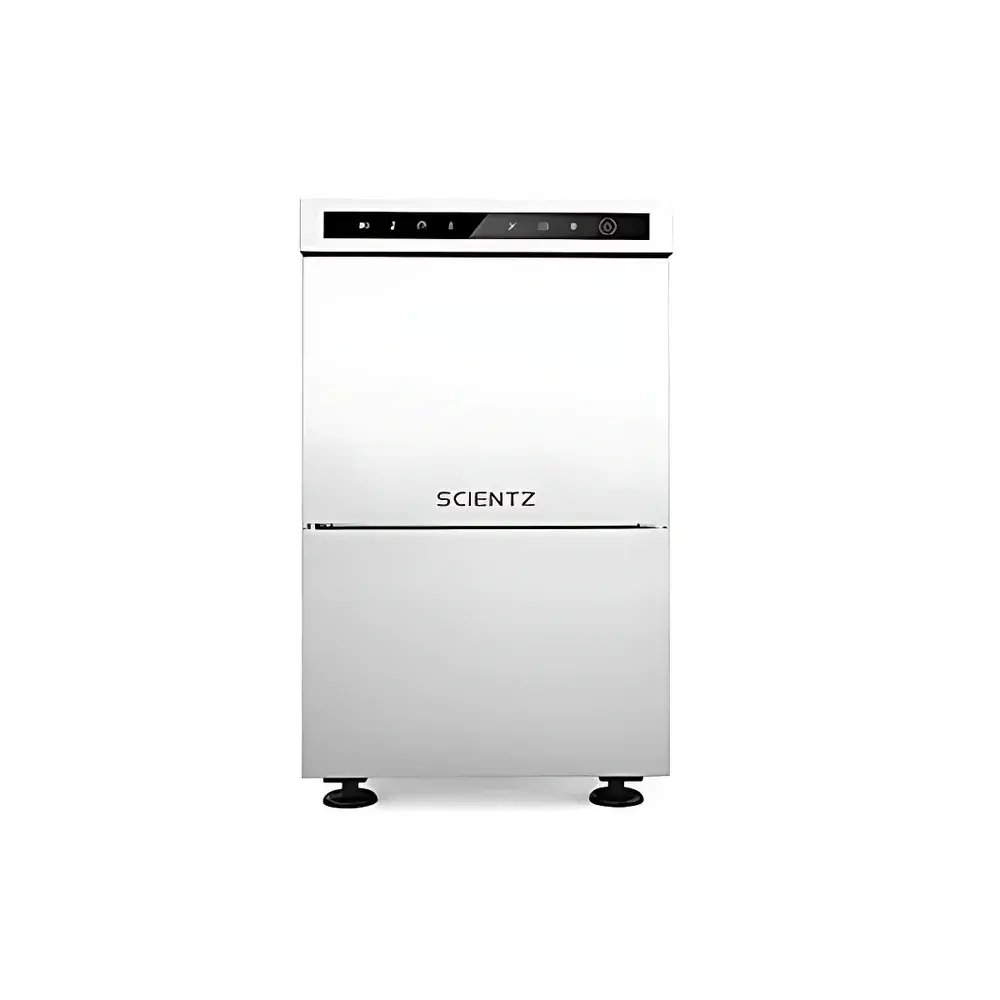
Scientz XB-20II Fully Automatic Flake Ice Machine
| Brand | Scientz |
|---|---|
| Model | XB-20II |
| Ice Production Capacity | 20 kg/24 h |
| Ice Storage Capacity | 10 kg |
| Cooling Method | Air-Cooled |
| Ice Type | Irregular Flake Ice |
| Compressor | High-Efficiency International Brand |
| Control System | Microprocessor-Based Automatic Control |
| Water Filtration | Integrated OEM Water Purifier |
| Drainage | Active Gravity-Assisted Elevated Drainage |
| Origin | Zhejiang, China |
| Manufacturer | Ningbo Scientz Biotechnology Co., Ltd. |
Overview
The Scientz XB-20II Fully Automatic Flake Ice Machine is an engineered solution for laboratories, clinical facilities, and industrial environments requiring consistent, low-moisture flake ice with rapid on-demand availability. It operates on a mechanical rotary extrusion principle: filtered feed water enters a helical evaporator maintained at −18 °C, where rapid phase transition from liquid to solid occurs via direct contact heat exchange. A gear-reduced auger rotates within the evaporator, mechanically shearing and compressing the nascent ice layer into irregular, porous flakes (typically 1–3 mm in nominal dimension) before gravity-assisted discharge into the insulated storage bin. Unlike plate or tube-type ice makers, this design minimizes residual surface moisture (<15% by weight), enhances thermal transfer efficiency during sample cooling or preservation, and eliminates bridging or clumping—critical for applications demanding uniform thermal contact and rapid melt kinetics.
Key Features
- Rapid Ice Generation: First ice output within 5 minutes of startup; continuous production stabilized at 20 kg per 24-hour cycle under standard ambient conditions (25 °C dry bulb, 60% RH).
- Low-Moisture Flake Output: Mechanically extruded ice exhibits high surface-area-to-volume ratio and minimal free water content, optimizing cooling efficiency in biological sample transport, histology specimen preparation, and enzymatic reaction quenching.
- Intelligent Self-Diagnostic Control: Embedded microprocessor monitors compressor current, evaporator temperature, water flow rate, and bin fullness; displays fault codes (e.g., E1: water supply interruption, E3: condenser overheat) on LED interface for traceable maintenance logging.
- Integrated Water Purification: OEM-certified inline water filter removes particulates >5 µm and reduces scale-forming ions (Ca²⁺, Mg²⁺), extending evaporator service life and ensuring compliance with CLSI GP44-A4 guidelines for laboratory-grade water purity in cold chain equipment.
- Elevated Drainage Architecture: Active gravity-assisted drainage system enables installation in locations without floor-level floor drains—supports flexible placement in ISO Class 7 cleanrooms or mobile laboratory trailers.
- Air-Cooled Condensing System: Optimized finned-tube condenser with axial fan ensures stable operation across ambient temperatures up to 35 °C; no external water source required, reducing infrastructure dependency and simplifying validation protocols.
Sample Compatibility & Compliance
The XB-20II produces ice suitable for direct contact with biological specimens, pharmaceutical intermediates, and food-grade materials. Its stainless-steel evaporator, food-grade polymer auger housing, and NSF/ANSI 12 certified internal components meet baseline requirements for GLP-compliant cold chain workflows. While not classified as medical device per FDA 21 CFR Part 820, its operational consistency supports adherence to ISO 13485:2016 Annex A.2 (environmental control) and ASTM F2965–14 (standard specification for laboratory ice machines). The unit is CE-marked for EMC Directive 2014/30/EU and Low Voltage Directive 2014/35/EU.
Software & Data Management
The XB-20II employs embedded firmware (v2.1.3) with non-volatile memory for runtime logging—including cumulative operating hours, total ice mass produced, and frequency of fault events. Data export is available via RS-232 serial interface (ASCII protocol) for integration into LIMS or CMMS platforms. Audit trail functionality records all user-initiated actions (e.g., manual defrost trigger, filter replacement alert acknowledgment), satisfying basic FDA 21 CFR Part 11 “electronic record” criteria when paired with institutional procedural controls.
Applications
- Life Sciences: Cryopreservation support, PCR setup cooling, tissue homogenization pre-chilling, and electrophoresis buffer temperature stabilization.
- Clinical Diagnostics: Specimen transport on ice packs, hematology analyzer coolant replenishment, and microbiology media temperature control during pour plates.
- Food & Beverage QA/QC: Rapid chilling of composite samples prior to microbial enumeration (ISO 7218), sensory evaluation panels, and HACCP-critical temperature hold verification.
- Industrial Process Support: Catalyst cooling in exothermic chemical synthesis, temperature moderation during polymer extrusion trials, and seafood processing line pre-chill staging.
FAQ
What is the typical flake size and density of ice produced by the XB-20II?
Flakes measure 1–3 mm in longest dimension with bulk density of approximately 350–420 kg/m³, enabling efficient packing and rapid thermal equilibration.
Does the unit require periodic descaling?
With integrated water filtration and use of softened or reverse-osmosis feed water, descaling intervals exceed 12 months under continuous operation; cleaning schedule should follow local water hardness testing.
Can the XB-20II be installed in a temperature-controlled room below 10 °C?
Ambient operation is validated between 10–35 °C; sub-10 °C environments may impair refrigerant charge dynamics and require factory-configured low-ambient kit (optional accessory).
Is remote monitoring supported via Ethernet or Wi-Fi?
No native IP connectivity; RS-232 output allows connection to third-party SCADA systems via serial-to-Ethernet converters compliant with Modbus RTU protocol.
What safety certifications does the XB-20II carry?
CE (EMC + LVD), RoHS 2011/65/EU, and CCC mark for domestic Chinese market; UL/cUL listing is not available.



