
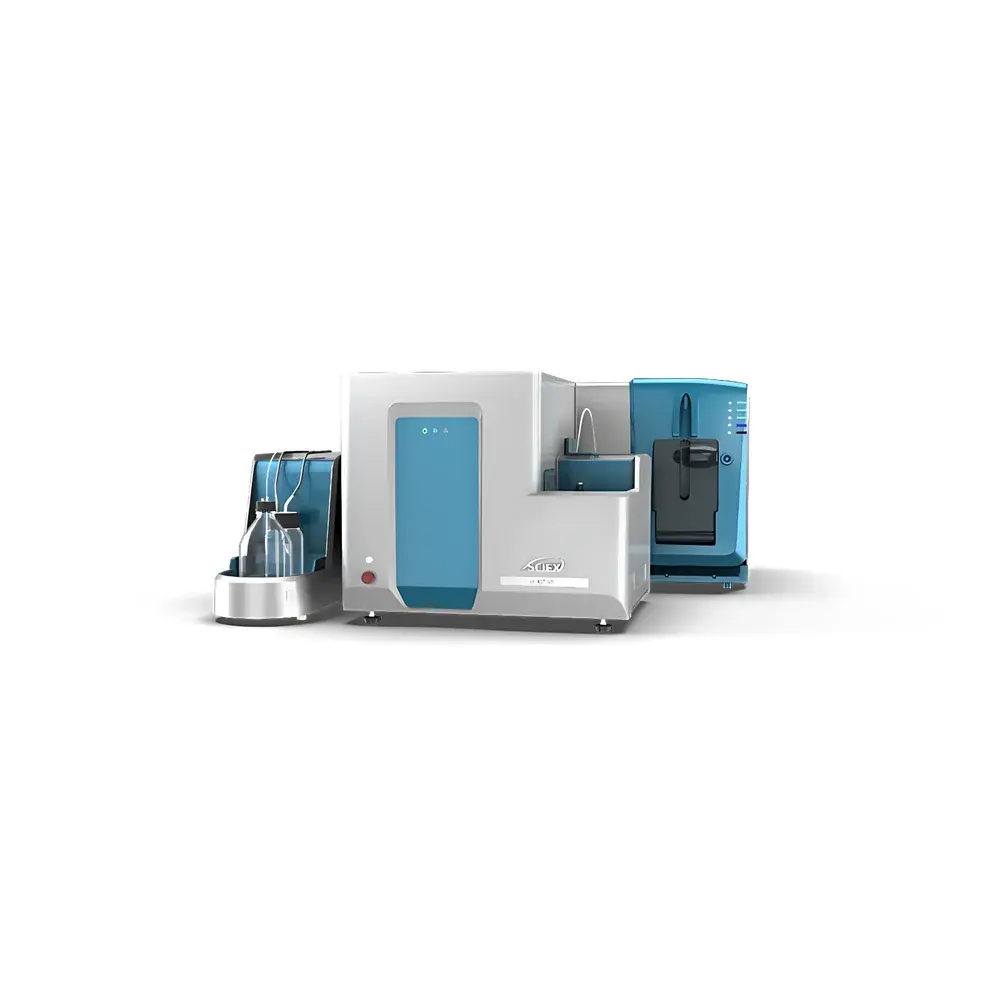
SCIEX Echo™ MS System
| Brand | SCIEX |
|---|---|
| Origin | USA |
| Manufacturer Type | Authorized Distributor |
| Product Category | Imported Instrument |
| Model | Echo™ MS System |
| Pricing | Upon Request |
| Application Scope | General-Purpose High-Throughput Quantitative Analysis |
Overview
The SCIEX Echo™ MS System is a breakthrough acoustic ejection mass spectrometry platform that redefines speed, precision, and robustness in quantitative bioanalysis. Engineered around Acoustic Droplet Ejection (ADE) coupled with Open Port Interface (OPI) and the industry-proven SCIEX Triple Quad™ 6500+ LC-MS/MS detection system, this integrated solution enables label-free, direct analysis of nanoliter-volume samples without chromatographic separation. Unlike conventional LC-MS/MS workflows—where sample injection, chromatographic elution, and ionization occur sequentially—the Echo™ MS operates on a fundamentally different principle: ADE acoustically transfers discrete 2.5 nL droplets from standard microplates directly into an OPI, where they merge with a continuous sheath flow and undergo electrospray ionization (ESI) at atmospheric pressure. This eliminates carryover, reduces matrix effects via inline dilution, and bypasses column-related variability—enabling true second-scale analysis cycles (up to 3 samples per second) while maintaining quantitative accuracy, linearity, and reproducibility across dynamic ranges exceeding 4–5 orders of magnitude.
Key Features
- Acoustic Droplet Ejection (ADE) Module: Contactless, non-contact sample transfer from 384-well and 1536-well plates; no pipette tips, no clogging, no cross-contamination; precise dispensing of 2.5 nL droplets with sub-nanoliter volume fidelity.
- Open Port Interface (OPI): Atmospheric-pressure, zero-dead-volume liquid interface enabling direct infusion of acoustically ejected droplets into ESI; supports real-time dilution (10–100×) of complex biological matrices (e.g., plasma, serum, cell lysates) without offline sample prep.
- OptiFlow™ Turbo V Ion Source: Self-optimizing electrospray source with intelligent probe sensing; automatically adjusts gas flows, voltages, and temperatures based on real-time signal feedback to maximize ionization efficiency across diverse compound classes.
- SCIEX Triple Quad™ 6500+ Mass Spectrometer: Industry-standard QqQ platform delivering high sensitivity, low ng/L to pg/mL lower limits of quantitation (LLOQ), excellent inter-day precision (CV < 15%), and compliance-ready data acquisition under SCIEX OS software.
- Robust Integration Architecture: Designed for seamless interoperability with third-party robotic liquid handlers and plate stackers; supports ASTM E1957-compliant plate handling protocols and GLP/GMP-aligned audit trail generation.
Sample Compatibility & Compliance
The Echo™ MS System is validated for small-molecule quantitation (e.g., drugs, metabolites, toxins) and select large-molecule applications (e.g., peptides, antibody-drug conjugates) in complex biological matrices. It accepts standard ANSI/SLAS-format microplates (384- and 1536-well), compatible exclusively with Beckman Coulter Life Sciences plate carriers per current system configuration. All hardware and software components meet IEC 61010-1 safety standards and electromagnetic compatibility (EMC) requirements per FCC Part 15 and CE directives. Data integrity is maintained through 21 CFR Part 11–compliant user authentication, electronic signatures, and immutable audit trails within SCIEX OS. While not registered as a medical device in China, the system adheres to ISO/IEC 17025 principles for testing laboratories and supports method validation per FDA Bioanalytical Method Validation Guidance and EMA Guideline on Bioanalytical Method Validation.
Software & Data Management
Controlled entirely by SCIEX OS v2.4 or later, the Echo™ MS workflow integrates instrument control, sequence scheduling, real-time monitoring, and quantitative processing in a single environment. The software provides automated calibration verification, peak integration with customizable dwell times, and multi-analyte MRM transitions per cycle. Raw data files (.wiff) are stored with embedded metadata (plate ID, well position, ejection time, source parameters), ensuring full traceability. Export options include CSV, PDF reports, and direct LIMS connectivity via HL7 or ASTM E1957 interfaces. Audit trails record all user actions—including method edits, result overrides, and reprocessing events—with timestamps and operator IDs, satisfying GLP, GCP, and internal QA requirements.
Applications
- High-throughput ADME/PK screening in early drug discovery
- Ultra-rapid clinical trial sample analysis (e.g., therapeutic drug monitoring)
- Metabolomics and lipidomics profiling with minimal sample consumption
- Quality control of biologics and biosimilars using peptide mapping workflows
- Toxicology screening in forensic and regulatory laboratories
- Method development acceleration for LC-MS/MS assays prior to full chromatographic implementation
FAQ
What sample volumes does the Echo™ MS system require per analysis?
Typical analysis uses 2.5 nL droplets ejected from microplate wells; total assay volume per sample is typically 1–5 µL when accounting for OPI sheath flow and dilution factor.
Can the Echo™ MS replace traditional LC-MS/MS for regulated bioanalysis?
It serves as a complementary high-throughput screening tool; final validation and regulatory submission assays generally retain LC separation per FDA/EMA guidance, though Echo™ MS data may support bridging studies and exploratory endpoints.
Is the system compatible with non-Beckman Coulter automation platforms?
Current firmware supports only Beckman Coulter Life Sciences plate carriers; custom integration with other robotics requires SCIEX Professional Services engagement and system qualification.
Does the Echo™ MS support polarity switching during acquisition?
Yes—SCIEX OS enables rapid positive/negative mode switching within a single run, with independent optimization of source parameters for each polarity.
What maintenance intervals are recommended for the ADE transducer and OPI capillary?
ADE transducers are rated for >10 million ejections; OPI capillaries are consumables replaced every 2–4 weeks depending on matrix load and daily throughput—full replacement kits and preventive maintenance schedules are included in the service agreement.




