
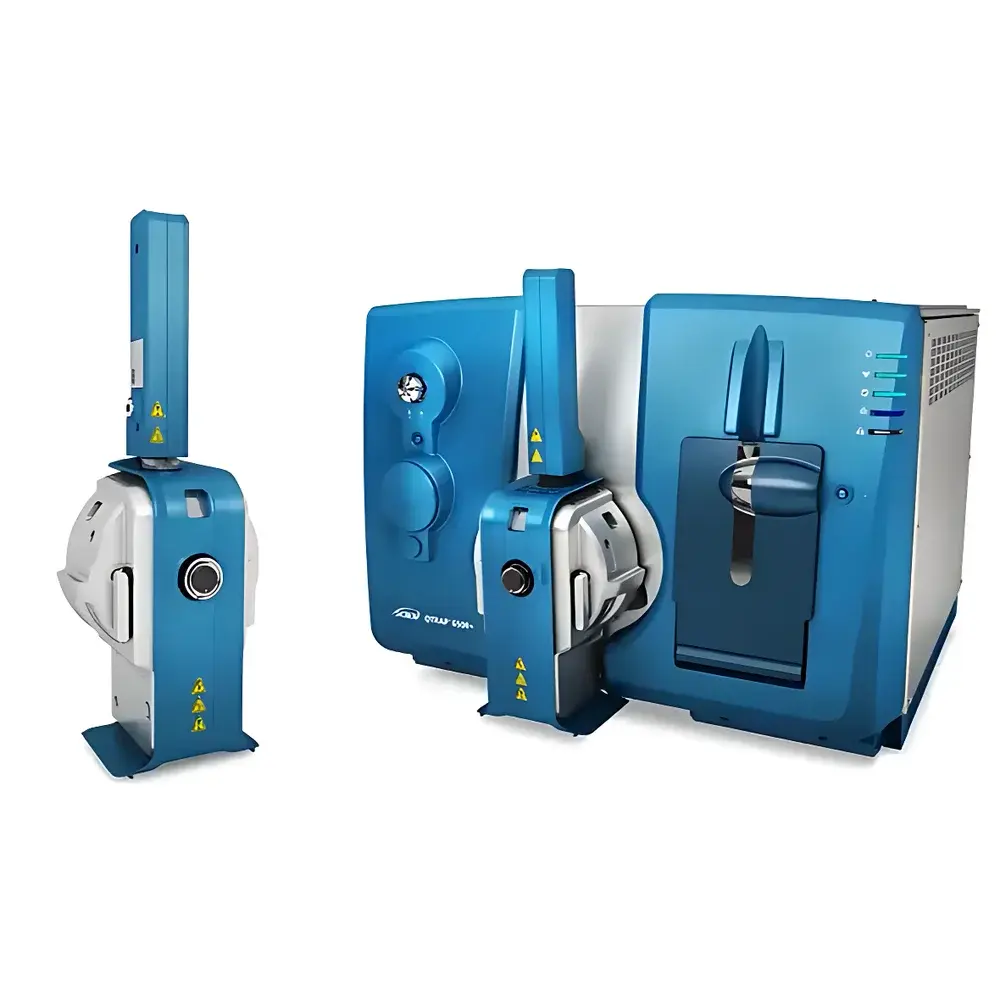
SCIEX M5 Microflow LC with OptiFlow™ Turbo V Source and Triple Quad™/QTRAP® Mass Spectrometer
| Brand | SCIEX |
|---|---|
| Origin | Singapore |
| Instrument Type | Tandem Quadrupole (Triple Quad™) or QTRAP® Mass Spectrometer |
| Flow Rate Range | 1–200 µL/min |
| Ion Source | OptiFlow™ Turbo V with Integrated Column Heater (up to 90 °C) |
| Spray Technology | SteadySpray™ Probe with Smart Probe Recognition |
| LC Platform | M5 Microflow LC featuring Microfluidic Flow Control™ |
| Column Compatibility | Phenomenex MicroFlow™ Columns |
| Software | SCIEX OS with MultiQuant™ MRMPilot™ and MasterView™ |
| Regulatory Compliance | FDA 21 CFR Part 11, GLP/GMP-ready audit trail, ISO/IEC 17025-aligned workflows |
| Sample Introduction | Auto-sampler with vial-bottom sensing and jet-wash pump |
| Hardware Interface | Tool-free, hand-tight standard fittings with audible click confirmation |
| Gradient Delivery | Dual-pump architecture supporting direct injection and trap-elute modes |
Overview
The SCIEX M5 Microflow LC – OptiFlow™ Turbo V Source and Triple Quad™/QTRAP® Mass Spectrometry Platform is an integrated quantitative solution engineered for high-sensitivity, robust, and operationally simplified analysis of small molecules, peptides, monoclonal antibodies (mAbs), and antibody-drug conjugates (ADCs). Built upon the foundational principles of electrospray ionization (ESI) coupled with microflow liquid chromatography, this platform leverages reduced flow rates (1–200 µL/min) to maximize ionization efficiency—achieving up to 50× higher signal-to-noise ratios compared to conventional analytical-scale HPLC-MS systems operating at 200–1000 µL/min. Unlike nanoflow systems, which demand stringent environmental control and specialized expertise, the M5 Microflow LC delivers comparable sensitivity while maintaining method transferability, system stability, and day-to-day operational reproducibility across regulated and discovery laboratories.
Key Features
- Microfluidic Flow Control™ technology ensures precise, pulseless gradient delivery across the full 1–200 µL/min range, enabling retention time stability <0.02 min RSD over 100 injections.
- OptiFlow™ Turbo V source integrates a column heater (0–90 °C) directly into the ion source housing, eliminating post-column dead volume and improving analyte transfer efficiency—critical for thermally labile or low-abundance biomolecules.
- SteadySpray™ probe generates uniform droplet size distribution under variable flow conditions, yielding consistent desolvation and ion yield without manual tuning.
- Smart Probe Recognition automatically configures source parameters—including gas flows, temperatures, and voltages—based on detected probe geometry and flow rate, reducing method setup time and operator dependency.
- M5 Microflow LC features tool-free, hand-tight fittings with tactile click feedback, enabling rapid reconfiguration between microflow columns, traps, and MS interfaces without torque wrenches or adapters.
- Auto-sampler incorporates vial-bottom sensing and jet-wash pump technology to minimize carryover (<0.005%) and maximize data yield from limited-volume biological samples (e.g., dried blood spots, microdialysates).
- Dual-pump architecture supports both direct injection and trap-elute workflows, facilitating high-throughput quantitation in regulated bioanalysis without compromising peak capacity or resolution.
Sample Compatibility & Compliance
The platform is validated for quantitative analysis across diverse biological matrices including plasma, serum, cerebrospinal fluid (CSF), tissue homogenates, and cell lysates. It meets method validation requirements per ICH M10, USP , and FDA Bioanalytical Method Validation Guidance. All instrument control, data acquisition, and processing functions comply with FDA 21 CFR Part 11 through SCIEX OS software, providing electronic signatures, role-based access control, and immutable audit trails. System suitability testing, calibration verification, and performance qualification protocols align with ISO/IEC 17025:2017 for accredited testing laboratories. The integrated hardware-software architecture supports full traceability from sample vial to final report, satisfying GLP and GMP documentation standards for CMC and clinical trial support.
Software & Data Management
SCIEX OS serves as the unified operating environment, integrating instrument control, real-time monitoring, and post-run processing. MultiQuant™ software provides validated workflows for MRM and enhanced MRM³ quantitation, including internal standard normalization, matrix-matched calibration, and outlier detection algorithms compliant with EMA and FDA expectations. MRMPilot™ automates method development by recommending optimal transitions, declustering potentials, and collision energies based on compound structure and retention time. MasterView™ enables cross-platform data review, batch reprocessing, and trend analysis across multiple instruments and studies. Raw data files are stored in vendor-neutral .wiff format, compatible with third-party platforms for independent verification or regulatory submission.
Applications
- Small Molecule Quantitation: Enables sub-pg/mL detection of pharmaceuticals, metabolites, and endogenous compounds in complex biological matrices—ideal for PK/PD studies and therapeutic drug monitoring.
- Peptide Quantitation: Supports targeted proteomics workflows with high specificity for signature peptides in immunoaffinity-enriched samples, achieving CVs <8% across 5-log linear dynamic range.
- mAb and ADC Bioanalysis: Delivers simultaneous quantitation of intact antibody, catabolites, and payload-to-antibody ratio (DAR) using middle-up or hybrid peptide mapping strategies.
- Translational Biomarker Verification: Facilitates multiplexed quantitation of protein panels in longitudinal cohort studies, with demonstrated reproducibility across multi-site clinical trials.
- Regulated Bioanalysis: Fully supports Tier-1 and Tier-2 bioanalytical method validation for IND-enabling studies, with documented IQ/OQ/PQ protocols available from SCIEX Global Services.
FAQ
What flow rate range does the M5 Microflow LC support?
The M5 Microflow LC operates continuously from 1 µL/min to 200 µL/min, covering both low-microflow (1–50 µL/min) and high-microflow (50–200 µL/min) regimes without hardware modification.
Is method transfer from analytical HPLC to microflow LC straightforward?
Yes—retention times scale predictably with flow rate and column dimensions; SCIEX provides method translation calculators and gradient adjustment templates to accelerate migration while preserving selectivity and resolution.
Does the OptiFlow™ Turbo V source require manual optimization for different flow rates?
No—Smart Probe Recognition auto-configures source parameters; only column temperature and mobile phase composition require user-defined input during method setup.
Can the system be used for both quantitative and qualitative analysis?
Yes—the platform supports MRM, MRM³, information-dependent acquisition (IDA), and SWATH® acquisition on QTRAP® configurations, enabling seamless transition from quantitation to structural characterization.
What regulatory documentation is provided for GxP environments?
SCIEX delivers comprehensive validation packages including URS, FRS, DQ/IQ/OQ/PQ protocols, 21 CFR Part 11 compliance reports, and change control templates aligned with Annex 11 and ALCOA+ principles.




