
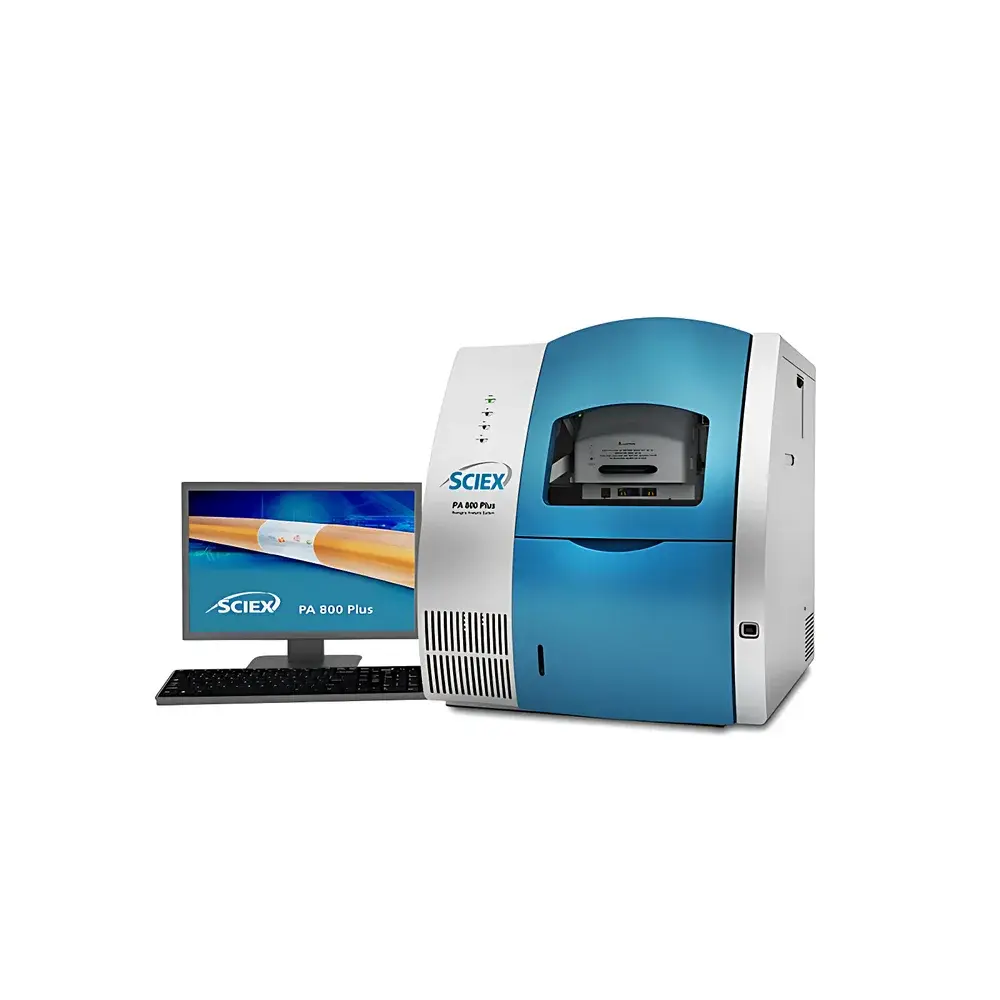
SCIEX PA 800 Plus Capillary Electrophoresis System
| Brand | SCIEX |
|---|---|
| Origin | USA |
| Model | PA 800 Plus |
| Instrument Type | Capillary Electrophoresis (CE) |
| Sample Type | Organic/Biopharmaceutical Analysis |
| Voltage Range | 1–30 kV |
| Detection Modes | UV, Laser-Induced Fluorescence (LIF), Diode Array Detection (DAD) |
| Injection Method | Electrokinetic |
| Pressure Range | –5 to 100 psi |
| Cooling System | Liquid-Cooled Thermostatic Control |
| Operating Principle | Capillary Zone Electrophoresis (CZE), Capillary Isoelectric Focusing (cIEF), Capillary Gel Electrophoresis (CGE), Micellar Electrokinetic Chromatography (MEKC) |
Overview
The SCIEX PA 800 Plus Capillary Electrophoresis System is a fully automated, high-resolution analytical platform engineered for comprehensive characterization of biopharmaceuticals. It operates on the fundamental principles of capillary electrophoresis—including capillary zone electrophoresis (CZE), capillary isoelectric focusing (cIEF), capillary gel electrophoresis (CGE), and micellar electrokinetic chromatography (MEKC)—to resolve complex biomolecules based on charge-to-size ratio, isoelectric point, or molecular weight. Designed specifically for regulated biologics development and quality control laboratories, the PA 800 Plus delivers reproducible, orthogonal separation data critical for assessing protein purity, charge variant distribution, glycosylation profiles, and degradation products. Its integrated high-voltage power supply (1–30 kV), precise liquid-based thermal management system, and multi-modal detection capability (UV, LIF, DAD) enable method robustness across diverse sample matrices—from monoclonal antibodies and antibody-drug conjugates (ADCs) to recombinant proteins and biosimilars.
Key Features
- Fully automated sample handling with programmable electrokinetic and pressure-assisted injection (–5 to +100 psi), minimizing operator variability and supporting unattended overnight runs.
- Liquid-cooled thermostatic control system maintaining capillary temperature stability within ±0.1 °C—essential for migration time reproducibility and resolution consistency in cIEF and CZE applications.
- Modular optical detection architecture supporting simultaneous or sequential UV absorbance (190–400 nm), laser-induced fluorescence (with 488 nm excitation), and diode array detection (190–800 nm) for enhanced sensitivity and spectral confirmation.
- High-voltage power supply with real-time current monitoring and adaptive voltage ramping to prevent Joule heating artifacts and ensure optimal separation efficiency.
- Compliant hardware design aligned with 21 CFR Part 11 requirements, including electronic signatures, audit trails, and user-access controls—facilitating GMP/GLP-compliant operation in QC and regulatory submission environments.
Sample Compatibility & Compliance
The PA 800 Plus accommodates a broad range of biopharmaceutical samples, including intact mAbs, reduced and non-reduced subunits, glycoprotein variants, peptide maps, oligonucleotides, and small-molecule impurities. Its compatibility extends to native, denatured, and chemically modified analytes under both aqueous and organic-aqueous buffer systems. The system meets key international standards for analytical instrumentation validation, including ICH Q5E (comparability), USP (electrophoretic analysis), and ISO/IEC 17025 (testing laboratory competence). All CE methods developed on the PA 800 Plus are routinely qualified per ICH Q2(R2) guidelines for specificity, precision, linearity, accuracy, and robustness.
Software & Data Management
Powered by SCIEX’s official PA 800 Plus Software Suite, the system provides intuitive method development tools, real-time electropherogram visualization, peak integration with customizable baseline algorithms, and automated reporting templates compliant with ALCOA+ data integrity principles. Raw data files are stored in vendor-neutral formats (e.g., .cdf) and support third-party reprocessing via open-source libraries such as CE-MS Toolbox or commercial platforms like Chromeleon CDS. Audit trail functionality records all user actions—including method edits, run executions, and result approvals—with immutable timestamps and operator identification—fully traceable during FDA or EMA inspections.
Applications
- Charge heterogeneity profiling of monoclonal antibodies using cIEF with imaged capillary isoelectric focusing (iCIEF) capabilities.
- Size-based purity assessment of therapeutic proteins via CGE under reducing and non-reducing conditions.
- Quantitative glycan mapping following enzymatic release and labeling (e.g., 2-AB), analyzed by CE-LIF.
- Peptide mapping verification post-enzymatic digestion to confirm primary structure and detect modifications (deamidation, oxidation, glycation).
- Impurity profiling of small-molecule APIs and intermediates using MEKC with chiral selectors or surfactant-modified buffers.
FAQ
What regulatory standards does the PA 800 Plus support for GMP compliance?
The system includes built-in 21 CFR Part 11 compliance features—audit trail, electronic signatures, role-based access control—and supports IQ/OQ/PQ documentation packages aligned with ASTM E2500 and EU Annex 11.
Can the PA 800 Plus be integrated into a laboratory information management system (LIMS)?
Yes—it supports standard data export protocols (CSV, XML, .cdf) and offers optional OPC UA connectivity for bidirectional LIMS integration and automated result transfer.
Is method transfer from older PA 800 systems straightforward?
Method parameters, macro scripts, and calibration files are backward-compatible; SCIEX provides migration utilities and technical support for seamless transition and requalification.
What maintenance intervals are recommended for routine operation?
Capillary replacement every 200–300 runs, buffer reservoir cleaning after each batch, and annual preventive maintenance including high-voltage module calibration and detector wavelength verification.
Does the system support unattended operation for extended method development studies?
Yes—up to 96-sample trays with programmable queue scheduling, automatic capillary conditioning cycles, and failure-recovery logic for interrupted runs.





