
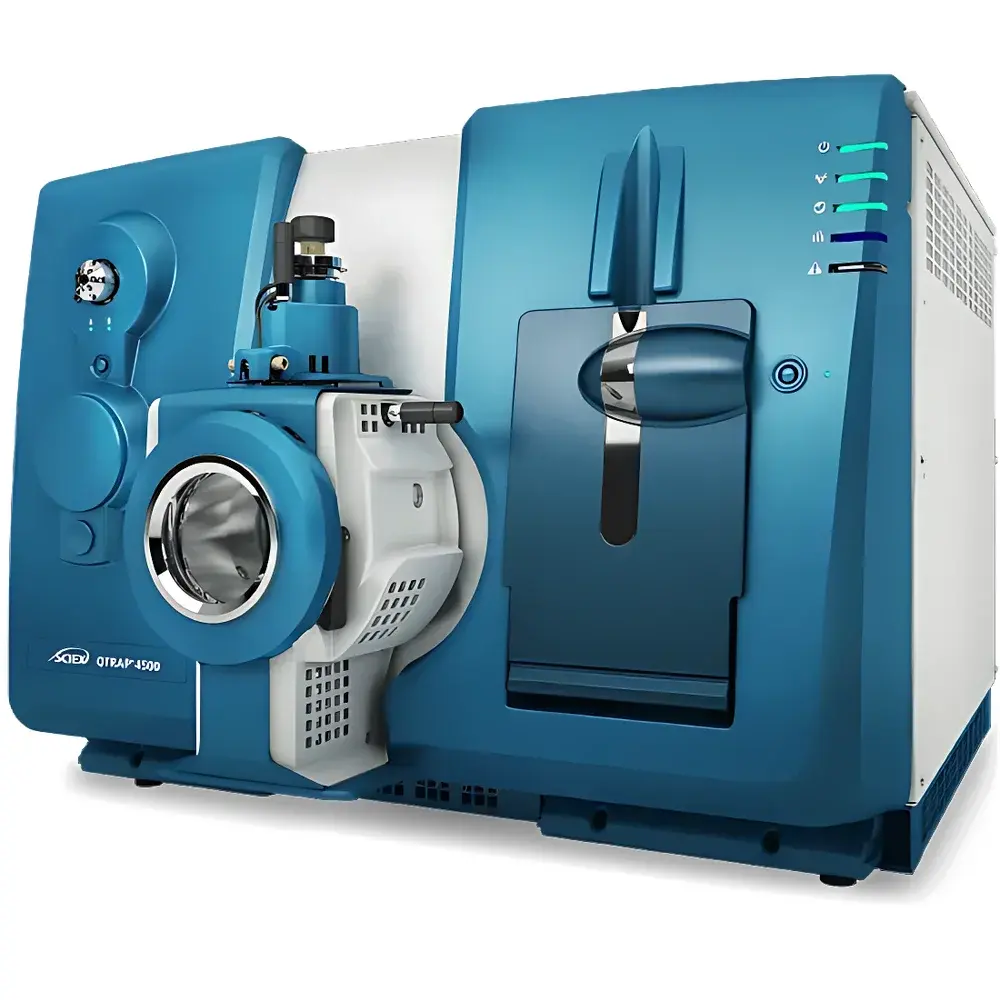
SCIEX QTRAP 4500 System
| Brand | SCIEX |
|---|---|
| Origin | USA |
| Model | QTRAP 4500 System |
| Category | Hybrid Triple Quadrupole / Linear Ion Trap Mass Spectrometer |
| Regulatory Status | Research-Use-Only (RUO), Not FDA-cleared or CE-IVD marked |
| Compliance | Designed for GLP/GMP-compliant laboratories |
Overview
The SCIEX QTRAP® 4500 System is a hybrid mass spectrometer integrating triple quadrupole (QqQ) architecture with a Linear Accelerator™ (LINAC™) linear ion trap (LIT). Engineered for high-sensitivity quantitative analysis and confident qualitative identification in a single platform, it operates on the principle of tandem mass spectrometry (MS/MS) with dual-mode functionality: conventional multiple reaction monitoring (MRM) on the QqQ pathway, and enhanced product ion scanning, information-dependent acquisition (IDA), and MS3 on the LIT pathway. Its core innovation lies in the curved LINAC collision cell—optimized for rapid ion transmission at high pressure—enabling sub-50 ms polarity switching, 20,000 Da/s scan speed, and >100× sensitivity gain in full-scan MS/MS mode compared to standard QqQ operation. This architecture makes it uniquely suited for UHPLC-coupled workflows requiring simultaneous quantitation and structural confirmation across complex biological, environmental, and pharmaceutical matrices.
Key Features
- Hybrid QqQ/LIT Architecture: Combines robust MRM quantitation with LIT-based qualitative capabilities—including enhanced MS/MS, triggered MS3, and high-resolution precursor ion scanning—without hardware reconfiguration.
- Curved LINAC Collision Cell: Minimizes residence time while maximizing collision-induced dissociation (CID) efficiency, enabling true MS/MS spectra suitable for spectral library matching (e.g., NIST, MassBank) and reducing cross-talk in high-throughput multi-analyte assays.
- AcQuRate™ Pulse-Counting Detector: Digitally calibrated detector with pulse-overlap correction, delivering linear dynamic range >5 orders of magnitude and improved precision across low- and high-abundance ions.
- QJet™ Ion Guide Technology: High-pressure RF-only ion funnel that increases ion transmission efficiency by improving collisional focusing and reducing gas load on the turbomolecular pump—enhancing long-term stability during extended LC-MS/MS runs.
- eQ™ High-Speed Electronics: Enables polarity switching in ≤50 ms and real-time duty cycle optimization for co-eluting analytes with disparate ionization efficiencies.
- Robust Source Design: Supports flow rates from 1 µL/min (nanoLC) to 1 mL/min (conventional HPLC), compatible with electrospray (ESI), atmospheric pressure chemical ionization (APCI), and optional APPI sources.
Sample Compatibility & Compliance
The QTRAP 4500 System is validated for use with liquid chromatography interfaces and accommodates diverse sample types—including plasma, urine, tissue homogenates, food extracts, and environmental water samples—provided appropriate sample preparation (e.g., protein precipitation, SPE, QuEChERS) is performed. It meets key regulatory design expectations for analytical instrumentation used in GLP and GMP environments: audit-trail-enabled software (SCIEX OS), electronic signature support, and configurable user access controls. While the instrument itself carries no medical device certification, its hardware and firmware are engineered to align with ISO/IEC 17025:2017 requirements for testing laboratories and support method validation per ICH M10 and USP guidelines. It is explicitly designated as Research Use Only (RUO) and is not intended for clinical diagnostic or therapeutic applications.
Software & Data Management
Controlled via SCIEX OS software, the system supports fully integrated method development, acquisition, processing, and reporting. The software includes built-in tools for MRM optimization (e.g., compound optimization, dwell time balancing), automated peak integration (MultiQuant™), and library-search-enabled identification (MasterView™). All raw data files (.wiff) are stored in a vendor-neutral, metadata-rich format compliant with mzML standards. When deployed in validated IT environments, SCIEX OS supports 21 CFR Part 11 compliance through electronic signatures, audit trails, and role-based permissions—critical for regulated bioanalysis (e.g., PK/PD studies under FDA guidance) and environmental monitoring governed by EPA Method 1694.
Applications
- Pharmacokinetics & Bioanalysis: Quantification of small-molecule drugs and metabolites in biological fluids with sub-pg/mL sensitivity and wide linear dynamic range (e.g., 104–105).
- Clinical Research: Targeted proteomics (e.g., biomarker verification via peptide MRM), vitamin D metabolite profiling, and steroid hormone panels.
- Food Safety & Environmental Monitoring: Multi-residue screening of pesticides, mycotoxins, veterinary drug residues, and PFAS compounds using scheduled MRM with IDA-triggered confirmation.
- Metabolomics & Lipidomics: Untargeted feature detection followed by LIT-based MS3 for structural elucidation of isobaric lipids and phase II metabolites.
- Forensic Toxicology: Simultaneous quantitation and identification of controlled substances and novel psychoactive substances (NPS) in postmortem specimens.
FAQ
What distinguishes the QTRAP 4500 from a standard triple quadrupole system?
It integrates a linear ion trap with triple quadrupole optics, enabling both high-sensitivity MRM quantitation and rich MS/MS spectral acquisition in a single run—eliminating the need for separate instruments or method reconfiguration.
Can the QTRAP 4500 perform quantitative analysis in regulated environments?
Yes—when operated with SCIEX OS in a validated configuration, it supports audit trails, electronic signatures, and data integrity controls required for GLP, GMP, and 21 CFR Part 11 compliance.
Is the system compatible with nanoLC and microflow applications?
Yes—the ion source and QJet interface support flow rates down to 1 µL/min, making it suitable for nanospray and capillary LC configurations.
Does the QTRAP 4500 require special maintenance beyond standard LC-MS/MS protocols?
No—it follows routine maintenance schedules aligned with SCIEX’s Field Service recommendations, including periodic source cleaning, calibration, and collision gas filter replacement—no additional LIT-specific servicing is required.
What software is required to unlock LIT functionality?
SCIEX OS v2.4 or later is mandatory; earlier versions do not support MS3, enhanced MS/MS, or LIT-specific acquisition methods.





