
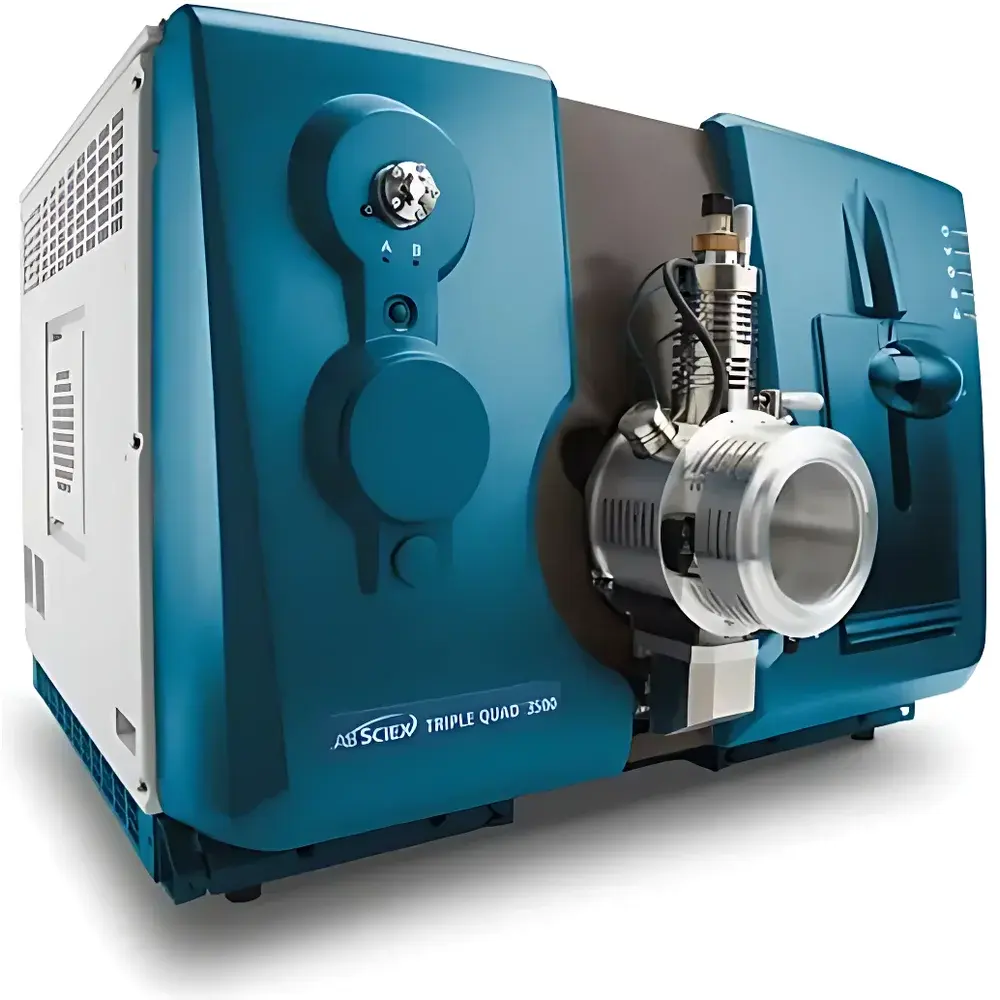
SCIEX Triple Quad™ 3500 Liquid Chromatography Tandem Mass Spectrometer
| Brand | SCIEX |
|---|---|
| Origin | USA |
| Model | Triple Quad™ 3500 |
| Instrument Type | Tandem Quadrupole Mass Spectrometer (QqQ) |
| Mass Range | 5–2000 Da |
| Ion Source | Turbo V™ Electrospray Ionization (ESI)/Atmospheric Pressure Chemical Ionization (APCI) Source |
| Collision Cell | Curved LINAC® Collision Cell |
| Ion Guide | QJet® Ion Guide |
| Front-End Optics | High-Pressure Q0 |
| Detection System | AcQuRate® Pulsed Counting Detector |
| Duty Cycle | Optimized for Fast LC and High-Throughput Quantitation |
| Regulatory Compliance Support | FDA 21 CFR Part 11, GLP/GMP Data Integrity Frameworks |
Overview
The SCIEX Triple Quad™ 3500 is a high-performance, tandem quadrupole liquid chromatography mass spectrometry (LC-MS/MS) system engineered for robust, reproducible quantitative analysis in regulated and high-throughput laboratory environments. Operating on the principle of selected reaction monitoring (SRM) and multiple reaction monitoring (MRM), the system delivers exceptional sensitivity, specificity, and dynamic range for trace-level quantitation across diverse sample matrices. Its core architecture integrates proven ion optics—including the Turbo V™ source with Curtain Gas™ interface—to minimize matrix effects and maintain signal stability during extended acquisition of complex biological, environmental, or pharmaceutical samples. The curved LINAC® collision cell enables efficient fragmentation and ion transmission, while the high-pressure Q0 and QJet® ion guide collectively enhance duty cycle efficiency—particularly critical when interfaced with ultra-high-performance liquid chromatography (UHPLC) methods running sub-2-minute gradients.
Key Features
- Turbo V™ Source with Curtain Gas™ Technology: Provides consistent desolvation and ion transmission across wide polarity ranges and challenging matrices, reducing source contamination and extending maintenance intervals.
- Curved LINAC® Collision Cell: Delivers improved ion focusing and transmission efficiency during collision-induced dissociation (CID), resulting in higher MRM sensitivity and lower limits of quantitation (LLOQ).
- QJet® Ion Guide and High-Pressure Q0: Enables effective ion capture and transfer from atmospheric pressure to the high-vacuum region, supporting fast LC cycles without compromising signal fidelity.
- AcQuRate® Pulsed Counting Detector: Offers linear dynamic range exceeding five orders of magnitude with high reproducibility and accuracy across repeated injections—even under high-duty-cycle conditions.
- eQ™ Electronics Platform: Integrates real-time signal processing and rapid polarity switching (<15 ms), facilitating comprehensive multi-analyte quantitation in a single run.
- Compact Footprint & Modular Design: Optimized for space-constrained laboratories while maintaining full service accessibility and component-level replaceability per ISO/IEC 17025-compliant maintenance protocols.
Sample Compatibility & Compliance
The Triple Quad™ 3500 supports broad-spectrum analyte coverage—from small molecules (e.g., drugs, metabolites, pesticides) to moderately polar peptides—within a mass range of 5–2000 Da. It is routinely deployed in bioanalytical method validation per FDA Guidance for Industry (Bioanalytical Method Validation, May 2018), EMA CHMP guidelines, and ICH M10. The system’s hardware and software architecture are designed to support audit-ready workflows compliant with 21 CFR Part 11, including electronic signatures, secure user access controls, and immutable audit trails for all acquisition, processing, and reporting events. Full traceability aligns with GLP and GMP requirements for contract research organizations (CROs) and pharmaceutical quality control laboratories.
Software & Data Management
Controlled via SCIEX OS software, the Triple Quad™ 3500 provides intuitive method setup, automated calibration, and intelligent peak integration algorithms optimized for MRM data. The software supports batch processing, customizable report templates, and seamless export to LIMS or enterprise data systems via ASTM E1384-compliant interfaces. Built-in data integrity safeguards include time-stamped raw file generation, version-controlled method storage, and role-based permissions. For laboratories subject to regulatory inspection, optional Sciex Cloud Connect enables remote instrument monitoring and secure, encrypted data backup aligned with ISO 27001 information security standards.
Applications
- Pharmaceutical bioanalysis: PK/PD studies, therapeutic drug monitoring (TDM), and impurity profiling in plasma, urine, and tissue homogenates.
- Clinical toxicology: Multi-panel screening for opioids, stimulants, benzodiazepines, and novel psychoactive substances (NPS) with sub-ng/mL sensitivity.
- Food safety testing: Quantitative residue analysis of veterinary drugs, mycotoxins, and pesticide metabolites in milk, meat, and produce extracts.
- Environmental monitoring: Detection of endocrine-disrupting compounds (EDCs), PFAS, and pharmaceutical residues in wastewater and surface water at ng/L levels.
- Metabolomics and biomarker verification: Targeted quantitation of central carbon metabolism intermediates and lipid mediators in cell culture and bioreactor samples.
FAQ
What ionization modes does the Triple Quad™ 3500 support?
Electrospray Ionization (ESI) and Atmospheric Pressure Chemical Ionization (APCI), both operated in positive and negative polarity modes with automatic polarity switching capability.
Is the system compatible with UHPLC separation systems?
Yes—the high-speed eQ™ electronics and low-dead-volume ion path enable full utilization of UHPLC gradients down to 30 seconds per run without sacrificing MRM dwell time or sensitivity.
How is data integrity ensured during routine operation?
Through native 21 CFR Part 11 compliance features in SCIEX OS software, including electronic signatures, audit trail logging, and secure user authentication with configurable permission levels.
Can the system be integrated into a centralized laboratory informatics infrastructure?
Yes—via standard ODBC, ASTM E1384, and HL7 interfaces, supporting direct ingestion into LIMS, ELN, and enterprise analytics platforms.
What maintenance intervals are recommended for routine operation?
Source cleaning every 2–4 weeks depending on sample load; vacuum pump oil replacement every 6 months; annual performance verification per manufacturer-recommended PQ protocol.






