
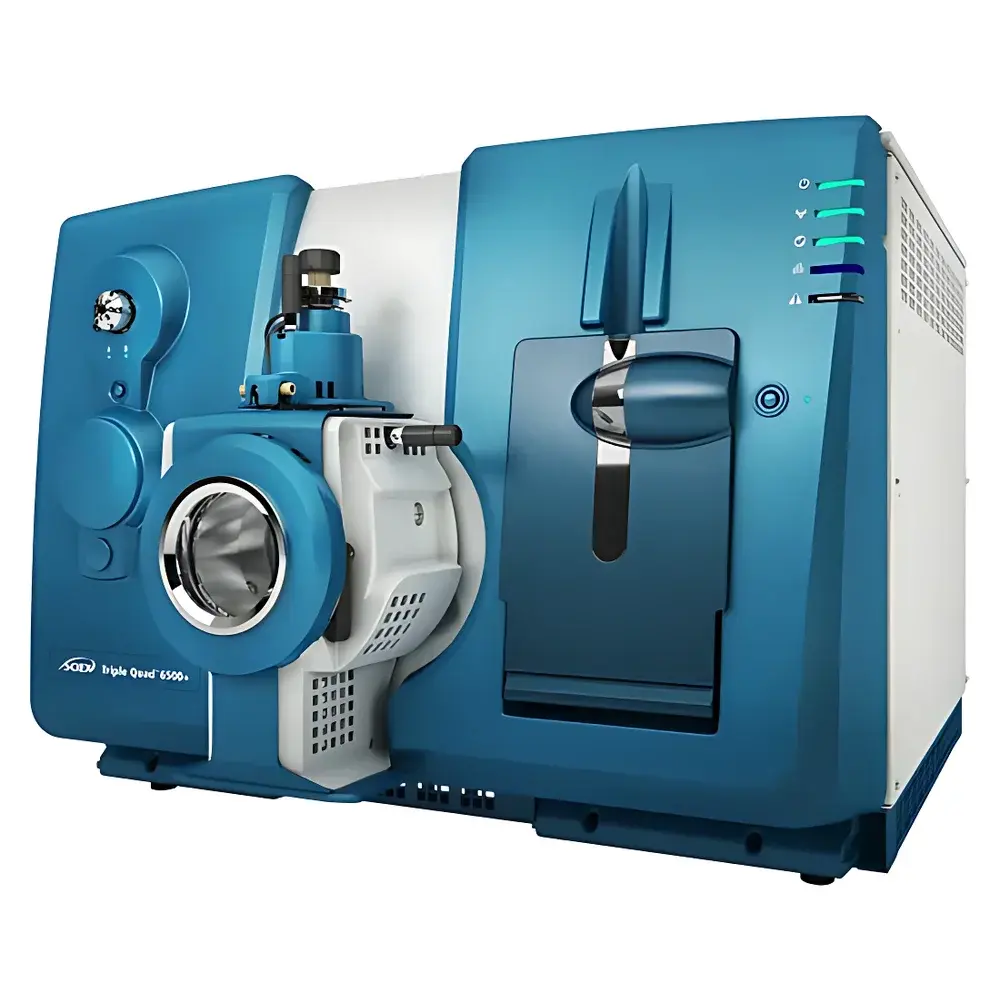
SCIEX Triple Quad™ 6500+ System
| Brand | SCIEX |
|---|---|
| Origin | USA |
| Model | 6500+ System |
| Application Field | Universal |
| Mass Range (m/z) | Up to 2000 |
| MRM Scan Speed | Up to 12,000 Da/s |
| Polarity Switching Time | 5 ms |
| Linear Dynamic Range | 6 orders of magnitude |
| Ion Source | IonDrive™ Turbo V |
| Optional Technology | SelexION™+ Differential Mobility Spectrometry |
| Detection Mode | Triple Quadrupole + Linear Ion Trap (QTRAP®) |
Overview
The SCIEX Triple Quad™ 6500+ System is a high-performance liquid chromatography–tandem mass spectrometry (LC-MS/MS) platform engineered for demanding quantitative and qualitative analysis across diverse sample matrices. Built upon a robust triple quadrupole architecture enhanced with QTRAP® technology, it integrates the precision and selectivity of multiple reaction monitoring (MRM) with the structural elucidation capability of linear ion trap scanning. Its core measurement principle relies on electrospray ionization (ESI) or atmospheric pressure chemical ionization (APCI), followed by mass-selective filtering in Q1, collision-induced dissociation (CID) in a curved LINAC™ collision cell, and product ion detection in Q3—enabling both targeted quantitation and untargeted screening within a single acquisition. The system is purpose-built for regulatory-compliant workflows in clinical research, environmental monitoring, food safety, and pharmaceutical development, where reproducibility, trace-level sensitivity, and data integrity are non-negotiable.
Key Features
- IonDrive™ Turbo V source delivering exceptional ion transmission stability across instruments and over time, validated for inter-laboratory method transfer and long-term operational consistency.
- LINAC™ collision cell design enabling true CID with high-efficiency fragmentation and generation of structurally informative MS/MS spectra compatible with spectral library searching.
- MRM scan speed up to 12,000 Da/s—optimized for ultra-high-performance liquid chromatography (UHPLC) gradients with narrow peak widths, ensuring ≥12 data points per chromatographic peak.
- 5-ms polarity switching enables simultaneous positive- and negative-mode analysis without compromising cycle time or quantitative accuracy.
- SelexION™+ differential mobility spectrometry option adds an orthogonal separation dimension prior to mass analysis, enhancing selectivity in complex biological or environmental extracts.
- QTRAP® functionality provides linear ion trap full-scan sensitivity >100× higher than conventional triple quadrupole full-scan mode, supporting retrospective data mining and suspect screening.
- MRM3 capability—available via automated method setup plugins—introduces a third stage of mass selection to eliminate co-eluting isobaric interferences, extending quantitative confidence in highly matrix-suppressed applications.
Sample Compatibility & Compliance
The 6500+ System accommodates a broad range of analytes—from small-molecule pharmaceuticals (2000 Da)—across diverse biological fluids (plasma, urine, tissue homogenates), environmental water/soil extracts, food digests, and forensic toxicology specimens. Its hardware and software architecture support compliance with international regulatory frameworks including FDA 21 CFR Part 11 (electronic records/signatures), ISO/IEC 17025 (testing laboratory competence), and ICH M10 (bioanalytical method validation). Audit trails, user access controls, and electronic signature enforcement are embedded in SCIEX OS software to meet GLP and GMP documentation requirements.
Software & Data Management
SCIEX OS software provides a unified interface for instrument control, method development, data acquisition, and quantitative processing. It includes integrated tools for automated MRM transition optimization, retention time alignment, and calibration curve fitting with weighted linear regression. Raw data files are stored in vendor-neutral .wiff format and support export to open standards (e.g., mzML) for third-party processing. The software supports secure data archiving, version-controlled method libraries, and configurable reporting templates aligned with LIMS integration protocols. All processing steps—including peak integration, background subtraction, and normalization—are fully traceable and auditable.
Applications
- Quantitative bioanalysis of drugs and metabolites in regulated preclinical and clinical studies.
- Multi-residue pesticide and veterinary drug screening in food commodities per EU SANTE/2023/2022 guidelines.
- Endogenous biomarker verification in plasma and CSF using stable isotope-labeled internal standards.
- Comprehensive environmental contaminant profiling—including PFAS, pharmaceutical residues, and flame retardants—in wastewater and sediment samples.
- Rapid forensic toxicology workflows combining MRM quantitation with QTRAP®-enabled MS/MS spectral confirmation for novel psychoactive substances.
- High-throughput residue testing in agricultural products under USDA-FSIS and FDA Food Safety Modernization Act (FSMA) mandates.
FAQ
What distinguishes the 6500+ from earlier Triple Quad systems?
The 6500+ introduces IonDrive™ high-efficiency ion optics, LINAC™ collision cell geometry, and enhanced detector electronics—collectively improving MRM sensitivity by up to 10× and expanding linear dynamic range to six orders of magnitude.
Is QTRAP® functionality standard or optional?
QTRAP® operation is inherent to the 6500+ hardware architecture; no additional hardware is required to access linear ion trap scanning modes such as Enhanced Product Ion (EPI), Information-Dependent Acquisition (IDA), or MRM3.
Can the system be configured for regulated GLP/GMP environments?
Yes—SCIEX OS software includes full 21 CFR Part 11 compliance features, including role-based permissions, electronic signatures, and immutable audit trails for all instrument and data processing events.
Does the 6500+ support hyphenated techniques beyond LC-MS?
While optimized for UHPLC coupling, the system is compatible with capillary electrophoresis (CE-MS) and supercritical fluid chromatography (SFC-MS) interfaces when paired with appropriate front-end modules.
How is method transfer supported between laboratories?
IonDrive™ source reproducibility, standardized calibration protocols, and portable .method files enable consistent performance across instruments—even across global sites—reducing re-validation burden.






