
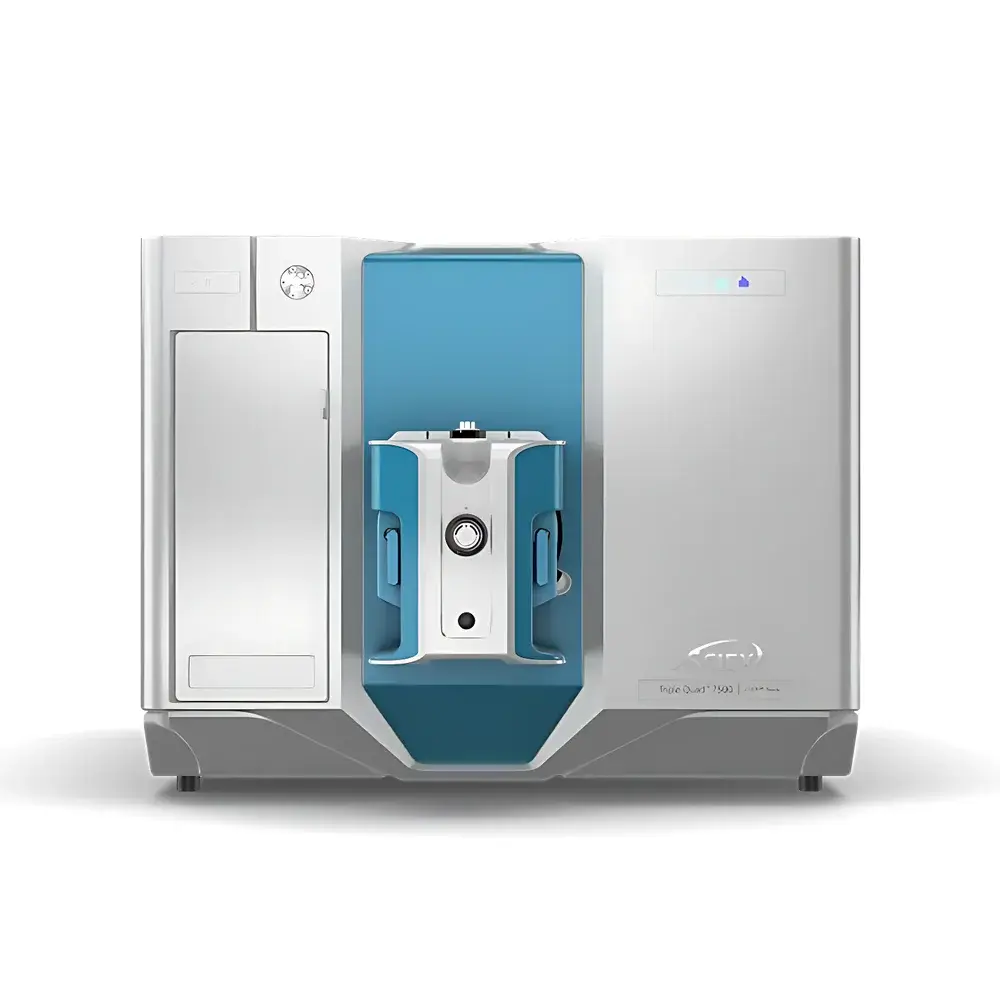
SCIEX Triple Quad 7500 LC-MS/MS System – QTRAP® Ready
| Brand | SCIEX |
|---|---|
| Origin | USA |
| Model | SCIEX Triple Quad 7500 LC-MS/MS System |
| Instrument Type | Tandem Quadrupole (Triple Quadrupole) Mass Spectrometer |
| Configuration | LC-MS/MS with QTRAP® Ready Architecture |
| Application Scope | Universal Quantitative and Qualitative Analysis in Life Sciences, Clinical Research, Environmental, Food Safety, and Forensic Laboratories |
| Regulatory Compliance | Designed for GLP/GMP-compliant environments |
Overview
The SCIEX Triple Quad 7500 LC-MS/MS System – QTRAP® Ready is a high-performance, tandem quadrupole mass spectrometer engineered for ultra-sensitive, robust, and reproducible quantitative analysis in complex matrices. Built upon a fundamentally re-engineered ion optics architecture—including the OptiFlow™ Pro ion source, E Lens™ transmission optics, and D Jet™ ion guide—the system delivers industry-leading sensitivity across an exceptionally broad flow-rate range (1 µL/min to 3 mL/min), without mechanical repositioning of spray components. Its core measurement principle relies on electrospray ionization (ESI) or atmospheric pressure chemical ionization (APCI) coupled with triple quadrupole mass filtering (Q1 → q2 → Q3) for selected reaction monitoring (MRM), while retaining full compatibility with linear ion trap (LIT) functionality via QTRAP® Ready hardware and firmware. This dual-mode capability enables seamless transition between high-precision MRM quantitation and information-rich qualitative scanning—such as enhanced product ion (EPI), MRM³, enhanced resolution (ER), and high-sensitivity full-scan acquisition—all within a single chromatographic run.
Key Features
- OptiFlow™ Pro Ion Source: Enables stable electrospray performance across microflow, nanoflow, and conventional HPLC flow rates (1 µL/min to 3 mL/min) without hardware adjustment.
- E Lens™ Technology: Improves ion transmission efficiency by optimizing electric field gradients in the interface region, delivering up to 10× higher sensitivity compared to legacy ESI-only configurations at low flow rates.
- D Jet™ Ion Guide: A pressurized RF-only multipole that increases ion capture efficiency while maintaining robustness against contamination and matrix-induced signal suppression.
- QTRAP® Ready Architecture: Factory-integrated hardware and firmware enabling immediate activation of hybrid triple quadrupole–linear ion trap capabilities—including EPI, MRM³, ER, and full-scan LIT modes—without hardware modification.
- High-Energy Detector System: Supports polarity switching in ≤5 ms and delivers a linear dynamic range exceeding six orders of magnitude (10⁶) for accurate quantitation over wide concentration spans.
- SCIEX OS Software Platform: Unified data acquisition, processing, and reporting environment with workflow-driven method templates, customizable dashboards, and built-in 21 CFR Part 11 compliance tools (e.g., user access controls, audit trail logging, electronic signatures).
Sample Compatibility & Compliance
The SCIEX Triple Quad 7500 system accommodates diverse sample types—including plasma, serum, urine, tissue homogenates, environmental water extracts, food digests, and forensic biological specimens—across regulated and non-regulated laboratory settings. It meets design requirements for Good Laboratory Practice (GLP) and current Good Manufacturing Practice (cGMP) environments. The SCIEX OS software supports full 21 CFR Part 11 compliance, including role-based user authentication, immutable audit trails, and electronic signature validation. While not registered as a medical device in China, the system conforms to international quality standards referenced in ISO/IEC 17025, ASTM D7622 (for environmental analysis), USP (validation of compendial procedures), and ICH M10 (bioanalytical method validation guidelines). Routine calibration and performance verification follow SCIEX-recommended protocols aligned with global regulatory expectations.
Software & Data Management
SCIEX OS serves as the central software platform for instrument control, real-time data acquisition, automated peak integration, calibration curve generation, and report export. Its modular architecture allows lab managers to deploy standardized workflows for bioanalysis (e.g., PK/PD studies), residue testing, or metabolite identification without scripting. All raw data files (.wiff) are stored in a vendor-neutral, metadata-rich format supporting long-term archival and third-party reprocessing. Audit trail records capture every user action—including method edits, result overrides, and report approvals—with timestamps, operator IDs, and contextual change logs. Integration with LIMS systems is supported via standard APIs and HL7-compliant interfaces. Analyst™ software compatibility is retained for legacy method migration, but SCIEX OS introduces advanced features such as intelligent background subtraction, automated interference detection, and AI-assisted spectral deconvolution for co-eluting analytes.
Applications
The SCIEX Triple Quad 7500 system is deployed in academic research laboratories for targeted metabolomics and proteomics, pharmaceutical QC/QA labs for impurity profiling and stability-indicating assays, clinical research centers for biomarker validation and therapeutic drug monitoring, environmental agencies for trace-level pesticide and PFAS quantification, and food safety programs for mycotoxin and veterinary drug residue screening. Its QTRAP® Ready functionality uniquely supports hybrid workflows—for example, simultaneous MRM quantitation of 50+ analytes alongside EPI scans for structural confirmation, or MRM³ acquisition to resolve isobaric interferences in highly complex samples such as dried blood spots or wastewater influent. Method development time is reduced through predictive dwell-time optimization and auto-tuning routines embedded in SCIEX OS.
FAQ
What distinguishes the Triple Quad 7500 from previous-generation triple quadrupoles?
It integrates three major hardware innovations—OptiFlow™ Pro, E Lens™, and D Jet™—that collectively improve ion transmission efficiency, reduce signal variability, and extend operational uptime between maintenance cycles.
Can the system perform both quantitative and qualitative analysis in one run?
Yes. QTRAP® Ready enables concurrent MRM quantitation and qualitative scans (e.g., EPI, MRM³, full-scan LIT) without sacrificing sensitivity or cycle time.
Is the SCIEX OS software compatible with existing Analyst™ methods?
Yes. SCIEX OS includes backward-compatible import tools for Analyst™ v1.6.2 and later, allowing gradual migration without method redevelopment.
Does the system support 21 CFR Part 11 compliance out-of-the-box?
Yes. With proper configuration—including validated installation, user access management, and enabled audit trail settings—SCIEX OS satisfies core technical requirements for electronic records and signatures.
What maintenance intervals are recommended for routine operation?
Source cleaning is advised every 2–4 weeks depending on sample cleanliness; quadrupole and detector calibration is performed daily or per shift using internal calibrants; annual preventive maintenance by certified SCIEX Field Service Engineers is recommended for optimal long-term performance.





