
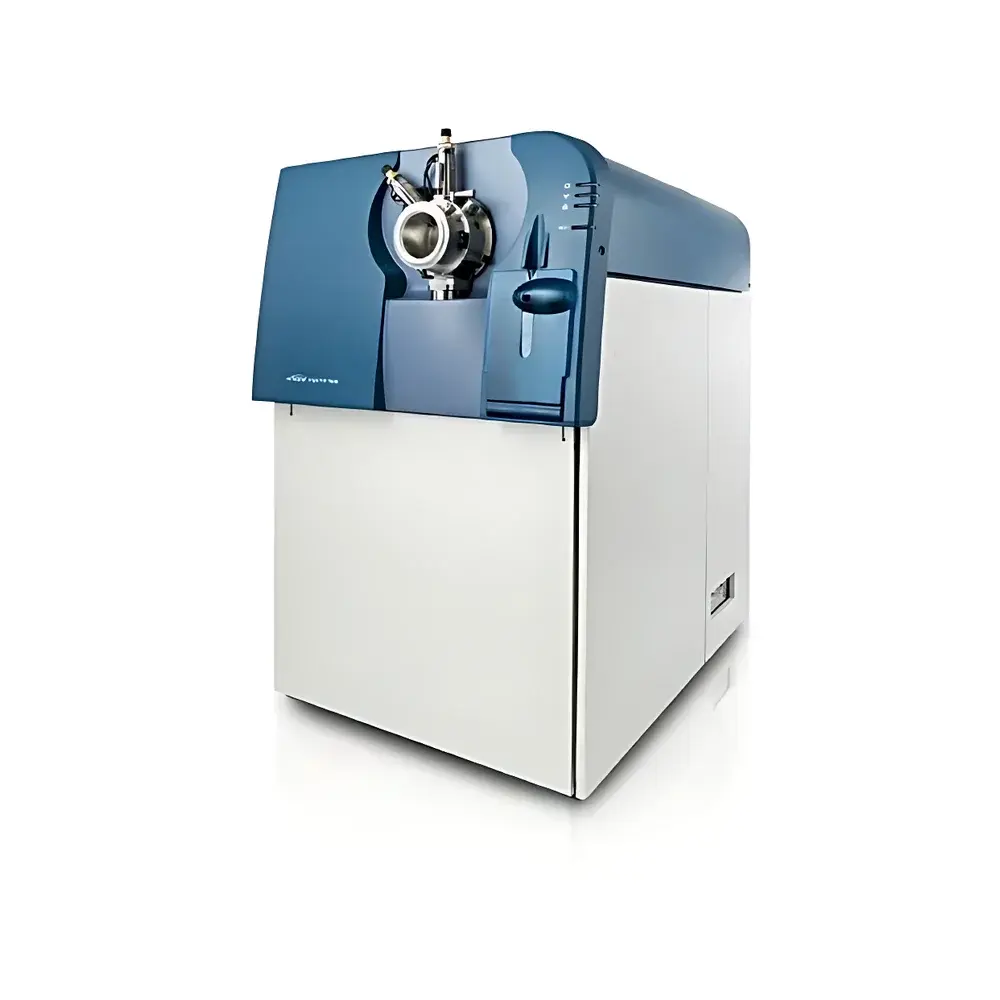
SCIEX TripleTOF® 5600+ High-Resolution Hybrid Q-TOF Mass Spectrometry System
| Brand | SCIEX |
|---|---|
| Origin | USA |
| Model | TripleTOF® 5600+ |
| Mass Analyzer Type | Time-of-Flight (TOF) with Quadrupole Precursor Selection |
| Ion Source | Turbo V™ Electrospray Ionization (ESI) / Atmospheric Pressure Chemical Ionization (APCI) |
| Additional Separation Technology | SelexION® Differential Ion Mobility Spectrometry (DIMS) |
| Data Acquisition Mode | SWATH® Acquisition (Data-Independent Acquisition, DIA) |
| Regulatory Compliance | Designed for 21 CFR Part 11–compliant environments |
| Application Focus | Quantitative and Qualitative LC-MS/MS in Drug Discovery, Proteomics, Metabolomics, and Impurity Profiling |
Overview
The SCIEX TripleTOF® 5600+ is a high-resolution hybrid quadrupole time-of-flight (Q-TOF) mass spectrometer engineered for simultaneous qualitative identification and quantitative analysis in complex biological and pharmaceutical matrices. It integrates a high-transmission triple quadrupole front-end architecture—optimized for precursor ion selection and collision-induced dissociation (CID)—with an orthogonal accelerated TOF mass analyzer capable of delivering high mass accuracy ( 35,000 FWHM at m/z 400), and fast spectral acquisition rates (up to 100 Hz). Unlike conventional data-dependent acquisition (DDA) platforms, the TripleTOF 5600+ supports comprehensive, reproducible data-independent acquisition (DIA) via SWATH® Acquisition, enabling consistent detection and quantification of thousands of analytes across multiple samples without pre-defined inclusion lists. Its design reflects a convergence of robust ion optics, stable high-voltage acceleration, and digital signal processing to ensure long-term mass calibration stability and inter-laboratory transferability.
Key Features
- Hybrid Q-TOF architecture combining quadrupole precursor filtering with high-resolution, high-sensitivity TOF detection
- SelexION® differential ion mobility spectrometry module for added gas-phase separation, enhancing selectivity in co-eluting isobaric species and reducing chemical noise
- Turbo V™ dual-mode ion source supporting ESI and APCI with heated nebulizer gas, optimized desolvation, and self-cleaning geometry to minimize carryover and extend operational uptime
- SWATH® Acquisition with variable Q1 isolation windows (user-definable from 1–25 Da), enabling deep, reproducible coverage of complex proteomic or metabolomic samples without method bias
- Real-time, full-scan MS/MS capability with no duty cycle penalty—every precursor ion fragmented and recorded within each cycle
- Integrated calibration delivery system for automatic, lock-mass–based recalibration during acquisition to maintain sub-ppm mass accuracy over extended runs
Sample Compatibility & Compliance
The TripleTOF 5600+ interfaces seamlessly with ultra-high-performance liquid chromatography (UHPLC), nanoLC, capillary electrophoresis (CE), and CESI systems, supporting flow rates from 1 nL/min to 2 mL/min. It accommodates diverse sample types—including plasma, tissue homogenates, cell lysates, synthetic peptides, small-molecule APIs, and environmental extracts—without hardware modification. The system meets key regulatory requirements for GLP and GMP laboratories: audit trail functionality, electronic signatures, user access controls, and secure data archiving are fully supported through SCIEX OS software. Instrument qualification documentation aligns with ASTM E2500, ISO/IEC 17025, and FDA guidance on computerized system validation. All raw data files are stored in open-format .wiff format, ensuring long-term readability and third-party software compatibility.
Software & Data Management
SCIEX OS serves as the unified control and processing platform, offering intuitive method setup, real-time monitoring, and integrated post-acquisition workflows for peptide identification (via ProteinPilot™), small-molecule annotation (via MasterView™), and quantitative profiling (via PeakView™ and MarkerView™). SWATH® microApp enables automated library generation, spectral alignment, peak integration, and statistical comparison across hundreds of samples. All processing steps are scriptable and support batch reprocessing under version-controlled conditions. Raw data integrity is preserved via SHA-256 hashing; metadata—including instrument parameters, calibration logs, and user actions—is embedded directly into each .wiff file to satisfy 21 CFR Part 11 audit requirements.
Applications
The TripleTOF 5600+ is widely deployed in discovery-phase drug development for metabolite identification, reaction monitoring, and impurity characterization. In quantitative bioanalysis, it delivers LOQs comparable to triple quadrupole systems (e.g., 1000 high-quality MS/MS spectra per second enables deep, label-free quantitation across > 10,000 proteins in single-run analyses. It is also used in food safety (mycotoxin screening), environmental analysis (PFAS profiling), and clinical research (biomarker verification), where untargeted discovery and targeted quantification must coexist on one platform.
FAQ
What distinguishes SWATH® Acquisition from traditional DDA?
SWATH® is a data-independent method that systematically fragments all precursors within sequential, user-defined m/z windows—ensuring consistent detection across samples and eliminating stochastic sampling bias inherent in DDA.
Can the TripleTOF 5600+ be used in regulated bioanalytical labs?
Yes—when configured with SCIEX OS and appropriate procedural controls, it supports full 21 CFR Part 11 compliance, including electronic signatures, audit trails, and role-based access management.
Is SelexION® required for routine operation?
No—SelexION® is an optional add-on module; the base TripleTOF 5600+ operates as a high-performance Q-TOF without it, though DIMS significantly improves selectivity for challenging isomeric or isobaric analytes.
How does mass accuracy stability compare between runs?
With internal calibration and ambient temperature control, mass measurement error remains below ±2 ppm RMS over 48-hour continuous acquisition when using standard lock-mass correction protocols.
What LC flow rates are supported without source modification?
The Turbo V™ source supports analytical (200–2000 µL/min), micro (1–50 µL/min), and nano-flow (50–500 nL/min) regimes natively, with no hardware swaps required between modes.






