
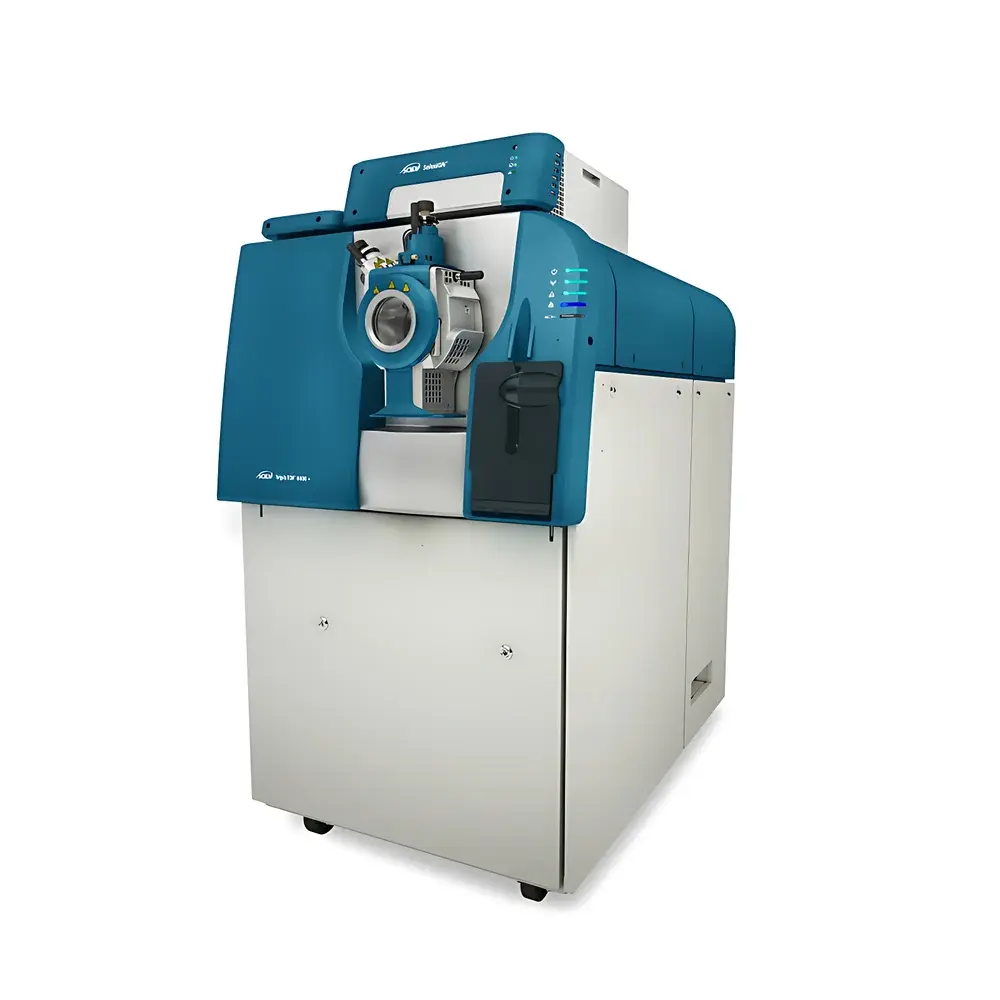
SCIEX TripleTOF™ 6600+ System
| Brand | SCIEX |
|---|---|
| Origin | USA |
| Model | TripleTOF™ 6600+ System |
| Category | Hybrid Quadrupole-Time-of-Flight Mass Spectrometer (Q-TOF MS) |
| Configuration | LC-MS/MS Platform for High-Resolution Accurate-Mass (HRAM) Analysis |
| Intended Use | Discovery and Quantitative Proteomics, Metabolomics, Lipidomics, and Small-Molecule Applications |
Overview
The SCIEX TripleTOF™ 6600+ System is a high-performance hybrid quadrupole–time-of-flight mass spectrometer engineered for comprehensive, data-independent acquisition (DIA) in liquid chromatography–mass spectrometry (LC-MS) workflows. It integrates a robust RF-only quadrupole front-end with a high-resolution, high-sensitivity TOF analyzer capable of >60,000 full-width-at-half-maximum (FWHM) resolution at m/z 400 and sub-ppm mass accuracy (external calibration). The system operates on orthogonal acceleration TOF principles, delivering simultaneous high-speed spectral acquisition (>100 Hz transient rate), accurate mass measurement, and MS/MS capability without sacrificing sensitivity or dynamic range. Designed specifically for large-scale, label-free quantitative analysis, the TripleTOF 6600+ serves as a core platform for discovery-phase biomarker research, systems biology, and translational omics—where reproducible, retrospective data interrogation is essential.
Key Features
- SteadySpray™ Ion Source Technology: Optimized for low-flow (nano- to micro-L/min) electrospray ionization, enabling enhanced signal stability, reduced carryover, and improved resistance to matrix-induced suppression and source contamination.
- Redesigned TOF Ion Optics: Includes segmented entrance lens assembly with independent voltage control for ion transmission tuning, differential pumping stages, and optimized reflectron geometry—resulting in extended uptime and consistent mass resolution across extended acquisition periods.
- TargetTIC™ Ion Current Management: Dynamically regulates total ion current entering the TOF region during complex sample analysis, minimizing detector saturation and reducing adduct formation and in-source fragmentation—critical for maintaining quantitative linearity in biological matrices.
- Scanning SWATH® Acquisition Mode: A proprietary DIA implementation that segments the precursor mass range into variable-width, overlapping windows (e.g., 25 Da wide, 1 Da overlap) and acquires high-resolution MS/MS spectra across all windows in each cycle. Unlike conventional fixed-window SWATH®, Scanning SWATH® adapts window width based on local spectral density, maximizing fragment ion coverage per cycle while preserving duty cycle efficiency.
- High-Fidelity Data Storage Architecture: All acquired MS and MS/MS spectra are stored in vendor-neutral .wiff2 format with embedded metadata, supporting long-term archival, reprocessing, and cross-platform compatibility with open-source tools (e.g., OpenSWATH, DIA-NN, Skyline).
Sample Compatibility & Compliance
The TripleTOF 6600+ supports diverse sample types—including peptides, intact proteins, polar and non-polar metabolites, lipids, xenobiotics, and synthetic small molecules—across biological fluids (plasma, serum, CSF), tissue homogenates, cell lysates, and environmental extracts. Its hardware and software architecture comply with analytical data integrity requirements under FDA 21 CFR Part 11 (when deployed with appropriate audit trail and electronic signature configurations), ISO/IEC 17025:2017 (for testing laboratories), and GLP/GMP-aligned workflow validation frameworks. Method development, instrument qualification, and routine operation adhere to ASTM E2983 (standard guide for proteomic data reporting) and USP (analytical instrument qualification).
Software & Data Management
Control and data processing are managed via SCIEX OS software (v2.4 or later), which provides integrated method setup, real-time monitoring, automated calibration, and post-acquisition library-free quantification. Key modules include PeakView® for targeted quantitation, MarkerView™ for multivariate statistical analysis, and MasterView™ for project-level metadata curation. Raw data files support export to mzML and direct import into third-party DIA processing pipelines. Audit trail functionality records all user actions—including parameter edits, recalibrations, and reprocessing events—with timestamps and operator IDs. Data retention policies align with institutional biospecimen data management standards (e.g., NIH Genomic Data Sharing Policy) and support FAIR (Findable, Accessible, Interoperable, Reusable) data principles.
Applications
- Discovery Proteomics: Deep, reproducible profiling of >10,000 peptides per run in human plasma or tissue, with identification confidence anchored by high-resolution MS/MS spectra and retention time alignment across batches.
- Label-Free Quantitative Metabolomics: Simultaneous relative quantification of hundreds of endogenous metabolites across multi-cohort studies, leveraging accurate mass filtering and isotopic pattern recognition.
- Biomarker Verification & Prioritization: Retrospective extraction of candidate markers from archived SWATH® datasets without re-injection—enabling hypothesis-driven validation using the same original run.
- Post-Translational Modification (PTM) Mapping: Detection and site-localization of phosphorylation, acetylation, and ubiquitination events via diagnostic fragment ions and neutral loss-triggered scanning.
- Pharmaceutical ADME Studies: Structural characterization of drug metabolites in preclinical matrices, supported by in silico fragmentation prediction (MetabolitePilot™ integration) and accurate mass error thresholds < 3 ppm.
FAQ
What distinguishes Scanning SWATH® from conventional SWATH® acquisition?
Scanning SWATH® dynamically adjusts isolation window widths based on precursor ion density across the m/z range, improving fragment ion sampling depth and reducing undersampling in crowded regions—without increasing cycle time.
Can the TripleTOF 6600+ perform targeted quantitation comparable to triple quadrupole systems?
While not a replacement for scheduled MRM on QqQ platforms, its high-resolution MS/MS spectra enable library-free, peptide-centric quantitation with precision approaching ±15% CV in replicate analyses when combined with stable isotope-labeled standards.
Is the system compatible with nanoLC and microLC configurations?
Yes—it is routinely coupled with nano-electrospray sources (e.g., NanoSpray III, Chip-Based Nanospray) and supports flow rates from 50 nL/min to 1 mL/min via configurable source interfaces and pressure-regulated nebulizer gas delivery.
Does SCIEX provide instrument qualification documentation?
Yes—comprehensive IQ/OQ/PQ protocols, performance verification reports (e.g., resolution, mass accuracy, sensitivity), and compliance-ready templates are included with system installation and covered under SCIEX’s global service agreements.
How is data integrity ensured during long-duration DIA acquisitions?
Real-time internal calibration (using lock mass or dual-source reference ions), automatic gain control (AGC) optimization per cycle, and continuous vacuum monitoring ensure spectral fidelity over 72+ hour unattended runs.
Related Products






