
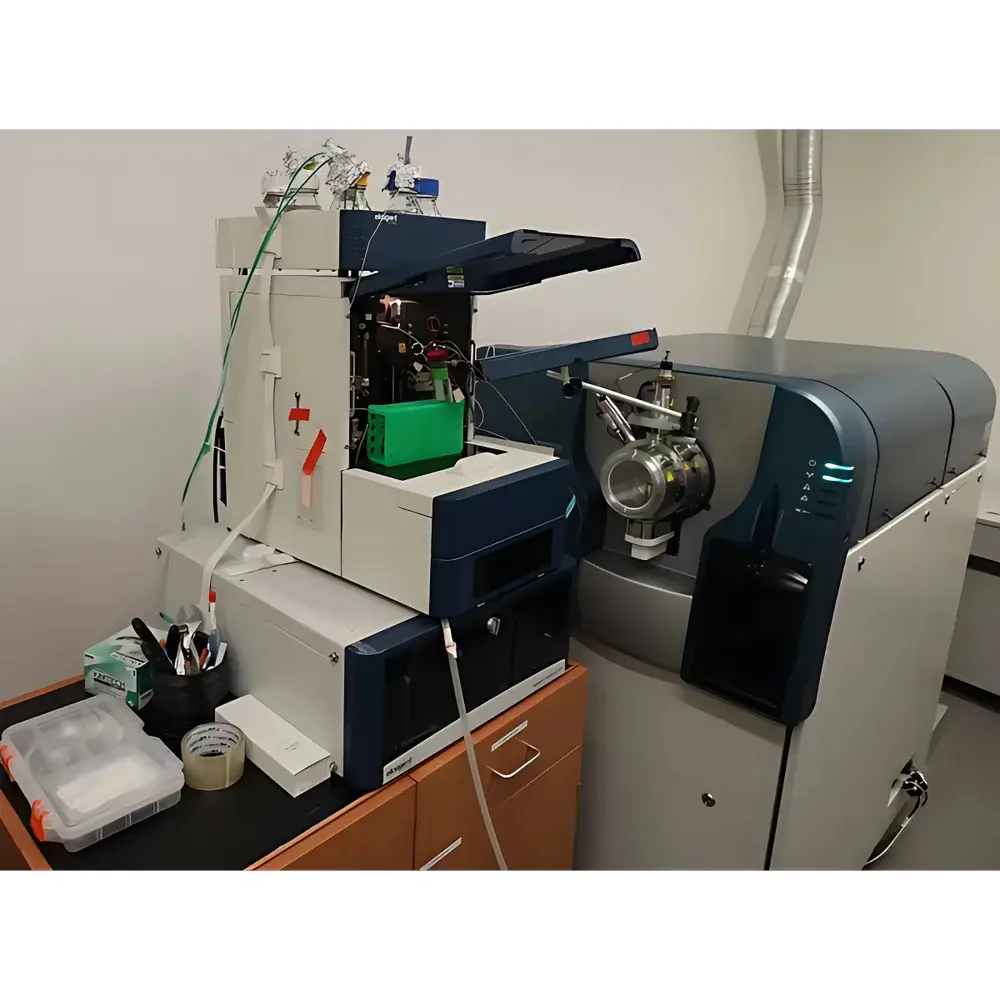
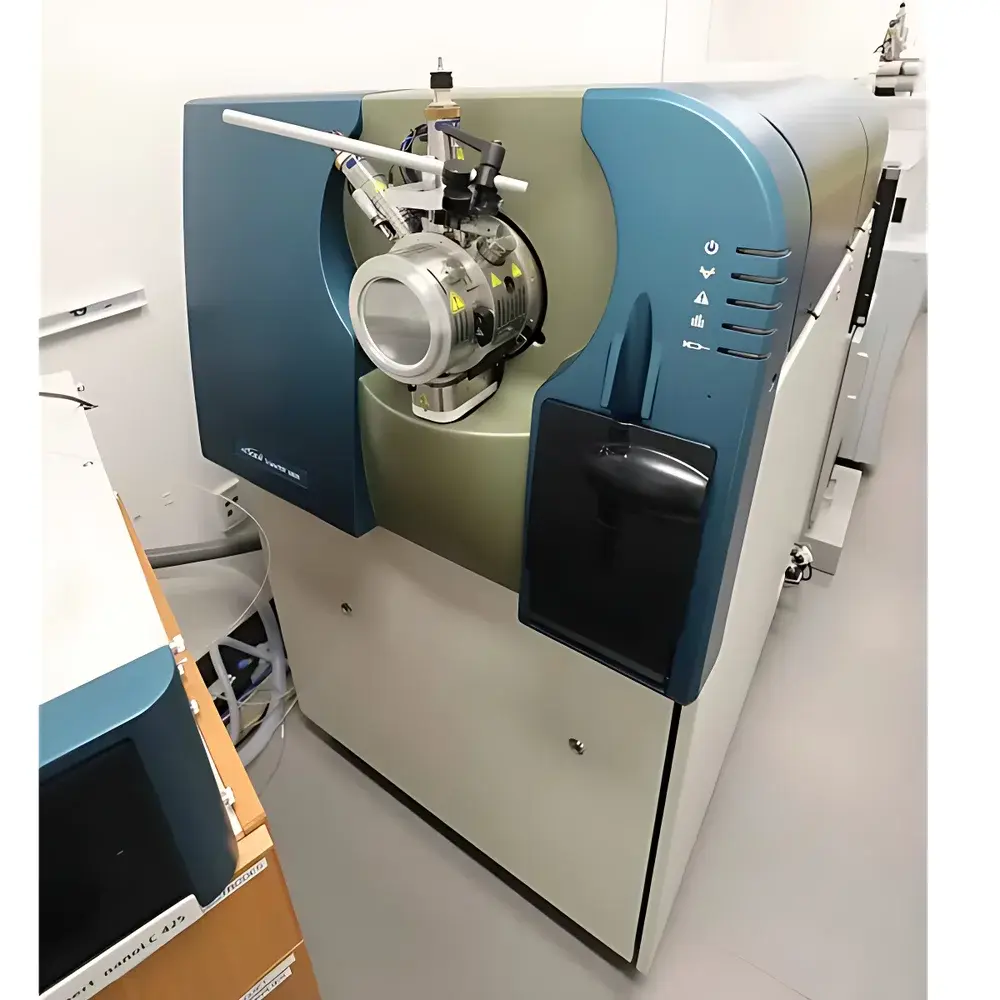
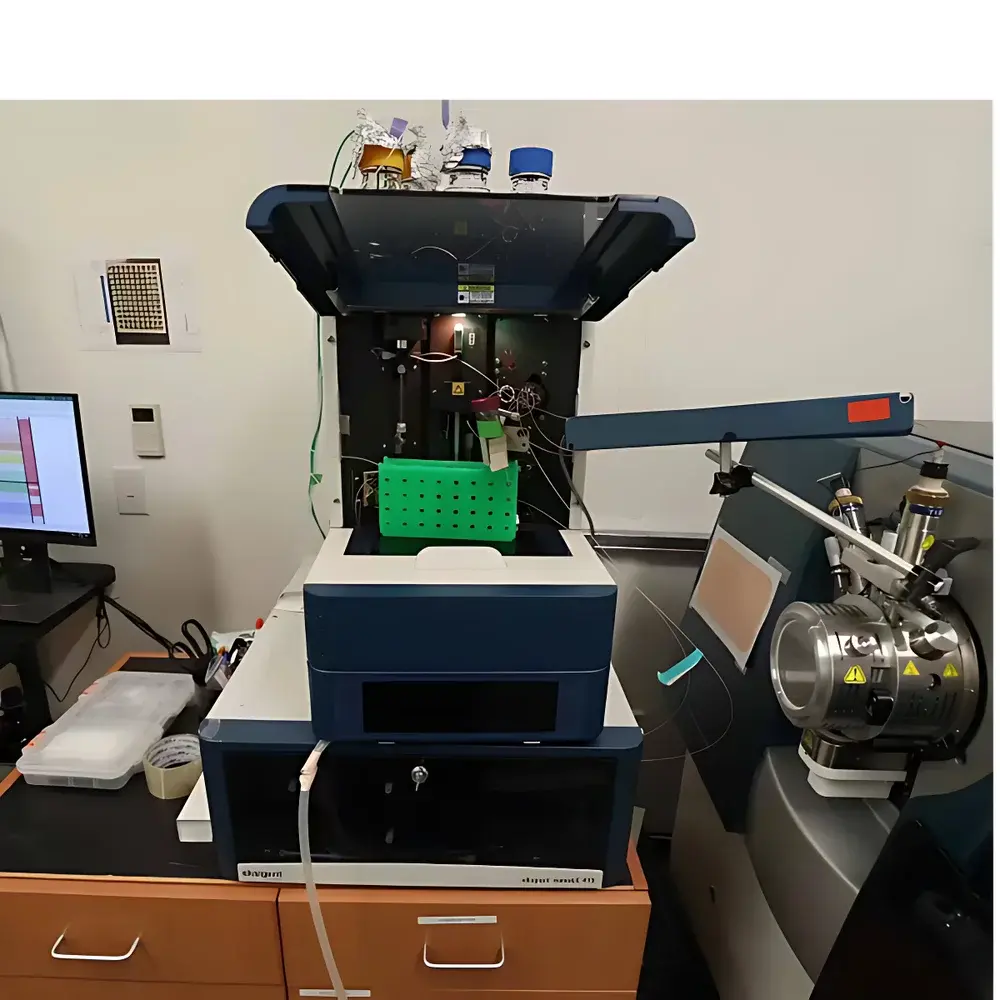
SCIEX TripleTOF 6600+LC400 Mass Spectrometry System
| Brand | SCIEX |
|---|---|
| Origin | USA |
| Instrument Type | Time-of-Flight (TOF) Hybrid Quadrupole-TOF Mass Spectrometer |
| Model | TripleTOF 6600 |
| Resolution | 10,000 (FWHM at m/z 956) |
| Sensitivity | ≤10 amol β-galactosidase tryptic peptide (S/N ≥10) |
| Mass Accuracy | ≤10 ppm RMS (calibrated) |
| Mass Stability | ≤10 ppm over 24 h |
| Acquisition Rate | Up to 100 Hz MS/MS spectra |
| Linear Dynamic Range | 5 orders of magnitude |
| Q1 m/z Range | Up to 2250 Th |
| SWATH Window Flexibility | 2–25 Da variable width, up to 200 windows per cycle |
Overview
The SCIEX TripleTOF 6600+LC400 is a high-performance hybrid quadrupole time-of-flight (Q-TOF) mass spectrometer engineered for comprehensive, reproducible, and quantitative proteomics and small-molecule analysis. Integrated with a robust LC400 ultra-high-pressure liquid chromatography system, it delivers industry-leading sensitivity, mass accuracy, and acquisition speed for both discovery and targeted workflows. The system operates on the principle of orthogonal acceleration TOF mass analysis combined with collision-induced dissociation (CID) in a triple-quadrupole-like tandem configuration—where Q1 acts as a mass-selective filter, Q2 as a collision cell, and the TOF analyzer provides high-resolution, high-mass-accuracy detection. This architecture enables simultaneous data-dependent acquisition (DDA), data-independent acquisition (DIA), and scheduled multiple reaction monitoring (sMRM) within a single platform—supporting GLP/GMP-aligned workflows across academic, pharmaceutical, and clinical research laboratories.
Key Features
- Enhanced detector technology delivering a linear dynamic range exceeding five orders of magnitude—enabling confident detection and quantification of low-abundance peptides alongside high-intensity species in complex biological matrices.
- Extended Q1 precursor selection range up to m/z 2250—critical for intact protein analysis, glycopeptide characterization, and large-molecule metabolite profiling.
- SWATH 2.0 acquisition engine with fully configurable window widths (2–25 Da) and up to 200 sequential isolation windows per cycle—optimizing spectral specificity in regions of high precursor density while maintaining broad coverage in sparse regions.
- Thermally stabilized TOF flight tube with active temperature control (<±0.1 °C)—reducing mass drift and improving long-term mass accuracy to ≤10 ppm RMS and stability to ≤10 ppm over 24 hours.
- Dynamic accumulation time adjustment per precursor—automatically optimizing dwell time to maximize signal-to-noise ratio in MS/MS spectra without compromising cycle time or quantitative precision.
- Integrated LC400 UHPLC system featuring dual-gradient capability, 1200 bar pressure rating, and <1 µL system volume—ensuring peak capacity, retention time reproducibility (<0.1% RSD), and compatibility with nano- to analytical-scale separations.
Sample Compatibility & Compliance
The TripleTOF 6600+LC400 supports diverse sample types including tissue lysates, plasma, CSF, cell cultures, microbial extracts, and synthetic compound libraries. It is compatible with nanoflow, microflow, and standard-flow electrospray ionization (ESI), as well as matrix-assisted laser desorption/ionization (MALDI) via optional source retrofit. The system meets essential regulatory requirements for analytical method validation: mass calibration traceability to NIST-traceable standards, audit trail functionality compliant with FDA 21 CFR Part 11, and full electronic record integrity per ALCOA+ principles. Software workflows support ISO/IEC 17025, CLIA, and ICH M10 guidelines for bioanalytical method validation, and instrument performance verification aligns with ASTM E2983-22 (Standard Guide for Validation of Mass Spectrometric Methods).
Software & Data Management
Powered by SCIEX OS software v2.4+, the platform provides unified control, real-time spectral visualization, and integrated processing for DDA, DIA (SWATH), and sMRM experiments. PeakView and MarkerView software enable statistical comparison across hundreds of samples, while Spectronaut and DIA-NN are natively supported for deep DIA data extraction and library-free quantification. All raw data files (.wiff) include embedded metadata, instrument configuration logs, and calibration history. Automated QC reporting includes retention time stability, mass accuracy drift, and signal intensity trends—exportable in CSV or PDF for internal review or regulatory submission. Data archiving follows hierarchical storage management (HSM) protocols, with optional integration into LIMS environments via RESTful API.
Applications
- Large-scale quantitative proteomics: Identification and label-free quantification of >10,000 proteins across tissue or biofluid cohorts using SWATH 2.0 acquisition.
- Post-translational modification (PTM) mapping: High-sensitivity localization of phosphorylation, acetylation, and ubiquitination sites with sub-femtomole detection limits.
- Intact protein and top-down analysis: Accurate mass measurement of proteins up to 50 kDa with isotopic resolution under native or denaturing conditions.
- Small-molecule metabolomics and lipidomics: Structural elucidation of unknowns via MS/MS spectral matching against HMDB, LipidMaps, and METLIN databases.
- Biopharmaceutical characterization: Peptide mapping, deamidation assessment, and glycoform profiling of monoclonal antibodies and fusion proteins.
- Environmental and food safety screening: Multi-residue pesticide, mycotoxin, and veterinary drug analysis with confirmatory MS/MS spectra and retention time alignment.
FAQ
What distinguishes SWATH 2.0 from conventional DIA methods?
SWATH 2.0 introduces variable window widths synchronized with precursor density—allowing narrower windows (as low as 2 Da) where precursors cluster, and wider windows where spacing permits—maximizing both selectivity and coverage without sacrificing cycle time.
Is the TripleTOF 6600 compatible with existing SCIEX software licenses?
Yes—SCIEX OS v2.4+ maintains backward compatibility with method files, calibration sets, and processing templates from TripleTOF 5600 systems, enabling seamless workflow migration.
Does the system support GLP-compliant audit trails?
Yes—full electronic audit trail logging is enabled by default, recording all user actions, parameter changes, calibration events, and data processing steps in tamper-evident format per 21 CFR Part 11 requirements.
Can the LC400 be operated independently of the mass spectrometer?
Yes—the LC400 module features standalone controller firmware and can be used with UV/Vis, fluorescence, or other detectors when detached from the TripleTOF 6600 interface.
What maintenance intervals are recommended for optimal mass accuracy?
Daily automated mass calibration is advised; full system performance verification—including resolution, sensitivity, and mass accuracy—should be performed weekly using the SCIEX Performance Verification Kit (P/N 4478550).




