
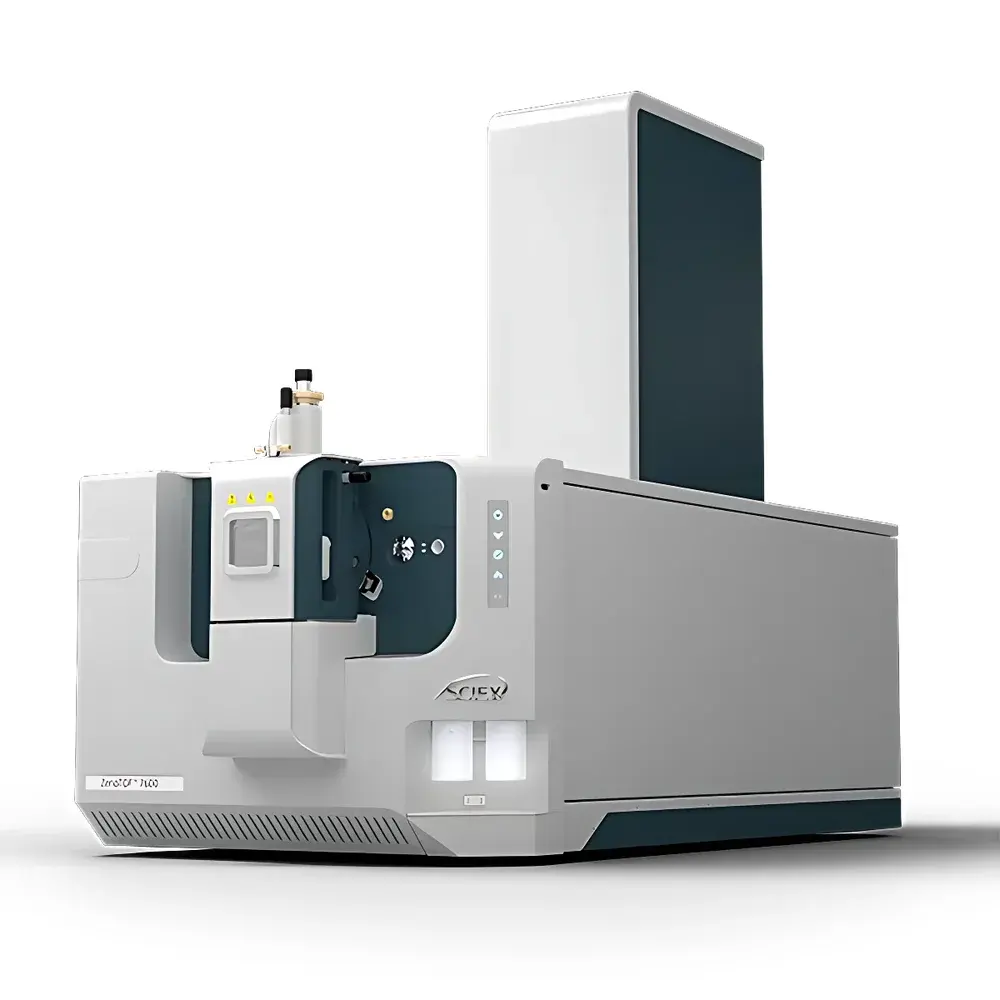
SCIEX ZenoTOF® 7600 System
| Brand | SCIEX |
|---|---|
| Origin | USA |
| Manufacturer Type | Authorized Distributor |
| Origin Category | Imported |
| Model | SCIEX ZenoTOF® 7600 System |
| Instrument Type | Quadrupole-Time-of-Flight (Q-TOF) Mass Spectrometer |
| Application Scope | Universal |
| Mass Range | >40,000 Da |
| Sensitivity Enhancement | 5–20× vs. prior-generation Q-TOF |
| Resolution | >42,000 (FWHM at m/z 1,222) |
| Mass Accuracy | <1 ppm (external calibration) |
| Pressure Range | 0–1024 bar (HPLC/UHPLC compatible) |
Overview
The SCIEX ZenoTOF® 7600 System is a high-performance quadrupole-time-of-flight (Q-TOF) mass spectrometer engineered for deep, confident characterization of diverse analytes—from intact proteins and post-translationally modified biologics to small-molecule metabolites, lipids, and positional isomers. At its core lies a dual innovation architecture: the Zeno trap ion accumulation technology and Electron-Activated Dissociation (EAD), enabling unprecedented MS/MS sensitivity, tunable fragmentation energy, and enhanced duty cycle efficiency. Unlike conventional collision-induced dissociation (CID) or higher-energy C-trap dissociation (HCD), EAD leverages controlled electron interaction to generate radical-driven fragmentation pathways—yielding complementary fragment ion spectra critical for top-down proteomics, disulfide bond mapping, sequence variant detection, and lipid double-bond localization. The system integrates seamlessly with UHPLC platforms operating up to 1024 bar, supporting sub-2-µm particle columns and fast gradient separations without compromising spectral quality.
Key Features
- Zeno trap technology: Achieves >90% ion injection efficiency into the TOF analyzer, delivering 5–20× higher MS/MS sensitivity versus legacy Q-TOF instruments—critical for low-abundance PTMs, host-cell proteins, and trace-level biomarkers.
- Electron-Activated Dissociation (EAD): A tunable, non-thermal fragmentation method enabling precise control over activation energy; supports structural elucidation of labile modifications (e.g., glycosylation, phosphorylation), backbone cleavage in large proteins, and regioisomeric differentiation in lipids and metabolites.
- High-resolution MS/MS acquisition: Sustains >42,000 resolution (FWHM) at m/z 1222 across full scan ranges, with mass accuracy <1 ppm using external calibration—meeting stringent requirements for untargeted discovery and regulatory-compliant workflows.
- Ultrafast acquisition kinetics: Supports MS/MS scan rates up to 133 Hz, significantly improving data-dependent acquisition (DDA) coverage and enabling high-resolution multiple reaction monitoring (MRMHR) for quantitative applications.
- Robust UHPLC compatibility: Fully rated for 1024 bar system pressure, ensuring compatibility with modern sub-2-µm column technologies and enabling rapid, high-peak-capacity separations.
Sample Compatibility & Compliance
The ZenoTOF 7600 accommodates a broad range of sample types—including intact monoclonal antibodies (mAbs), antibody-drug conjugates (ADCs), peptides, oligonucleotides, synthetic small molecules, lipids, and polar metabolites—without hardware modification. Its ion source design supports electrospray ionization (ESI), nano-ESI, and optional atmospheric pressure chemical ionization (APCI) configurations. From a compliance standpoint, the system supports audit-trail-enabled operation per FDA 21 CFR Part 11 when deployed with SCIEX OS Software v2.4 or later and validated instrument control modules. It aligns with ISO/IEC 17025 analytical method validation frameworks and supports GLP/GMP-aligned workflows through configurable user roles, electronic signatures, and raw data integrity controls. Note: This instrument is not registered or listed with the U.S. FDA as a medical device and is intended solely for research use—not clinical diagnostics or therapeutic application.
Software & Data Management
Controlled by SCIEX OS Software, the ZenoTOF 7600 provides unified acquisition, processing, and reporting capabilities across qualitative and quantitative paradigms. The software includes embedded spectral libraries (e.g., LipidBlast, HMDB, GlycoWorkbench), automated PTM localization algorithms (BioPharmaView™), and AI-assisted peptide-spectrum matching (ProteinPilot™). All raw data are stored in vendor-neutral SCIEX Data File (WIFF2) format, compliant with Proteomics Standards Initiative (PSI) mzML specifications. Integrated support for Waters UNIFI, Thermo Compound Discoverer, and third-party open-source tools (e.g., Skyline, MaxQuant) enables cross-platform reproducibility. Audit trails record all parameter changes, calibration events, and processing steps—ensuring traceability for regulatory submissions under ICH M10 and USP .
Applications
- Top-down and middle-down proteomics: Intact mass analysis, disulfide bond mapping, sequence variant identification, and comprehensive PTM profiling (e.g., oxidation, deamidation, glycosylation).
- Biopharmaceutical characterization: Higher-order structure assessment via native MS, ADC drug-to-antibody ratio (DAR) determination, and forced degradation product identification.
- Lipidomics and metabolomics: Positional isomer resolution (e.g., sn-1 vs. sn-2 acyl chains), double-bond localization via EAD-specific fragments, and structural annotation of unknown oxidized lipids.
- Small-molecule structural elucidation: Differentiation of regioisomers, stereochemical assignment support, and impurity profiling in synthetic chemistry and pharmaceutical development.
- Quantitative bioanalysis: High-resolution MRMHR for multiplexed biomarker verification in plasma, CSF, and tissue extracts—achieving LLOQs in the low-attomole range.
FAQ
What distinguishes EAD from CID or HCD in the ZenoTOF 7600?
EAD generates radical cations/anions via low-energy electron transfer, producing diagnostic fragments (e.g., c/z• ions in peptides, allylic cleavages in lipids) that are often suppressed under vibrational excitation methods—enabling unique structural insights.
Is the ZenoTOF 7600 suitable for regulated bioanalytical laboratories?
Yes—when configured with SCIEX OS Software v2.4+, 21 CFR Part 11 compliance modules, and documented IQ/OQ/PQ protocols, it supports GxP-aligned quantitative workflows including biomarker assay validation.
Can the system perform both DDA and targeted acquisition in a single run?
Yes—its intelligent scheduling engine enables hybrid acquisition modes, such as inclusion list-triggered MS/MS within DDA surveys or scheduled MRMHR during chromatographic peaks.
What is the maximum recommended flow rate for nano-ESI coupling?
Optimized performance is achieved at 50–500 nL/min; the Zeno trap’s high ion capacity ensures robust signal even at ultra-low flow rates typical of microfluidic and trapped-ion mobility interfaces.
Does the system support real-time data processing during acquisition?
SCIEX OS offers on-the-fly peak detection, retention time alignment, and spectral deconvolution—reducing post-run processing time by up to 60% for large-scale proteomic datasets.




