
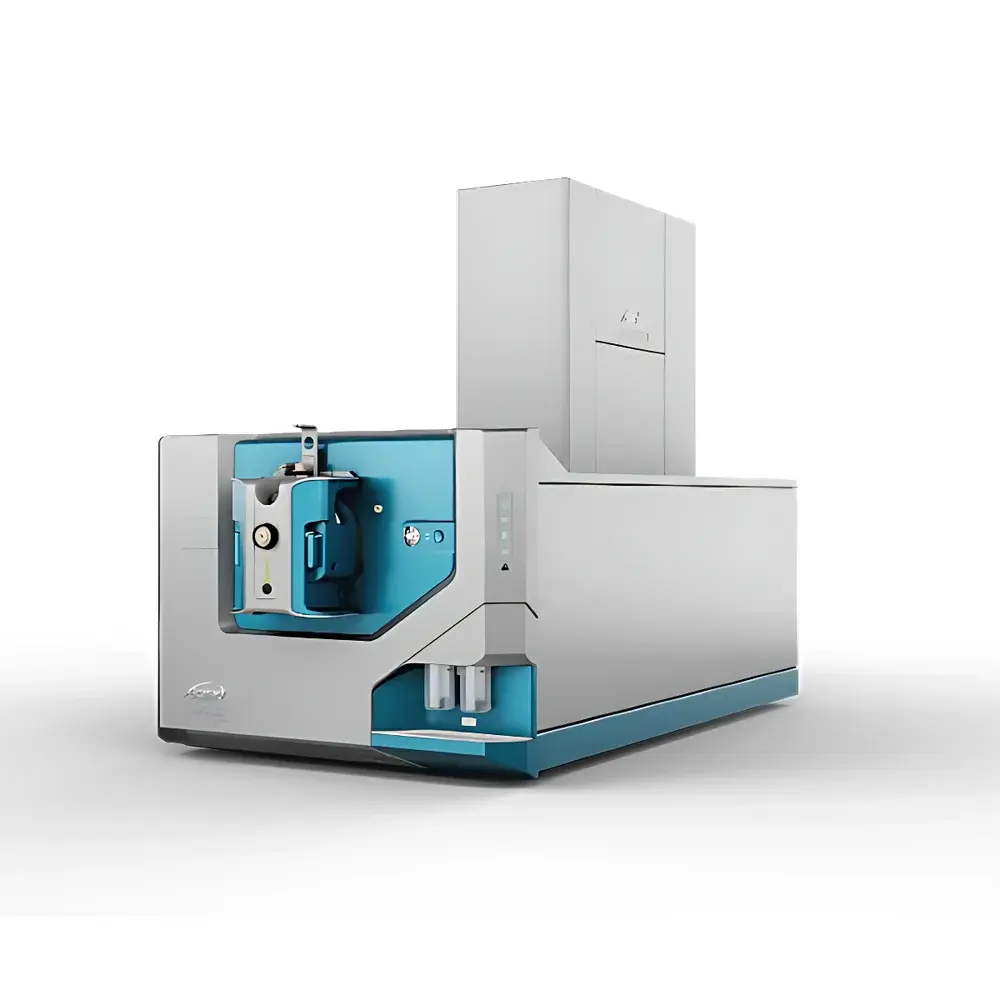
SCIEX ZenoTOF 8600 System
| Brand | SCIEX |
|---|---|
| Origin | USA |
| Model | SCIEX ZenoTOF 8600 System |
| Instrument Type | Quadrupole-Time-of-Flight (Q-TOF) Mass Spectrometer |
| Application Scope | Universal (Small Molecules to Intact Proteins) |
| Ion Source | OptiFlow Pro Turbo Ionization Source |
| Mass Analysis Technology | Zeno™ Trap-Enhanced TOF with High-Frequency Pulsed Injection |
| Max MS/MS Scan Rate | 858 Hz (dependent on mass range and acquisition mode) |
| Quadrupole Scanning Speed | up to 4000 Da/s |
| Fragmentation Modes | CID, EAD (Electron-Activated Dissociation) up to 50 eV in both positive and negative ion modes |
| Vacuum System | Oil-Free Dry Pumping |
| Software Platform | SCIEX OS 4.0 with Real-Time Performance Monitoring, Health Diagnostics & Auto-Tuning |
Overview
The SCIEX ZenoTOF 8600 System is a high-performance quadrupole-time-of-flight (Q-TOF) mass spectrometer engineered for deep, quantitative, and structural characterization across diverse analyte classes—from metabolites and lipids to post-translationally modified peptides and intact proteins. Leveraging SCIEX’s proprietary Zeno™ trap technology, the system fundamentally redefines ion transmission efficiency in Q-TOF architecture by temporally accumulating precursor ions prior to pulsed injection into the orthogonal time-of-flight analyzer. This approach achieves up to 20× higher duty cycle and significantly improved signal-to-noise ratio compared to conventional Q-TOF designs—without compromising mass accuracy ( 35,000 FWHM at m/z 556), or dynamic range (> 5 orders). The platform operates on a robust electrospray ionization (ESI) foundation enhanced by the OptiFlow Pro source, delivering stable, high-efficiency ionization across flow rates from 0.5–1000 µL/min without hardware switching. Its dual fragmentation capability—collision-induced dissociation (CID) and electron-activated dissociation (EAD)—enables comprehensive structural elucidation, including labile modifications and isomeric differentiation, under both positive and negative ion polarity.
Key Features
- Zeno™ Trap Technology: Enables ion accumulation and synchronized pulsed injection into the TOF analyzer, increasing effective ion utilization and detection sensitivity across broad mass ranges.
- OptiFlow Pro Ion Source: Integrates the reliability of Turbo V™ engineering with adaptive desolvation and electric field optimization, ensuring consistent ion yield across nanoflow to standard LC flow regimes.
- Mass Guard Interference Suppression System: Combines an active ion filtering mechanism with real-time optical monitoring to suppress chemical noise and extend source lifetime under high-throughput conditions.
- ZT Scan DIA 2.0 Acquisition: A data-independent acquisition (DIA) paradigm that dynamically slides isolation windows across user-defined m/z ranges, supporting simultaneous quantification and identification in single-run workflows.
- EAD Fragmentation (up to 50 eV): Provides complementary fragmentation pathways to CID, particularly advantageous for phospholipid headgroup cleavage, glycan linkage analysis, and top-down protein sequencing in negative mode.
- Oil-Free Vacuum Architecture: Utilizes dry scroll and turbomolecular pumping stages to eliminate hydrocarbon backstreaming, reduce power consumption by up to 24% versus oil-sealed systems, and minimize maintenance intervals.
Sample Compatibility & Compliance
The ZenoTOF 8600 accommodates liquid chromatography-coupled samples ranging from low-molecular-weight metabolites (≤ 500 Da) to intact monoclonal antibodies (> 150 kDa). It supports reversed-phase, HILIC, SEC, and 2D-LC interfaces, and is compatible with nano-, micro-, and analytical-scale separations. From a regulatory standpoint, the system complies with key requirements for GLP and GMP environments: full audit trail support in SCIEX OS 4.0, electronic signature capability per FDA 21 CFR Part 11, instrument calibration traceability to NIST standards, and documentation-ready performance verification protocols aligned with ASTM E2911 and ISO/IEC 17025 guidelines.
Software & Data Management
SCIEX OS 4.0 serves as the unified control, acquisition, and processing environment. Its modular architecture includes three integrated subsystems: (1) Real-Time Performance Dashboard—displays live metrics including ion current stability, mass calibration drift, and detector saturation; (2) Health Diagnostics Engine—provides predictive alerts for source contamination, vacuum degradation, or lens voltage deviation; and (3) Enhanced Auto-Tuning Workflow—automatically optimizes collision energy, declustering potential, and RF voltages based on internal calibrant response. Raw data files (.wiff) are natively compatible with third-party platforms including Skyline, MaxQuant, and Proteome Discoverer. All processing workflows support batch reprocessing, metadata tagging, and export to standardized formats (mzML, mzXML) for long-term archival and cross-platform reproducibility.
Applications
The ZenoTOF 8600 delivers validated utility in multiple regulated and discovery-oriented domains: untargeted metabolomics profiling with sub-picomolar sensitivity; lipidomics workflows requiring retention of labile acyl chain information; intact protein mass analysis for biosimilar comparability studies; phosphoproteomics with site-localized stoichiometry; and small-molecule impurity identification per ICH Q3 guidelines. Its high-speed DIA capability supports large-cohort clinical proteomics studies (> 1000 samples), while EAD-enabled negative-mode fragmentation expands capabilities in environmental toxin screening and nucleic acid adduct characterization.
FAQ
What distinguishes ZenoTOF 8600 from previous-generation Q-TOF instruments?
It introduces Zeno™ trap-based ion accumulation and pulsed injection, increasing effective duty cycle and improving MS/MS sensitivity—particularly for low-abundance precursors in complex matrices.
Is EAD available for both polarities?
Yes. Electron-activated dissociation is fully implemented in both positive and negative ion modes, with tunable energy up to 50 eV.
Does the system support automated calibration and performance verification?
SCIEX OS 4.0 includes scheduled auto-calibration using internal reference compounds and generates ISO/IEC 17025-compliant performance reports covering mass accuracy, resolution, and sensitivity.
Can ZT Scan DIA 2.0 be applied to non-proteomic applications?
Absolutely. Its flexible window definition and sliding isolation logic are equally applicable to small-molecule toxicology, pesticide residue screening, and polymer additive profiling.
What vacuum pump configuration is used?
A fully oil-free system comprising a dry scroll backing pump and high-capacity turbomolecular pump, certified for continuous operation at ≤ 5×10⁻⁷ Torr base pressure.





