
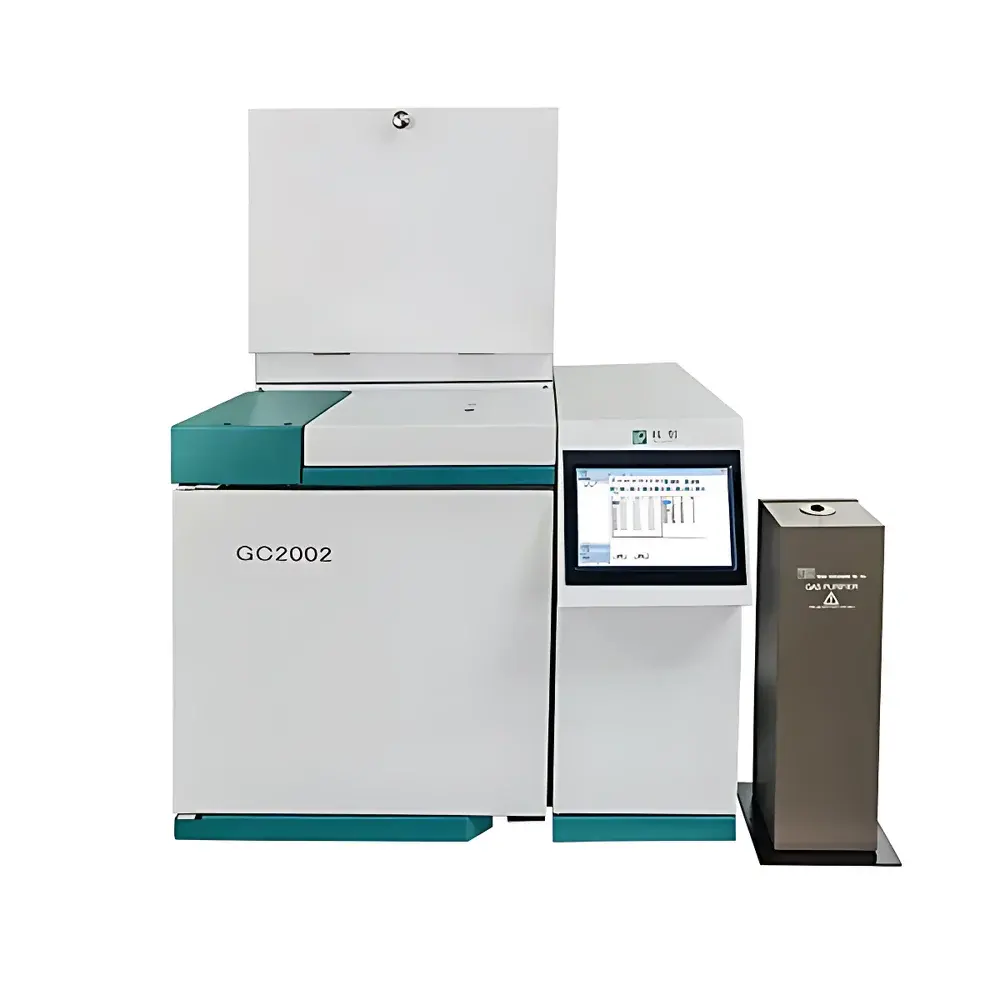
SciTech GC2002-N/PDHID High-Purity Special Gas Analysis System with Pulsed Discharge Helium Ionization Detection
| Brand | SciTech |
|---|---|
| Origin | Shanghai, China |
| Manufacturer Type | Direct Manufacturer |
| Region of Origin | Domestic (China) |
| Model | GC2002-N/PDHID |
| Detection Capability | ppb-level trace impurities in ultra-high-purity bulk and specialty gases (e.g., H₂, N₂, O₂, Ar, He, Ne, Kr, Xe, SiH₄, PH₃, B₂H₆, NF₃, Cl₂, F₂, HCl, HF) |
| Detector | VICI Pulsed Discharge Helium Ionization Detector (PDHID) with integrated high-voltage pulse generator and helium purifier |
| Valve System | Four-valve, multi-column configuration with carrier gas purge protection |
| Column Configuration | Separated temperature-controlled pre-column and analytical column |
| Sample Introduction | Pre-flush injection system with low dead-volume sampling loop |
| Communication Interface | Ethernet (10/100 Mbps), PC remote control, embedded chromatography workstation |
Overview
The SciTech GC2002-N/PDHID is a purpose-engineered gas chromatograph designed exclusively for ultra-trace analysis of impurities in high-purity and specialty gases. It operates on the principle of gas-phase separation coupled with pulsed discharge helium ionization detection (PDHID), a technique offering universal, non-destructive, and highly sensitive response to nearly all permanent gases and volatile inorganic compounds—without requiring compound-specific calibration. Unlike flame ionization or thermal conductivity detectors, PDHID delivers sub-ppb (parts-per-quadrillion) detection limits for key contaminants including H₂O, O₂, N₂, CO, CO₂, CH₄, and halogenated species in matrices such as electronic-grade silane (SiH₄), phosphine (PH₃), boron trifluoride (BF₃), nitrogen trifluoride (NF₃), and rare gases (He, Ne, Ar, Kr, Xe). The instrument’s core architecture centers on a helium carrier-based separation pathway, where ultra-pure helium—purified in-line via integrated getter-based purification—is ionized in short, high-energy pulses to generate stable electron cascades. This enables consistent baseline stability over extended run times (>72 h), essential for semiconductor fab QC labs and ISO 14644-8 Class 1 cleanroom gas certification workflows.
Key Features
- Integrated VICI PDHID detector with proprietary pulsed high-voltage power supply and real-time helium purity monitoring—ensuring <100 ppt residual H₂O/O₂ in carrier stream
- Four-valve, multi-column switching architecture with carrier gas purge protection—enabling sequential heart-cutting, back-flushing, and column isolation without manual intervention
- Independent temperature control for pre-columns and analytical columns (range: 30–200 °C, ±0.1 °C stability)—facilitating method development for co-eluting impurities
- Pre-flush sample introduction system with 0.5 mL stainless-steel loop—reducing ambient air ingress (O₂/N₂) and minimizing sample consumption (<5 mL per analysis)
- Electronically actuated, thermostatically stabilized 10-port, 6-port, and 4-port valves—rated for >500,000 cycles under continuous helium service
- Embedded Linux-based chromatography workstation with dual-mode operation: standalone acquisition or full remote control via TCP/IP Ethernet (IEEE 802.3)
Sample Compatibility & Compliance
The GC2002-N/PDHID supports quantitative analysis of ultra-high-purity (UHP) gases meeting SEMI F57, ASTM D7607, and ISO 8573-8 specifications. It is routinely deployed for certifying electronic specialty gases per SEMI C37 (for dopant gases) and IEC 60404-8-11 (for magnetic material process gases). The system complies with GLP data integrity requirements through audit-trail-enabled method logging, user-access controls, and electronic signature support. All valve timing sequences, temperature ramps, and detector parameters are stored with time-stamped metadata—fully traceable for FDA 21 CFR Part 11 compliance when paired with validated LIMS integration.
Software & Data Management
The embedded workstation provides ISO/IEC 17025-aligned peak integration algorithms—including tangent skim, exponential curve fitting, and valley-to-valley baseline correction. Raw data files (.cdf) conform to ASTM E1947 and AIA/ANDI standards for cross-platform compatibility with third-party chemometric tools (e.g., MATLAB, SIMCA, OpenChrom). Method templates are exportable/importable as XML packages; calibration curves support multi-point linear and quadratic regression with forced zero-intercept options for trace-level quantification. Audit trails record every parameter change, user login/logout, and report generation event—with immutable timestamps synchronized to NTP servers.
Applications
- Residual oxygen and moisture verification in 6N–7N helium and argon used in EUV lithography tool purge lines
- ppb-level phosphine (PH₃) and arsine (AsH₃) quantification in silicon epitaxy precursor streams
- Trace fluorine-containing impurities (HF, F₂, ClF₃) in NF₃ etch gas cylinders prior to cylinder filling
- CO/CO₂ breakthrough monitoring in hydrogen fuel cell feed gas purification skids
- Validation of cryogenic distillation column performance for neon-helium separation in helium recovery plants
FAQ
What detection limit can be achieved for nitrogen in ultra-pure helium?
Typical MDL is 20–50 ppt (v/v) for N₂ in He, dependent on column selection, integration time, and helium purity.
Is the PDHID compatible with reactive gases like Cl₂ or F₂?
Yes—detector cell materials (stainless steel, alumina insulators, gold-plated electrodes) are chemically inert toward halogens at sub-ppm concentrations; routine passivation protocols are included.
Can the system be integrated into a central gas monitoring network?
Yes—via Modbus TCP or OPC UA gateways; native Ethernet interface supports SNMP v3 for enterprise-wide device health monitoring.
Does the instrument meet ISO/IEC 17025 method validation requirements?
Full validation documentation package—including linearity (R² ≥ 0.999), precision (RSD ≤ 3.2% at 100 ppt), and robustness testing—is provided with each system.
What maintenance intervals are recommended for the helium purifier?
Getter cartridge replacement is scheduled every 12 months or after 5000 hours of operation—whichever occurs first—monitored via integrated pressure differential sensor.
Related Products







