
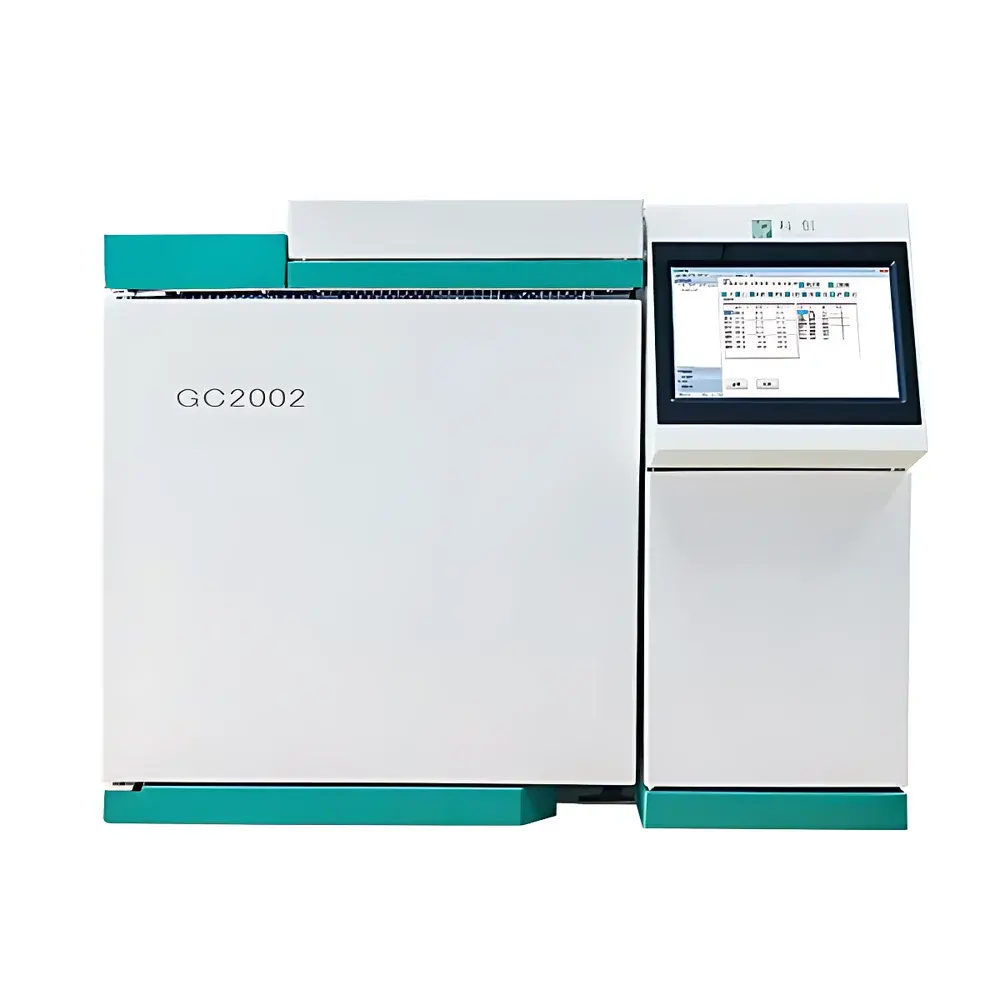
SciTech GC2002 ppm-Level Sulfur Compounds Dedicated Gas Chromatograph
| Brand | SciTech |
|---|---|
| Model | GC2002 |
| Origin | Shanghai, China |
| Manufacturer Type | Direct Manufacturer |
| Instrument Type | Laboratory Gas Chromatograph |
| Application Domain | Petroleum & Petrochemical Industry |
| Detection Modes | TCD (for %–ppm range), FPD (for sub-ppm to ppm-level sulfur) |
| Column Compatibility | Packed & Capillary Columns (sulfur-deactivated) |
| Injection System | VICI pneumatic valve with inertized quantitative loops (0.2–2.0 mL) |
| Oven Temperature Range | Ambient +5°C to 420°C |
| Max Programmed Ramps | 8-stage |
| Temperature Precision | ±0.1% of setpoint |
| FPD Sensitivity | ≤1.0 pg/s (P), ≤10.0 pg/s (S) |
| TCD Sensitivity | ≥10,000 mV·mL/mg (HTCD) |
| Baseline Noise (FPD) | ≤30 µV |
| Linear Dynamic Range | 10⁴ (FPD), 10⁵ (TCD) |
| Data Interface | RJ45 Ethernet (remote control & audit-ready data streaming) |
| Software | Embedded workstation with bidirectional instrument control, GLP-compliant event logging, and 253-unit network scalability |
Overview
The SciTech GC2002 is a laboratory-grade gas chromatograph engineered specifically for trace and ultra-trace sulfur compound analysis in hydrocarbon matrices—particularly refinery gases, natural gas streams, liquefied petroleum gas (LPG), and catalytic process effluents. It operates on the principle of gas-phase separation coupled with selective, high-sensitivity detection: sulfur-containing analytes (e.g., H₂S, COS, mercaptans, sulfides, thiophenes) are separated on de-activated packed or capillary columns under precisely controlled temperature gradients, then quantified via either flame photometric detection (FPD) for sub-ppm to ppm-level sulfur or thermal conductivity detection (TCD) for higher-concentration applications (0.01%–100%). The system’s architecture prioritizes chemical inertness—from VICI pneumatic valves and sulfur-deactivated quantitative loops (0.2–2.0 mL) to internally passivated gas pathways and specially treated column hardware—to eliminate adsorption, catalytic decomposition, or memory effects that compromise reproducibility in sulfur speciation.
Key Features
- Full microprocessor-based control with Ethernet (RJ45) interface enabling remote operation, real-time monitoring, and centralized fleet management—up to 253 instruments controllable from a single PC workstation.
- Dual-detector configuration: High-sensitivity FPD (≤10 pg/s for S) optimized for ppb–ppm sulfur quantification; HTCD (≥10,000 mV·mL/mg) for broad-range (%–ppm) analysis with inherent stability and no consumables.
- Column oven with automatic back-flush door and 8-stage programmable temperature ramping (0.1–40 °C/min, 0.1 °C/min resolution); temperature uniformity ±0.1% and repeatability ≤0.5% RSD across ramps.
- Complete inertization protocol: All wetted surfaces—including sample loops, valves, transfer lines, and column inlet/outlet fittings—are silanized or electropolished stainless steel to prevent sulfur retention or catalytic oxidation.
- Integrated diagnostic system with real-time fault reporting (location + nature), over-temperature cutoff on all 7 independently controlled zones, and automatic shutdown if any zone exceeds user-defined limits.
- Built-in digital signal acquisition: Analog-to-digital conversion occurs onboard; raw chromatographic data transmitted directly via Ethernet—eliminating analog cable noise and ensuring signal integrity for regulatory compliance.
Sample Compatibility & Compliance
The GC2002 supports direct gas-phase injection of pressurized cylinder samples (via stainless-steel regulator and agitation shaker for homogeneity), as well as loop-injected refinery off-gas, amine-treated streams, and synthetic calibration mixtures. Its design conforms to ASTM D5504 (determination of sulfur compounds in gaseous fuels by GC–FPD), ISO 8573-6 (trace contaminant analysis in compressed air), and relevant sections of API RP 14E for hydrocarbon stream monitoring. All firmware and software modules support audit trails, user access levels, electronic signatures, and data immutability per FDA 21 CFR Part 11 requirements when deployed in GLP/GMP environments. Calibration verification protocols align with ISO/IEC 17025 clause 5.9 for analytical instrument qualification.
Software & Data Management
The embedded GC workstation provides bidirectional communication: method upload, real-time parameter adjustment (oven temp, detector gain, valve timing), and live chromatogram display. Data files adhere to AIA/CDF format for interoperability with LIMS platforms. Event logging captures every hardware action (valve actuation, temperature change, detector ignition) with timestamp, operator ID, and IP address—enabling full traceability. Batch processing supports internal standard calibration, multi-point linear/nonlinear regression, and automated report generation (PDF/CSV) compliant with QA/QC documentation standards. Remote data streaming allows supervisors to monitor instrument status and chromatographic performance across distributed lab networks without local access.
Applications
- Quantification of total sulfur and individual sulfur species (H₂S, MeSH, DMS, COS, CS₂, thiophene) in natural gas per GPA 2261 and ISO 6974–5.
- Monitoring sulfur breakthrough in amine scrubbers and molecular sieve beds during refinery sour water stripping operations.
- Verification of sulfur removal efficiency in hydrotreating and hydrodesulfurization (HDS) unit feed/effluent streams.
- Analysis of odorant residuals (e.g., tert-butyl mercaptan) in propane/LPG distribution systems.
- Supporting catalyst deactivation studies through longitudinal tracking of sulfur accumulation in process gases.
FAQ
What sulfur detection limits does the GC2002 achieve with FPD?
With optimized gas flows and column selection, the system achieves ≤10 pg/s (sulfur) detection limit—translating to low-ppb quantitation for H₂S in nitrogen matrix using 1-mL loop injection.
Is the instrument compatible with capillary columns for speciated sulfur analysis?
Yes—both standard and sulfur-deactivated fused-silica capillary columns (e.g., DB-Sulfur, CP-Sil 5 CB) are supported via universal inlet configuration with pressure-programmable control.
How is data integrity ensured for regulated environments?
All raw data, method parameters, and system logs are stored with cryptographic hash validation; software enforces role-based access, electronic signatures, and immutable audit trails meeting 21 CFR Part 11 Annex 11 expectations.
Can the GC2002 be integrated into an existing plant DCS or MES?
Via Modbus TCP or OPC UA gateway (optional add-on), the instrument exports key status variables (oven temp, detector voltage, valve position, run completion flag) for SCADA-level integration.
What maintenance routines are recommended for sustained sulfur analysis accuracy?
Quarterly FPD jet cleaning, biannual detector alignment verification, and annual column reconditioning (baking at 300°C under helium) are advised; all procedures documented in the GLP-compliant maintenance log module.
Related Products





