
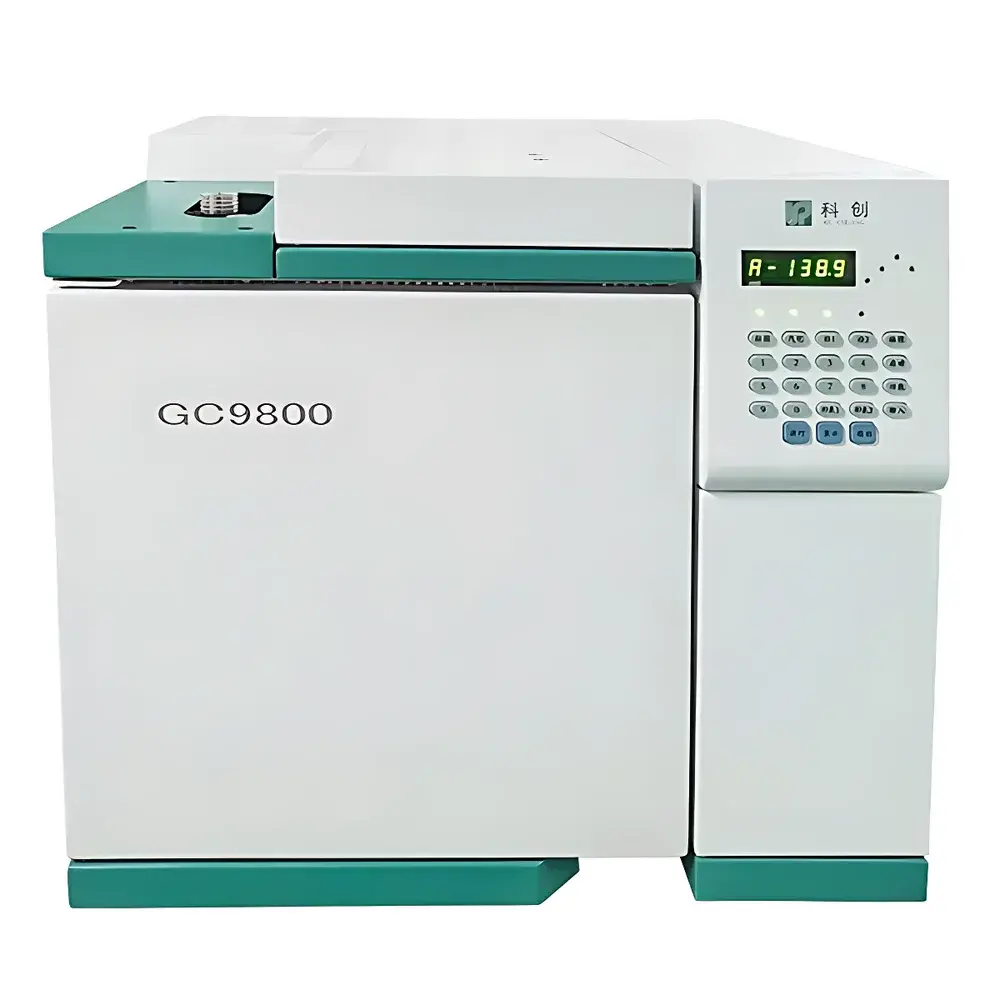
SciTech GC9800 Base Model Gas Chromatograph
| Brand | SciTech |
|---|---|
| Origin | Shanghai, China |
| Manufacturer Type | Direct Manufacturer |
| Regional Classification | Domestic (China) |
| Model | GC9800 Base |
| Instrument Type | Laboratory Gas Chromatograph |
| Application Scope | General-Purpose |
| Oven Temperature Range | Ambient + 10 °C to 400 °C |
| Oven Ramp Rate | 0.1–39 °C/min |
| Oven Cooling Rate | 400 °C → 50 °C in ≤4 min |
| Carrier Gas Flow Range & Control | 0–100 mL/min |
| Carrier Gas Pressure Range & Control | 0–250 kPa |
| Injector Maximum Operating Temperature | 300 °C |
| Injector Pressure Setting Range | 0–250 kPa |
| Injector Total Flow Setting Range | 0–1200 mL/min |
| Column Oven Dimensions | 250 × 250 × 180 mm |
| Temperature Control Accuracy | ±0.5% of setpoint |
| Temperature Display Resolution | 0.1 °C |
| Programmable Temperature Steps | 3-step |
| Programmed Temperature Reproducibility | ≤1% RSD |
| Detector Options | TCD, FID, ECD, FPD |
| TCD Sensitivity | ≥3000 mV·mL/mg (benzene) |
| FID Detection Limit | ≤1 × 10⁻¹¹ g/s (n-hexadecane) |
| ECD Detection Limit | ≤1 × 10⁻¹³ g/mL (γ-HCH) |
| FPD (P) Detection Limit | ≤5 × 10⁻¹² g/s |
| FPD (S) Detection Limit | ≤5 × 10⁻¹¹ g/s |
| TCD Baseline Noise | ≤10 µV |
| FID Baseline Noise | ≤1 × 10⁻¹³ A |
| ECD/FPD Baseline Noise | ≤40 µV |
| TCD Baseline Drift | ≤60 µV/30 min |
| FID Baseline Drift | ≤6 × 10⁻¹³ A/30 min |
| ECD/FPD Baseline Drift | ≤100 µV/30 min |
| TCD/FID/ECD/FPD Linear Dynamic Ranges | 10⁵, 10⁷, 10⁴, 10⁴ respectively |
| Detector Stabilization Time | ≤2 h (TCD/ECD), ≤1 h (FID/FPD) |
| Instrument Dimensions | 500 × 540 × 480 mm |
| Net Weight | 35 kg |
| Power Consumption | 1500 W |
Overview
The SciTech GC9800 Base Model Gas Chromatograph is a robust, entry-level analytical platform engineered for routine separation and quantitative analysis of volatile and semi-volatile organic compounds in research laboratories, quality control environments, and educational institutions. Built upon classical gas chromatographic principles—separation via differential partitioning between a mobile phase (inert carrier gas) and a stationary phase (capillary or packed column)—the GC9800 delivers reproducible retention times and peak resolution under precisely regulated thermal conditions. Its column oven employs PID-controlled heating with active air circulation and an automated rear door mechanism, enabling rapid cooling from 400 °C to 50 °C within four minutes—a critical capability for high-throughput workflows. The system supports both isothermal and multi-step programmed temperature ramping (up to three independent segments), with ramp rates adjustable from 0.1 to 39 °C/min and temperature stability maintained within ±0.5% of setpoint. All thermal zones—including oven, injector(s), and detector(s)—are independently controlled and digitally displayed to 0.1 °C resolution, ensuring traceable, audit-ready operation consistent with GLP-compliant laboratory practices.
Key Features
- Four-zone independent temperature control (oven, up to two injectors, detector) with digital LED display and real-time monitoring
- Column oven with large internal volume (250 × 250 × 180 mm) and motorized rear door for accelerated cool-down and improved thermal homogeneity
- Three-step programmable temperature ramping with user-defined hold times, start/end temperatures, and rate limits
- Support for multiple inlet configurations: split/splitless capillary injector, packed column injector, and gas sampling valve—enabling method flexibility across sample matrices
- Integrated self-diagnostic system that identifies and displays fault location and category (e.g., heater open circuit, thermocouple failure, pressure sensor drift)
- Dual safety protocols: over-temperature cutoff for all heated zones and real-time pressure monitoring with automatic shutdown if preset limits are exceeded
- Modular detector architecture permitting field-installation of TCD, FID, ECD, or FPD—each optimized for specific analyte classes (e.g., hydrocarbons, halogenated compounds, organophosphorus/sulfur species)
Sample Compatibility & Compliance
The GC9800 Base accommodates a broad spectrum of sample types—including environmental water extracts, petrochemical distillates, pharmaceutical residual solvents, food flavor volatiles, and polymer additives—when paired with appropriate column chemistry (e.g., DB-5ms, HP-INNOWAX, or PLOT Al₂O₃). Its injector pressure and flow control (0–250 kPa; 0–1200 mL/min total flow) ensure compatibility with both narrow-bore capillary columns and wider-packed formats. The instrument meets fundamental design requirements outlined in ISO 17025:2017 for testing and calibration laboratories, and its operational parameters align with ASTM D3606 (benzene/toluene in gasoline), USP (residual solvents), and EPA Method 8021B (halogenated organics). While not pre-certified for 21 CFR Part 11, the system’s deterministic hardware behavior, stable firmware, and full parameter logging support validation efforts required for GMP-regulated environments.
Software & Data Management
The GC9800 Base operates via embedded firmware with front-panel navigation; it does not include proprietary PC-based acquisition software. However, analog/digital output ports (RS-232, 1 V full-scale analog signal) enable seamless integration with third-party chromatography data systems (CDS) such as Chromeleon™, OpenLab CDS, or custom LabVIEW applications. All method parameters—including temperature programs, detector settings, and valve timing—are stored in non-volatile memory and recalled without recalibration. Raw signal outputs are continuously timestamped, supporting post-run reprocessing and peak integration using industry-standard algorithms. Audit trails for method changes, run sequences, and system errors can be exported as CSV files for archival review, facilitating compliance with internal SOPs and external inspection criteria.
Applications
- Residual solvent analysis in active pharmaceutical ingredients (APIs) per ICH Q3C guidelines
- Hydrocarbon profiling in fuels and lubricants using ASTM D5186 or D6730
- Pesticide residue screening in agricultural commodities (e.g., γ-HCH detection via ECD)
- Flavor and fragrance compound identification in beverages and cosmetics
- Monomer purity assessment in polymer synthesis (e.g., vinyl chloride, styrene)
- Environmental monitoring of VOCs in ambient air or soil headspace (EPA TO-17)
- Quality assurance of industrial gases (e.g., O₂, N₂, CO₂ purity verification via TCD)
FAQ
Does the GC9800 Base support electronic pressure control (EPC)?
No—the GC9800 Base uses mechanical pressure regulators and analog flow meters. For EPC functionality, consider the GC9800 Advanced Series with digital pneumatic modules.
Can I upgrade the base model with additional detectors after purchase?
Yes—detector modules are mechanically and electrically standardized. Installation requires only physical mounting, gas line connection, and firmware configuration via the front panel.
What is the minimum detectable concentration for chlorinated pesticides using the ECD option?
Under optimized conditions (63Ni source, 30 m × 0.32 mm ID DB-5 column, 2 µL injection), the system achieves ≤0.05 ng/mL (γ-HCH) with signal-to-noise ≥3, consistent with EPA Method 8081B performance criteria.
Is the column oven capable of sub-ambient operation?
No—the lowest controllable temperature is ambient +10 °C. Cryogenic cooling or Peltier-based sub-ambient control is not supported on this model.
How often does the system require calibration verification?
We recommend quarterly verification of temperature accuracy (using NIST-traceable reference thermometers) and annual sensitivity checks against certified standards (e.g., n-hexadecane for FID, benzene for TCD), documented per laboratory quality management procedures.
Related Products





