
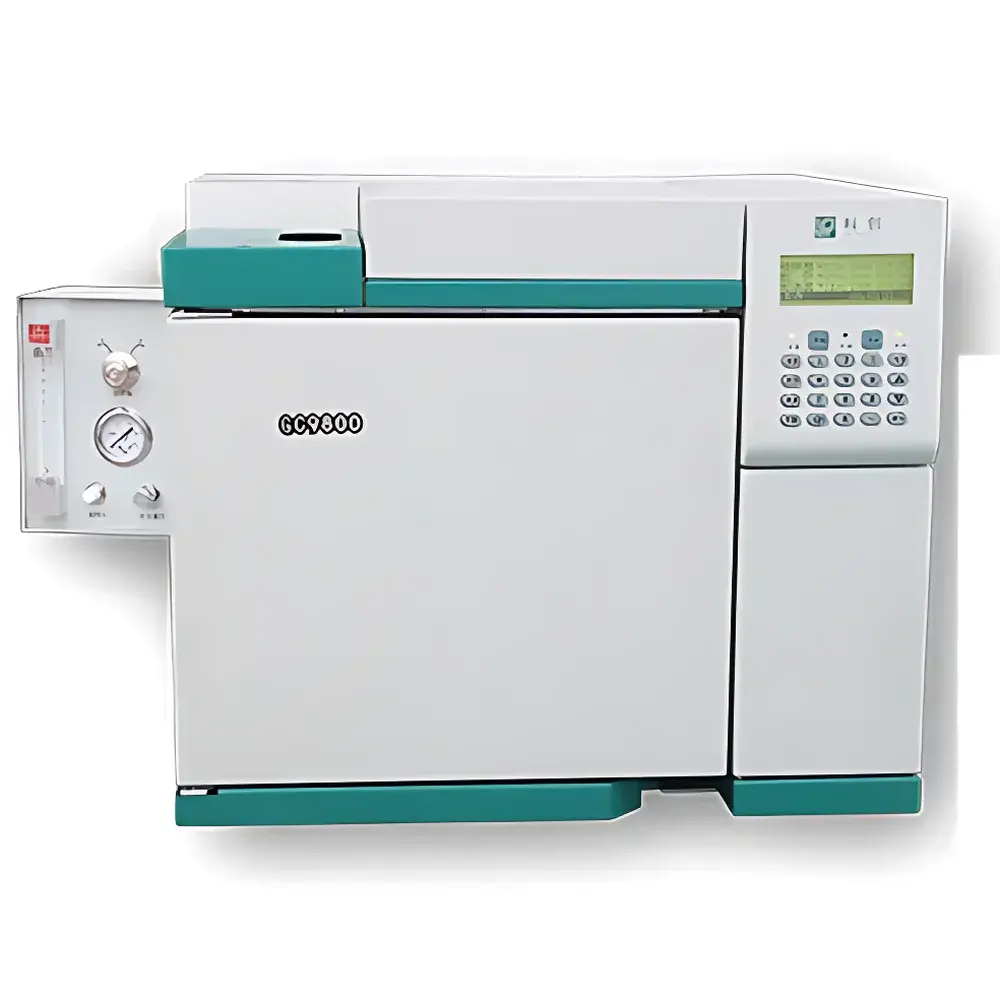
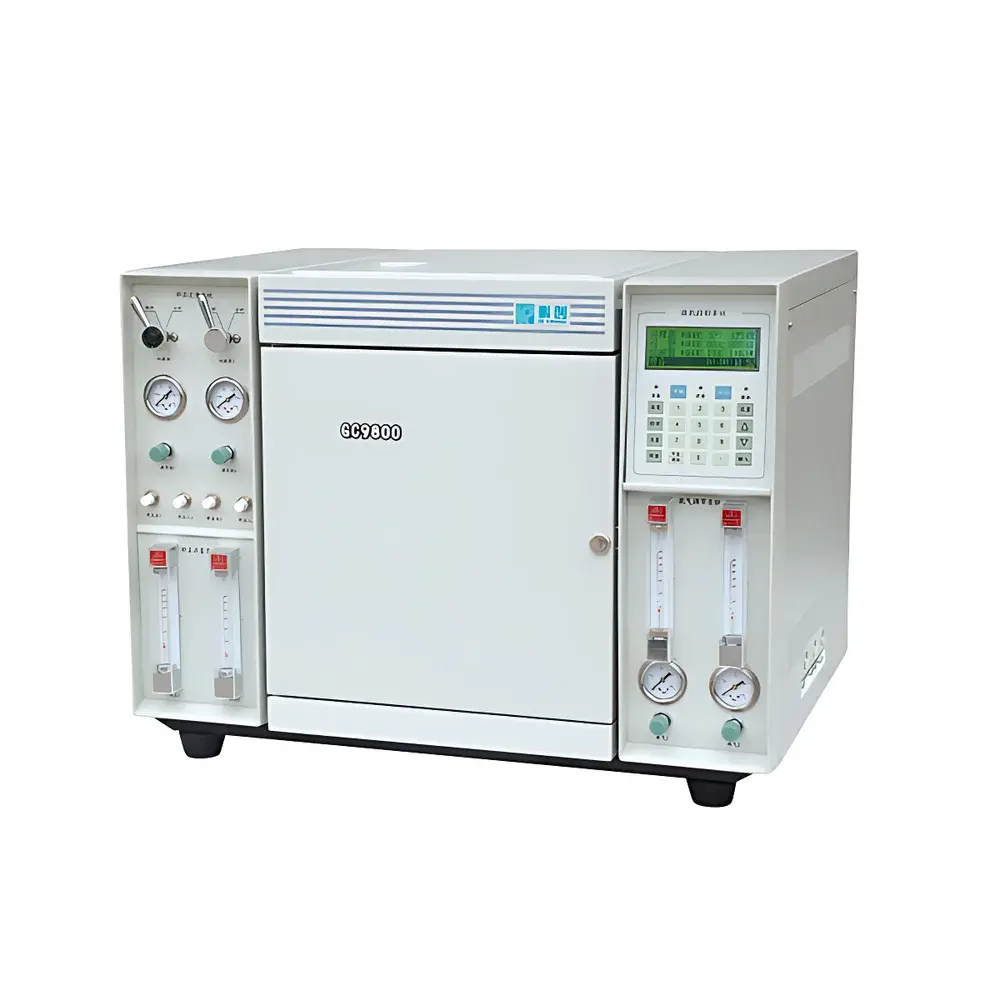
SciTech GC9800-N/FH High-Purity Gas Analysis Gas Chromatograph
| Brand | SciTech |
|---|---|
| Origin | Shanghai, China |
| Manufacturer Type | Direct Manufacturer |
| Product Category | Domestic Laboratory Gas Chromatograph |
| Model | GC9800-N/FH |
| Instrument Type | Laboratory Gas Chromatograph |
| Primary Application | Dedicated High-Purity Gas Analysis |
| Oven Temperature Range | 8 °C above ambient to 400 °C |
| Oven Ramp Rate | 0.1–39 °C/min (adjustable in 0.1 °C increments) |
| Oven Cooling Rate | 400 °C → 50 °C in ≤4 min |
| Carrier Gas Flow Range & Control | 0–100 mL/min |
| Carrier Gas Pressure Range & Control | 0–250 kPa |
| Injector Maximum Operating Temperature | 300 °C |
| Injector Pressure Setting Range | 0–250 kPa |
| Injector Total Flow Setting Range | 0–1200 mL/min |
| FID Detection Limit | ≤8.0×10⁻¹² g/s (n-hexadecane) |
| FID Baseline Noise | ≤1×10⁻¹³ A |
| FID Baseline Drift | ≤7×10⁻¹³ A / 30 min |
| FID Linear Dynamic Range | 10⁷ |
| Temperature Control Accuracy | ±0.5% of setpoint |
| Max. Temperature Program Steps | 8 |
| Temperature Program Reproducibility | ≤1% RSD |
Overview
The SciTech GC9800-N/FH is a purpose-engineered laboratory gas chromatograph optimized for trace-level impurity analysis in ultra-high-purity (UHP) industrial gases—such as hydrogen, nitrogen, oxygen, argon, helium, and synthetic air—commonly used in semiconductor fabrication, photovoltaic manufacturing, and advanced materials synthesis. Its analytical architecture centers on capillary gas chromatography with flame ionization detection (FID), enhanced by an integrated nickel-catalyzed methanizer (Ni converter) to enable quantitative detection of CO and CO₂ at sub-ppb levels. The system employs a dedicated gas sampling manifold with high-pressure, low-dead-volume valves and stainless-steel or fused-silica capillary columns tailored for permanent gas separation. Temperature-programmed elution—supported by precise oven thermal control (±0.5% accuracy), rapid cooling (400 °C → 50 °C in ≤4 min), and near-ambient operation (as low as 8 °C above ambient)—ensures robust resolution of closely eluting species including O₂/N₂/CH₄, Ar/O₂, and CO/CO₂/N₂ mixtures.
Key Features
- Eight-step programmable temperature control with ramp rates adjustable from 0.1 to 39 °C/min (0.1 °C increment), enabling method optimization for complex multi-component gas matrices.
- Dual independent pressure and flow control for carrier and auxiliary gases (0–250 kPa pressure; 0–100 mL/min flow), ensuring retention time stability under variable backpressure conditions typical in high-purity gas analysis.
- High-temperature injector (up to 300 °C) with fully programmable pressure and total flow settings (0–1200 mL/min), compatible with both split/splitless and gas-tight loop injection modes.
- Integrated Ni methanizer upstream of the FID, converting CO and CO₂ quantitatively to methane for uniform, highly sensitive hydrocarbon-equivalent detection (detection limit ≤8.0×10⁻¹² g/s as n-hexadecane).
- Large-capacity column oven with automatic rear-door opening and forced-air cooling, supporting fast cycle times without thermal memory effects.
- Embedded Ethernet (10/100BASE-T) interface compliant with TCP/IP protocols, enabling remote instrument control, real-time data streaming, and centralized fleet management across up to 253 units via a single workstation.
- Self-diagnostic firmware with fault localization (e.g., heater failure, sensor drift, valve timing error) and hardware-enforced overtemperature protection—automatic power cutoff if any zone exceeds user-defined limits.
Sample Compatibility & Compliance
The GC9800-N/FH is validated for analysis of Grade 5 (99.999%) and Grade 6 (99.9999%) industrial gases per ISO 8573-1:2010 (compressed air purity classes) and ASTM D1946 (standard test method for analysis of reformed gas). It supports full compliance with semiconductor industry requirements defined in SEMI F57 and SEMI F21 for residual hydrocarbon, oxygen, nitrogen, carbon monoxide, and carbon dioxide quantification. All fluidic pathways are electropolished stainless steel or passivated to minimize adsorption and catalytic decomposition of reactive analytes. The system architecture meets foundational prerequisites for GLP and GMP environments—including audit-trail-ready event logging, user-access controls, and electronic signature support when paired with compliant chromatography data systems (CDS).
Software & Data Management
The instrument integrates a native Ethernet-enabled data acquisition engine with embedded chromatographic processing algorithms. Raw analog signals are digitized at ≥10 kHz and transmitted directly via network cable as calibrated digital streams (no USB or RS-232 intermediaries), minimizing signal degradation and electromagnetic interference. The bundled SciTech ChromaLink™ workstation supports ICH M7-compliant peak integration, multi-point calibration curve generation (linear, quadratic, or polynomial), and automated report generation in PDF or CSV formats. Data files adhere to ASTM E1947-compliant metadata tagging (including instrument ID, method version, analyst ID, acquisition timestamp, and environmental conditions). Remote access functionality permits secure web-based monitoring and method deployment across distributed laboratories, with optional integration into enterprise LIMS platforms via HL7 or ASTM E2500-compliant APIs.
Applications
- Residual impurity profiling in bulk UHP hydrogen for fuel cell and ammonia synthesis feedstock qualification.
- Trace CO/CO₂ verification in electronic-grade nitrogen and argon used in CVD/PVD chamber purging.
- Quantitative O₂ and H₂O (via indirect detection using molecular sieve columns) in helium carrier gas for GC-MS systems.
- Verification of hydrocarbon contaminants (C₁–C₆) in oxygen supplied for medical device sterilization (per ISO 13485 Annex A).
- Batch release testing of specialty gas mixtures (e.g., calibration standards for environmental monitoring equipment) per ISO Guide 34 and ISO/IEC 17025 requirements.
FAQ
What detection technologies does the GC9800-N/FH support beyond FID?
The base configuration includes FID with Ni methanizer for CO/CO₂ detection. Optional configurations support thermal conductivity detection (TCD) for universal permanent gas analysis and pulsed discharge helium ionization detection (PDHID) for sub-ppq noble gas impurity measurement.
Is the system compliant with FDA 21 CFR Part 11?
Out-of-the-box, the GC9800-N/FH provides audit-trail-capable logging and user authentication. Full 21 CFR Part 11 compliance requires deployment with SciTech’s validated ChromaLink™ Enterprise CDS, including electronic signatures, role-based permissions, and immutable data archiving.
Can the instrument operate unattended for extended periods?
Yes—equipped with automated valve sequencing, scheduled shutdown/restart, and email/SNMP alerting for abnormal events (e.g., pressure loss, temperature deviation), it supports 72+ hour unattended operation under validated methods.
What column types are recommended for high-purity helium analysis?
Molecular sieve 5Å packed columns or PLOT Al₂O₃/KCl capillary columns are recommended for separating He from H₂, O₂, N₂, CH₄, and CO; column selection must be matched to the specified temperature program and detector configuration.
Does the system support external trigger inputs for synchronized sampling?
Yes—the rear panel includes TTL-compatible digital I/O ports for hardware-triggered injection, oven ramp initiation, or detector signal gating, enabling synchronization with process analyzers or mass spectrometers.






