
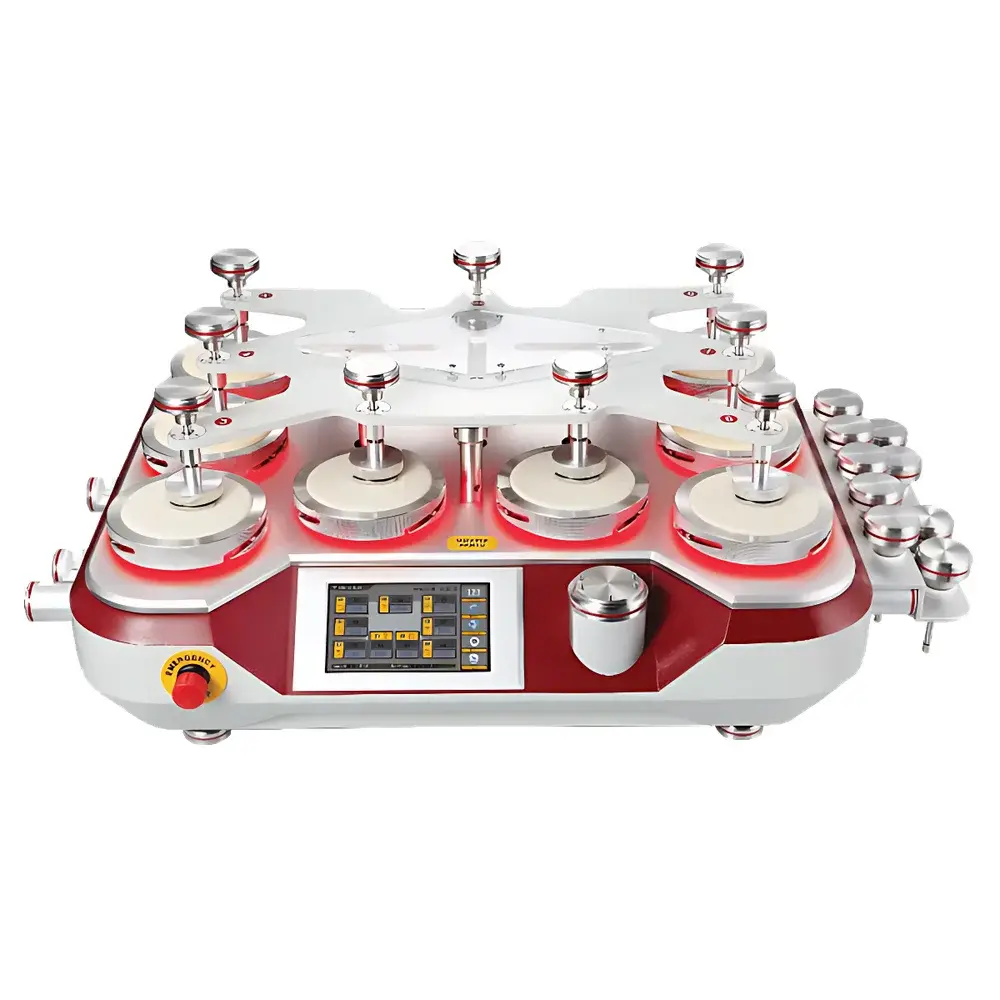
SDL Atlas M235 Martindale Abrasion and Pilling Tester
| Brand | SDL Atlas |
|---|---|
| Origin | Guangdong, China |
| Manufacturer Type | Manufacturer |
| Regional Classification | Domestic (China) |
| Model | M235 |
| Price Range | USD 14,000 – 42,000 |
Overview
The SDL Atlas M235 Martindale Abrasion and Pilling Tester is an engineered solution for objective evaluation of fabric surface durability under controlled cyclic rubbing motion. Based on the standardized Martindale method (ISO 12947-1 to -4, ASTM D4966, BS EN ISO 12947, GB/T 21196), it quantifies resistance to abrasion and propensity to form pills through a defined Lissajous-type elliptical motion—where a circular fabric specimen is subjected to multidirectional friction against a standard abradant (typically wool or nylon) under precisely regulated load and stroke count. The instrument’s mechanical architecture ensures high reproducibility across test positions by maintaining consistent contact pressure, motion amplitude (±0.5 mm deviation), and rotational symmetry of the abrasive head. Its modular design supports both routine QC compliance testing and R&D-level comparative analysis in textile development labs, apparel quality assurance departments, and third-party certification laboratories.
Key Features
- Full-color capacitive touchscreen interface with intuitive icon-driven navigation—enabling one- or two-touch execution of common protocols (e.g., start/stop, parameter recall, position reset)
- Multi-language support: English, Chinese, Spanish, and Turkish—configurable per user preference without firmware update
- Independent LED indicators and audible beeps per test station (4-, 6-, 8-, or 9-position configurations available), signaling test completion or abnormal termination
- Three-piece sliding motion plate assembly with integrated acoustic-dampening pads—reducing operational noise to ≤62 dB(A) at 1 m distance
- Quick-lock coupling mechanism for rapid removal and reinstallation of motion plates—facilitating traceable calibration and preventive maintenance per ISO/IEC 17025 requirements
- Integrated sample holder with spring-loaded clamping—ensuring uniform 9 kPa or 12 kPa contact pressure across all specimens without manual torque adjustment
- Compact footprint base (W × D × H: 620 × 540 × 410 mm for 4-head; up to 820 × 620 × 410 mm for 9-head)—optimized for space-constrained ISO 17025-accredited labs
- Side-mounted acrylic accessory rack (optional for 6/8/9-head models)—designed for organized, dust-free storage of Martindale abradants, weights, and calibration tools
Sample Compatibility & Compliance
The M235 accommodates a broad spectrum of planar textile substrates—including woven and knitted fabrics, nonwovens, coated textiles, leather, synthetic upholstery, carpet backing, and technical floor coverings. It supports standardized test geometries per ISO 12947-2 (abrasion) and ISO 12947-3 (pilling), as well as retailer-specific protocols (e.g., Walmart WMTS, H&M Higg Index Module 3, Inditex ZDHC MRSL). All test parameters—including load (9 kPa or 12 kPa default; optional 2 kPa–20 kPa range via custom weights), stroke count (1–99,999 cycles), and motion speed (40–70 rpm)—are programmable and audit-trail logged. The system meets essential electromagnetic compatibility (EMC) and electrical safety standards (IEC 61000-6-3, IEC 61000-6-4, IEC 61010-1), and its mechanical repeatability complies with ISO 12947-4 Annex B for inter-laboratory precision.
Software & Data Management
The M235 operates autonomously via embedded firmware but integrates seamlessly with SDL Atlas RemoteAccess—a secure cloud-enabled monitoring application. RemoteAccess provides real-time visibility into active test status, cycle progress, error logs, and historical run metadata (including operator ID, timestamp, material lot number, and test standard applied). Data export is supported in CSV and PDF formats, with optional integration into LIMS environments via configurable RESTful API endpoints. All instrument events—including parameter changes, calibration actions, and emergency stops—are time-stamped and stored locally with tamper-evident logging, satisfying GLP/GMP documentation requirements and FDA 21 CFR Part 11 electronic record integrity criteria when paired with user access controls.
Applications
- Quantitative assessment of wear resistance in apparel fabrics (e.g., denim, sportswear, workwear)
- Pilling tendency evaluation of polyester-cotton blends, acrylic knits, and fleece materials
- Performance validation of anti-pilling finishes and nanocoated textiles
- Quality conformance testing for automotive interior textiles (seats, door panels, headliners)
- Durability benchmarking of medical textiles (surgical gowns, drapes) per AAMI PB70 standards
- Development-stage screening of novel fiber architectures (e.g., core-sheath, bi-component filaments)
- Third-party certification testing aligned with OEKO-TEX® Standard 100 and GOTS requirements
FAQ
What international standards does the M235 comply with?
The M235 is validated for ISO 12947-1 to -4, ASTM D4966, BS EN ISO 12947, GB/T 21196, and JIS L1096, with full traceability to NIST-traceable force and displacement calibrations.
Can the instrument be used for non-textile materials such as rubber or plastics?
While primarily designed for planar flexible substrates, the M235 may be adapted for select elastomeric or thin polymer films using custom abradants and load configurations—subject to method validation per ISO 17025 Clause 7.2.
Is remote calibration verification possible?
Yes—RemoteAccess supports scheduled diagnostic runs and stores calibration certificate metadata, though physical verification with certified reference weights and motion analyzers remains mandatory per accreditation body requirements.
How often does the motion plate require maintenance?
Under typical lab usage (≤8 hrs/day), the three-piece sliding plate assembly requires lubrication every 6 months and full inspection annually, as documented in the included maintenance logbook and SDL Atlas Service Manual Rev. 4.2.
Does the system support automated reporting for audit submissions?
Yes—PDF reports include instrument ID, calibration due date, operator signature field, test standard version, raw cycle counts, and pass/fail determination per selected acceptance criteria, fully compliant with ILAC-P15 and ISO/IEC 17025 reporting clauses.






