
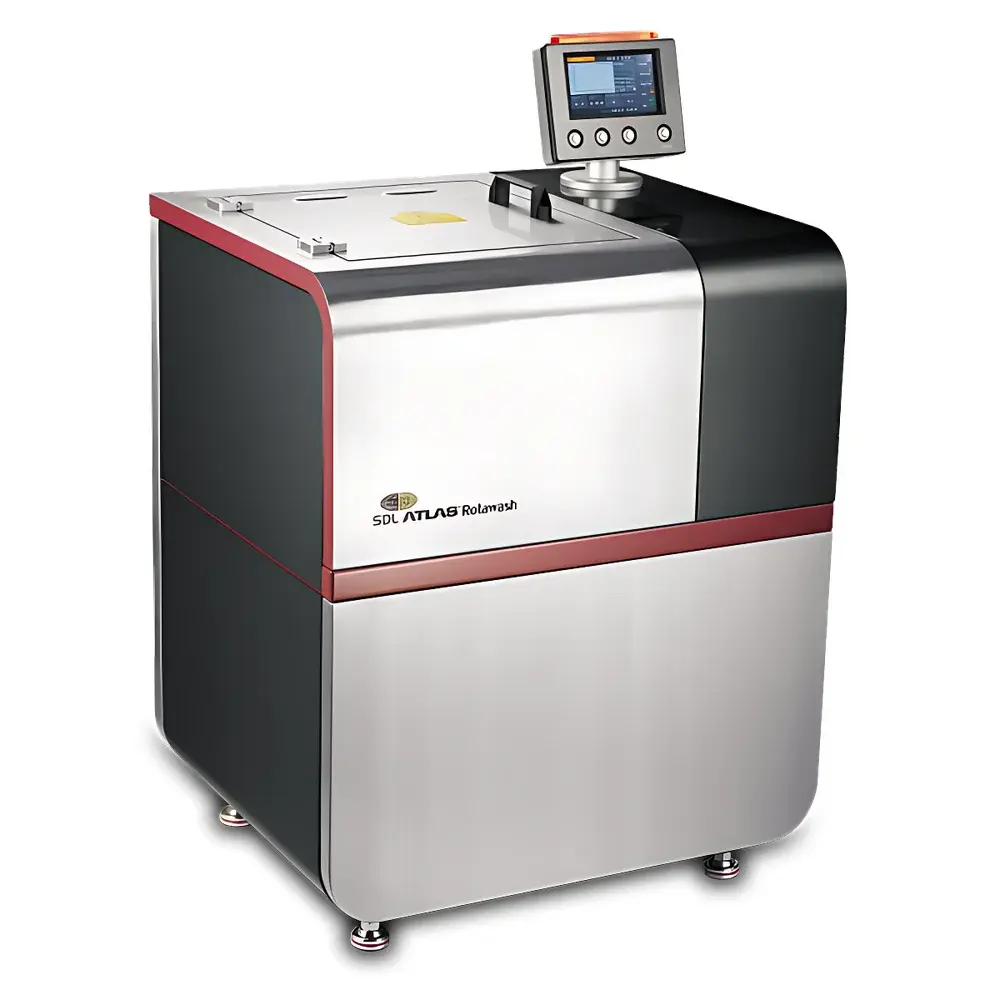
SDL Atlas Rotawash M228 Washing Fastness Tester
| Brand | SDL Atlas |
|---|---|
| Origin | Shenzhen, China |
| Manufacturer Type | Original Equipment Manufacturer (OEM) |
| Country of Manufacture | China |
| Model | M228 |
| Price Range | USD 14,000 – 70,000 |
| Wash Canister Options | 8-position or 12-position |
| Canister Volumes | 550 mL or 1200 mL |
| Construction | Full 316 stainless steel housing |
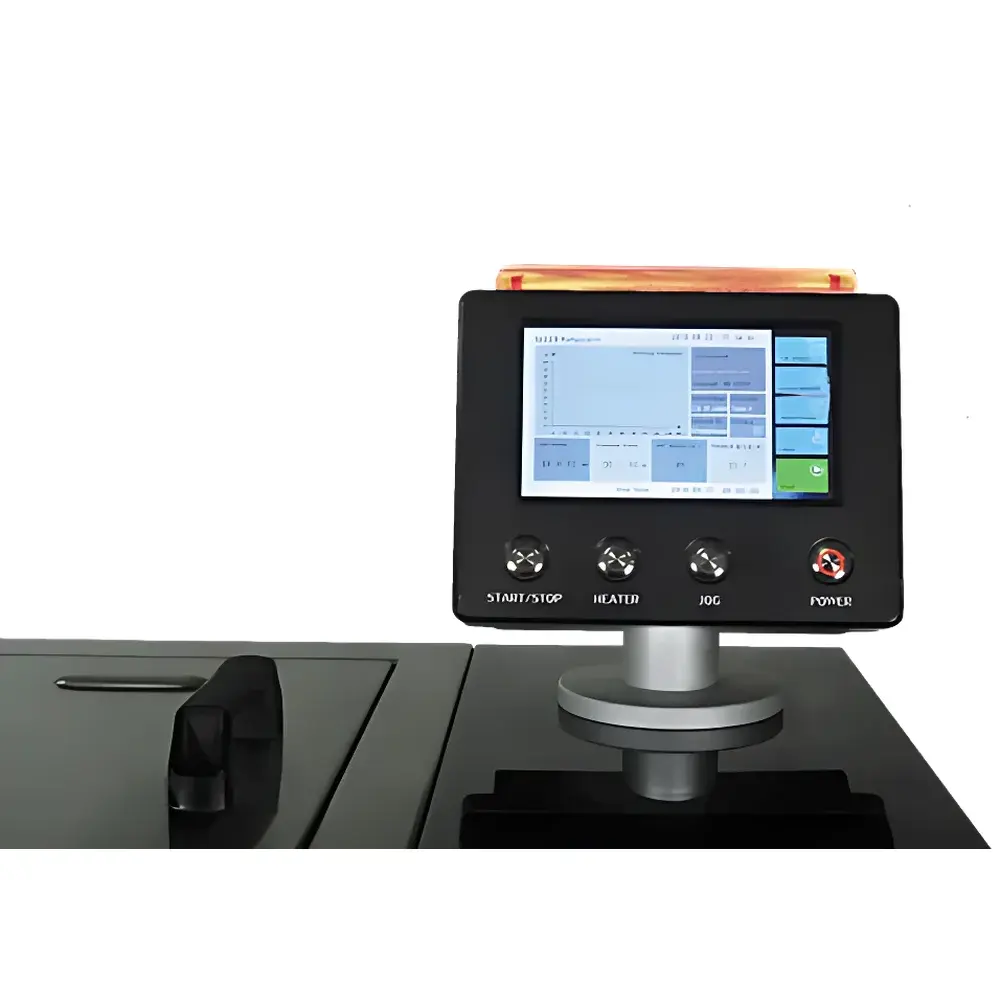
| Control Interface | Full-color capacitive touchscreen |
| Language Support | English, Chinese, Spanish, Turkish |
| Safety Features | Interlocked door switch (rotor stops immediately upon door opening), momentary jog button for rotor positioning |
| Connectivity | RemoteAccess™ mobile monitoring (iOS/Android compatible) |
| Compliance | Designed to meet ISO 105-C06, ISO 105-C08, AATCC Test Method 61, GB/T 3921, and related textile washing fastness standards |
Overview
The SDL Atlas Rotawash M228 Washing Fastness Tester is a precision-engineered, benchtop instrument designed to evaluate colorfastness to domestic and commercial laundering procedures in accordance with internationally recognized textile testing standards. It operates on the principle of controlled mechanical agitation—rotating cylindrical canisters containing fabric specimens, detergent solution, and stainless-steel balls—within a thermostatically regulated water bath. This simulates standardized wash cycles defined by ISO, AATCC, and GB/T methodologies, enabling reproducible assessment of dye migration, bleeding, crocking, and substrate degradation under repeatable thermal and mechanical stress conditions. The M228 is engineered for laboratories requiring high throughput without compromising compliance integrity, offering scalable capacity (8- or 12-canister configurations) and dual-volume canister support (550 mL and 1200 mL) to accommodate diverse specimen sizes—from small swatches to multi-layered garment panels.
Key Features
- Full 316 stainless steel construction ensures corrosion resistance and long-term stability in high-humidity laboratory environments, meeting stringent durability requirements for daily QC operations.
- Interlocked safety door mechanism halts rotor rotation instantly upon door actuation—eliminating risk of operator exposure during sample loading/unloading and supporting ISO/IEC 17025-compliant operational protocols.
- Momentary jog control enables precise manual positioning of canisters for effortless specimen insertion and retrieval—critical for maintaining consistent tension and placement across test batches.
- Capacitive full-color touchscreen interface provides intuitive navigation, real-time parameter visualization, and tactile feedback; supports multi-language operation (English, Chinese, Spanish, Turkish) to facilitate global lab deployment.
- Pre-loaded standard test methods—including ISO 105-C06 (colorfastness to washing, cotton), ISO 105-C08 (multi-fiber adjacent fabric), AATCC 61 (accelerated laundering), and GB/T 3921—reduce setup time and minimize procedural deviation.
- Programmable custom cycle storage allows users to define and save unique temperature profiles, rotation speeds (rpm), dwell times, rinse sequences, and drying parameters—enabling method development for proprietary finishes or novel fiber blends.
Sample Compatibility & Compliance
The Rotawash M228 accommodates a broad spectrum of textile substrates, including woven and knitted fabrics, nonwovens, yarns, and finished garments. Its modular canister system supports both single-specimen and multi-specimen configurations using standardized adjacent fabrics (e.g., multifiber DW, cotton, wool, acetate). All hardware—including canisters, balls, and clamps—is manufactured to dimensional tolerances specified in ISO 105-C06 Annex A and AATCC TM61 Section 6.1. The instrument’s thermal uniformity (±0.5 °C across bath volume) and rotational speed accuracy (±1 rpm) are validated per ISO/IEC 17025 calibration guidelines. Documentation packages include traceable factory calibration certificates and compliance statements aligned with ISO/IEC 17025, GLP, and textile-specific regulatory frameworks (e.g., OEKO-TEX® Standard 100 test prerequisites).
Software & Data Management
The embedded controller logs all test parameters—including start/stop timestamps, actual vs. setpoint temperatures, cumulative rotation counts, and error flags—in non-volatile memory. Data export is supported via USB drive (CSV format) for integration into LIMS or QA reporting systems. Optional RemoteAccess™ connectivity enables secure, encrypted remote monitoring: iOS and Android users receive push notifications at test completion, view live status (temperature, rpm, elapsed time), and access historical run logs without physical lab access—supporting hybrid work models and multi-site audit readiness. While the base firmware does not include 21 CFR Part 11 electronic signature functionality, audit trails (user login, method edits, run initiation) are timestamped and immutable, satisfying foundational GLP/GMP data integrity expectations.
Applications
- Quality assurance of dyed and printed textiles prior to bulk production release.
- Evaluation of reactive, disperse, acid, and pigment dye systems across natural and synthetic fibers.
- Validation of eco-friendly finishing agents (e.g., bio-based softeners, low-VOC binders) against wash-induced performance loss.
- Comparative analysis of colorfastness between competing suppliers’ materials in Tier-1 apparel sourcing labs.
- Supporting sustainability claims through standardized measurement of wash-related microfiber shedding (when used with optional filtration kits).
- Academic research on fiber–dye interaction kinetics under accelerated aging protocols.
FAQ
What standards does the Rotawash M228 comply with?
It is fully compatible with ISO 105-C06, ISO 105-C08, AATCC Test Method 61 (Types I–IV), GB/T 3921 (A–E), and JIS L 0844—configurable via preloaded method templates.
Can I use third-party canisters or stainless-steel balls?
No. Only SDL Atlas-certified consumables guarantee dimensional accuracy, surface finish, and mass tolerance required for compliant test execution; non-OEM parts invalidate standard conformance.
Is calibration traceable to national metrology institutes?
Yes. Factory calibration uses NIST-traceable temperature sensors and rotational encoders; on-site recalibration services are available through SDL Atlas authorized service centers.
Does the device support automated data transfer to ERP or PLM systems?
Direct API integration is not included, but CSV exports enable scripting-based ingestion into common enterprise platforms via middleware or custom ETL workflows.
What maintenance is required for long-term reliability?
Monthly inspection of door interlock function, quarterly cleaning of bath chamber seals and drain lines, and annual verification of thermal uniformity and speed accuracy—documented in the included Maintenance Logbook.





