
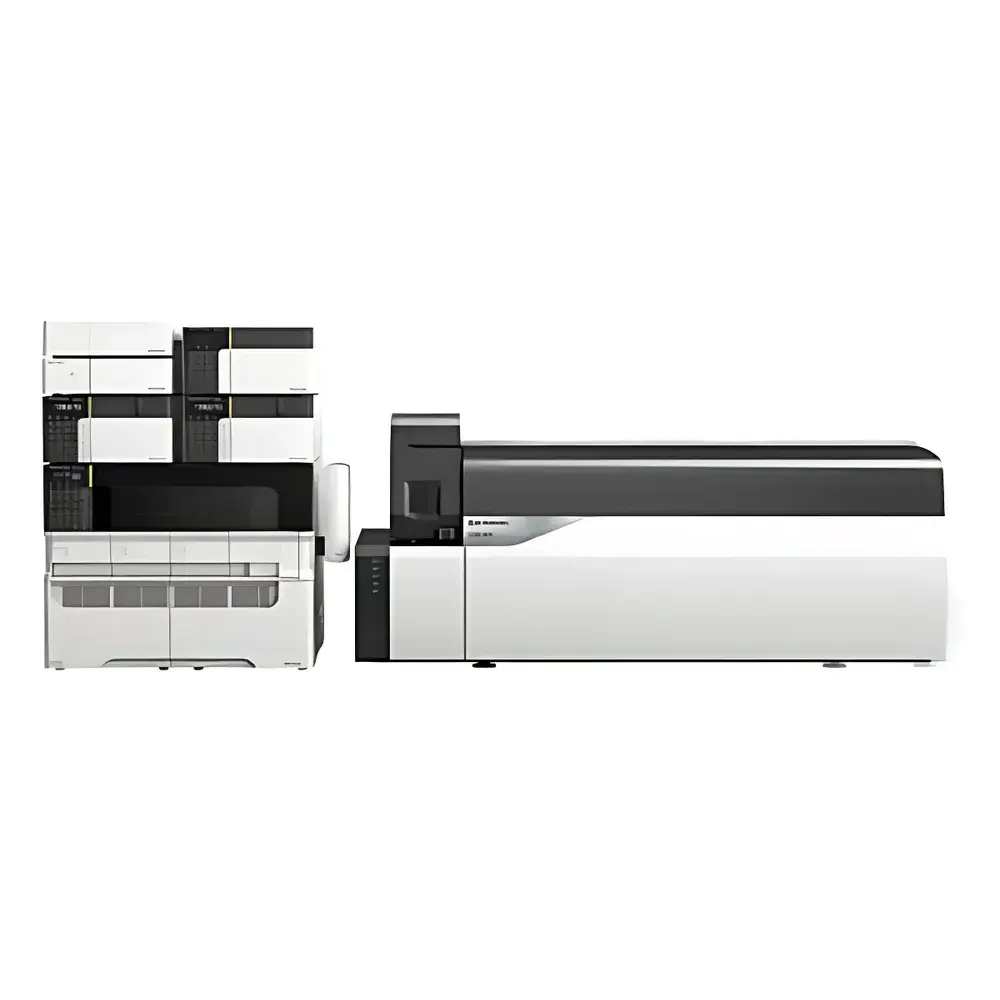
Shimadzu LCMS-8045 Used Triple Quadrupole Liquid Chromatography Mass Spectrometer
| Brand | Shimadzu |
|---|---|
| Origin | Japan |
| Model | LCMS-8045 |
| Instrument Type | Triple Quadrupole (TQ) |
| Mass Range | 10–3000 m/z |
| Sensitivity | S/N ≥ 100:1 (1 pg reserpine, ESI+) |
| Resolution | 0.5–0.7 m/z (FWHM) |
| Mass Accuracy | ±0.1 Da |
| Polarity Switching Time | 5 ms |
| Scan Speed | 30,000 u/sec |
| Step Size | 0.1 u |
Overview
The Shimadzu LCMS-8045 is a used triple quadrupole liquid chromatography mass spectrometer engineered for high-throughput, high-sensitivity quantitative analysis in regulated and research laboratory environments. Based on Shimadzu’s Ultra-Fast MS platform architecture, the LCMS-8045 employs electrospray ionization (ESI) coupled with collision-induced dissociation (CID) in a tandem quadrupole configuration to deliver robust selected reaction monitoring (SRM) and multiple reaction monitoring (MRM) performance. Its core design emphasizes reproducible ion transmission, minimal signal drift, and compatibility with ultra-high-performance liquid chromatography (UHPLC) systems—enabling sub-second peak detection and reliable integration of narrow chromatographic peaks. The instrument operates under high-vacuum conditions maintained by dual-stage turbomolecular pumps and features a compact, service-oriented mechanical layout optimized for long-term operational stability in routine QC, environmental testing, pharmaceutical development, and food safety applications.
Key Features
- Sub-millisecond polarity switching: 5 ms transition between positive and negative ion modes supports simultaneous MRM acquisition without sacrificing dwell time or quantitative precision—critical for multi-analyte assays in complex matrices.
- High-speed scanning at 30,000 u/sec: Maintains spectral fidelity and peak shape integrity even during rapid UHPLC gradients, enabling concurrent quantitation (MRM) and confirmation (product ion scan) within a single injection.
- Precision mass stepping at 0.1 u: Ensures consistent resolution and reproducible fragment ion selection across wide mass ranges, enhancing method transferability and inter-laboratory comparability.
- Modular ion source design: Cable-free, tubing-free ESI interface allows solvent line and desolvation tube replacement without breaking vacuum—reducing maintenance downtime and improving long-term ionization stability.
- Collision cell optimization: Patented curved collision cell geometry minimizes neutral noise and improves precursor-to-product ion transmission efficiency, contributing to sustained sensitivity over extended run times.
- Scalable platform: Hardware and firmware architecture supports seamless upgrade to LCMS-8060 specifications (e.g., enhanced detector gain, improved RF stability), preserving capital investment through evolving analytical requirements.
Sample Compatibility & Compliance
The LCMS-8045 is validated for use with standard reversed-phase, HILIC, and ion-pairing LC methods using aqueous/organic mobile phases. It accommodates flow rates from 0.05 to 1.5 mL/min and interfaces natively with Shimadzu Nexera and Prominence UHPLC/HPLC systems via standard ESI or APCI sources. The system meets essential regulatory expectations for data integrity and traceability: raw data files are stored in proprietary .qgd format with embedded acquisition metadata; audit trails, user access logs, and electronic signatures can be enabled via LabSolutions software configured per 21 CFR Part 11 requirements. Method validation parameters—including linearity (R² ≥ 0.999), LOD/LOQ determination, matrix effect assessment, and carryover evaluation—are fully supported through built-in tools aligned with ICH Q2(R2), USP , and ISO/IEC 17025 frameworks.
Software & Data Management
Control, acquisition, and processing are managed through Shimadzu LabSolutions LCMS software (v5.9x or later), a Windows-based platform offering intuitive graphical workflows for method building, sequence setup, real-time monitoring, and post-run review. Key modules include Quant Browser for automated peak integration and calibration curve fitting; Library Search for spectral matching against NIST/EPA/Tox21 libraries; and Multi-Component Analysis for simultaneous quantification of >100 analytes in a single MRM method. All processed results export to CSV, PDF, or XML formats compliant with LIMS integration protocols. Raw data archiving follows hierarchical storage principles, with optional encryption and checksum verification to satisfy GLP/GMP archival retention policies.
Applications
- Residue analysis of pesticides, veterinary drugs, and mycotoxins in food and agricultural commodities (AOAC 2012.01, EN 15662)
- Pharmaceutical impurity profiling and stability-indicating assays per ICH Q3B/Q5C guidelines
- Environmental screening of PFAS, pharmaceuticals, and endocrine disruptors in wastewater and soil extracts (EPA Method 1694, ISO 21675)
- Clinical toxicology and therapeutic drug monitoring (TDM) in human plasma and urine matrices
- Metabolite identification support via information-dependent acquisition (IDA) triggered from full-scan or MRM events
FAQ
Is the LCMS-8045 compliant with 21 CFR Part 11?
Yes—when deployed with LabSolutions LCMS v5.91+ and configured with role-based user accounts, electronic signatures, and audit trail logging enabled, the system satisfies technical controls required for FDA-regulated submissions.
What maintenance intervals are recommended for a used LCMS-8045?
Ion source cleaning every 2–4 weeks (depending on sample load), turbo pump bearing inspection annually, and routine calibration with tune mix every 72 hours or prior to critical batches.
Can the LCMS-8045 perform qualitative analysis alongside quantitation?
Yes—it supports scheduled MRM with embedded product ion scans, neutral loss scans, and precursor ion scans, allowing structural confirmation without method re-injection.
Is source replacement possible without venting the mass spectrometer?
Yes—the cable-free, tube-free ion source design permits full desolvation tube and capillary exchange under vacuum, minimizing instrument downtime and contamination risk.
Does this unit include original factory documentation and service history?
All verified units are supplied with full OEM documentation package—including installation qualification (IQ) records, operational qualification (OQ) reports, and most recent preventive maintenance logs—available upon request prior to shipment.
Related Products






