
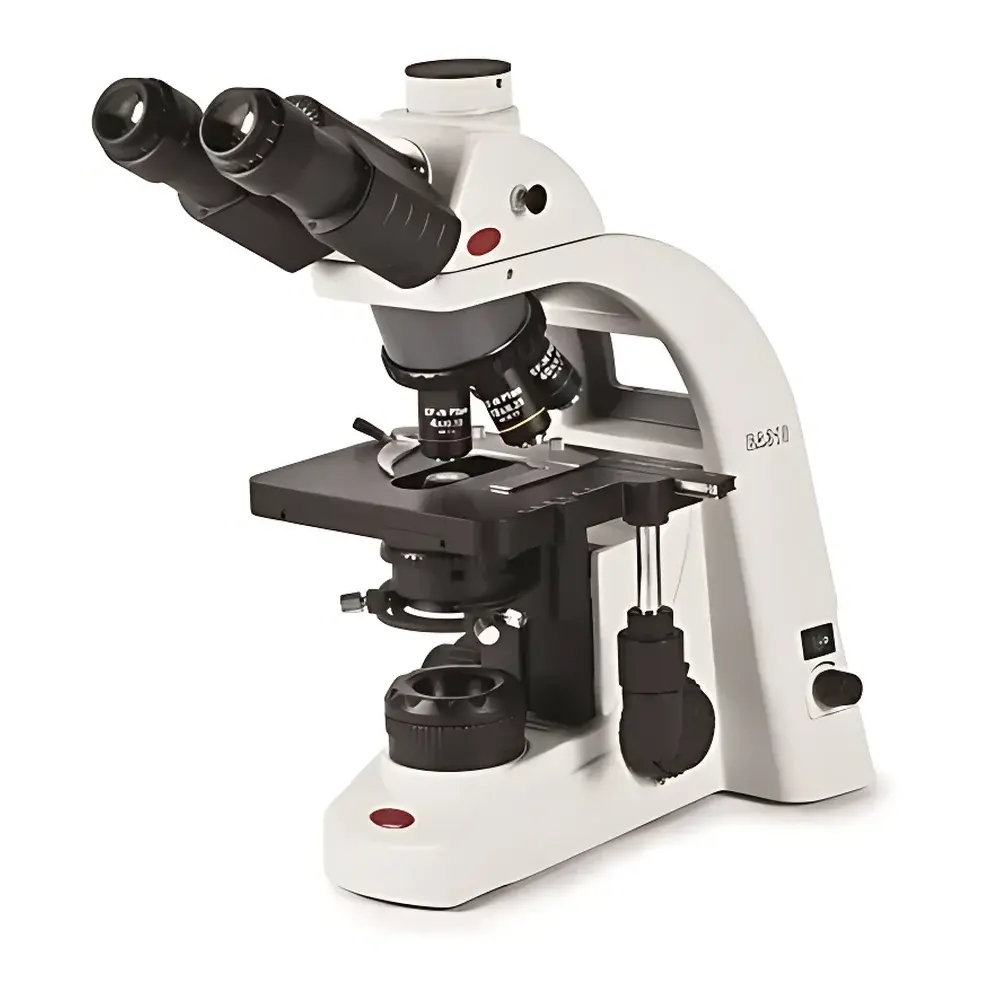
SDLATLAS G208B Precision Trinocular Optical Microscope
| Brand | SDLATLAS |
|---|---|
| Origin | USA |
| Manufacturer Type | Original Equipment Manufacturer (OEM) |
| Import Status | Imported |
| Model | G208B |
| Pricing | Available Upon Request |
Overview
The SDLATLAS G208B Precision Trinocular Optical Microscope is a high-stability, research-grade upright microscope engineered for consistent optical performance in industrial quality control and materials characterization laboratories. Built upon a rigid cast-aluminum mechanical base and precision-machined optical pathway, it employs standard brightfield illumination with Köhler illumination compatibility to ensure uniform field brightness and optimal contrast across the entire visual field. Its optical design conforms to finite-conjugate correction standards (160 mm tube length), supporting interchangeable achromatic objective lenses and standardized 23.2 mm eyepiece tubes. The instrument delivers total magnifications of 40×, 100×, 400×, and 1000×—achievable via 10× wide-field eyepieces paired with 4×, 10×, 40×, and 100× (oil immersion) achromatic objectives—making it suitable for fiber morphology analysis, textile defect identification, coating thickness estimation, and microstructural evaluation of non-biological specimens.
Key Features
- Trinocular head with 30° inclined viewing angle and full 360° rotational capability, enabling ergonomic operation and simultaneous visual observation plus imaging output
- Coaxial coarse and fine focusing mechanism with 20 mm vertical travel range and 2 µm fine-focus graduation for precise Z-axis positioning
- Large mechanical stage (160 × 140 mm) equipped with dual-axis vernier-calibrated X–Y translation (0.1 mm resolution), facilitating systematic scanning of extended samples such as woven fabrics or composite laminates
- Adjustable 6 V / 30 W quartz halogen illuminator with continuous intensity control, optimized for stable color temperature (~3200 K) and minimal thermal drift during prolonged operation
- Dedicated trinocular port (23.2 mm diameter) compliant with C-mount and standard 1″ photographic adapters, supporting integration with CCD/CMOS cameras, digital microscopy systems, or third-party image acquisition hardware
- Reinforced dovetail-mounted nosepiece accommodating up to five objective positions, ensuring repeatable lens alignment and minimal parfocality error (< 0.02 mm)
Sample Compatibility & Compliance
The G208B accommodates opaque, translucent, and semi-transparent solid specimens up to 45 mm in height—including yarn cross-sections, nonwoven fabric layers, polymer films, metallographic mounts, and printed circuit board substrates. Its stage clips and optional specimen holders support flat, rigid, or low-profile samples without requiring vacuum or conductive coating. While not designed for live-cell or fluorescence applications, the system meets mechanical and optical requirements referenced in ASTM E2917 (Standard Practice for Determining the Precision of Microscopical Measurements) and ISO 10934-1 (Optics and optical instruments — Vocabulary for microscopy). All electrical components comply with UL 61010-1 and IEC 61010-1 safety standards for laboratory equipment.
Software & Data Management
The microscope functions as a hardware platform compatible with industry-standard image analysis software suites—including ImageJ/Fiji (open-source), Olympus cellSens, and Media Cybernetics Image-Pro Premier—via standard USB 3.0 or GigE camera interfaces. When integrated with validated digital imaging systems, the G208B supports audit-trail-enabled workflows aligned with GLP and GMP documentation practices. Metadata capture (magnification, objective ID, illumination setting, timestamp) is preserved in TIFF or OME-TIFF formats, ensuring traceability per FDA 21 CFR Part 11 requirements when deployed in regulated textile testing or materials certification environments.
Applications
- Textile quality assurance: fiber type identification, yarn twist assessment, pilling resistance evaluation, and weave structure documentation
- Materials science: grain boundary mapping in sintered ceramics, filler dispersion analysis in polymer composites, and surface defect quantification on coated substrates
- Forensic trace evidence examination: comparison of synthetic fiber morphology and dye distribution patterns
- Electronics manufacturing: solder joint inspection, PCB solder mask integrity verification, and component lead coplanarity assessment
- Educational and vocational training labs requiring robust, serviceable instrumentation with standardized optical interfaces
FAQ
Is oil immersion required for 1000× magnification?
Yes—achieving nominal 1000× total magnification requires the 100× oil immersion objective with Type A immersion oil (n = 1.515) and proper Köhler illumination alignment.
Can the G208B be used with automated stage controllers or motorized focus units?
The mechanical stage features standard M4 threaded mounting holes and linear scale interfaces; third-party motorized stages and focus controllers may be integrated using custom brackets and TTL/RS-232 trigger signals.
Does SDLATLAS provide calibration certificates or metrological traceability documentation?
Upon request, SDLATLAS issues factory-verified alignment reports referencing NIST-traceable reference standards for stage movement linearity and objective magnification accuracy.
What is the maximum sample weight supported on the mechanical stage?
The stage and base assembly are rated for static loads up to 2.5 kg; dynamic stability is maintained under typical manual manipulation conditions.
Are replacement objectives and eyepieces available through SDLATLAS distribution channels?
All standard 160 mm finite-conjugate achromatic objectives (4×–100×) and 10× wide-field eyepieces are stocked globally and supplied with individual optical test reports.




