
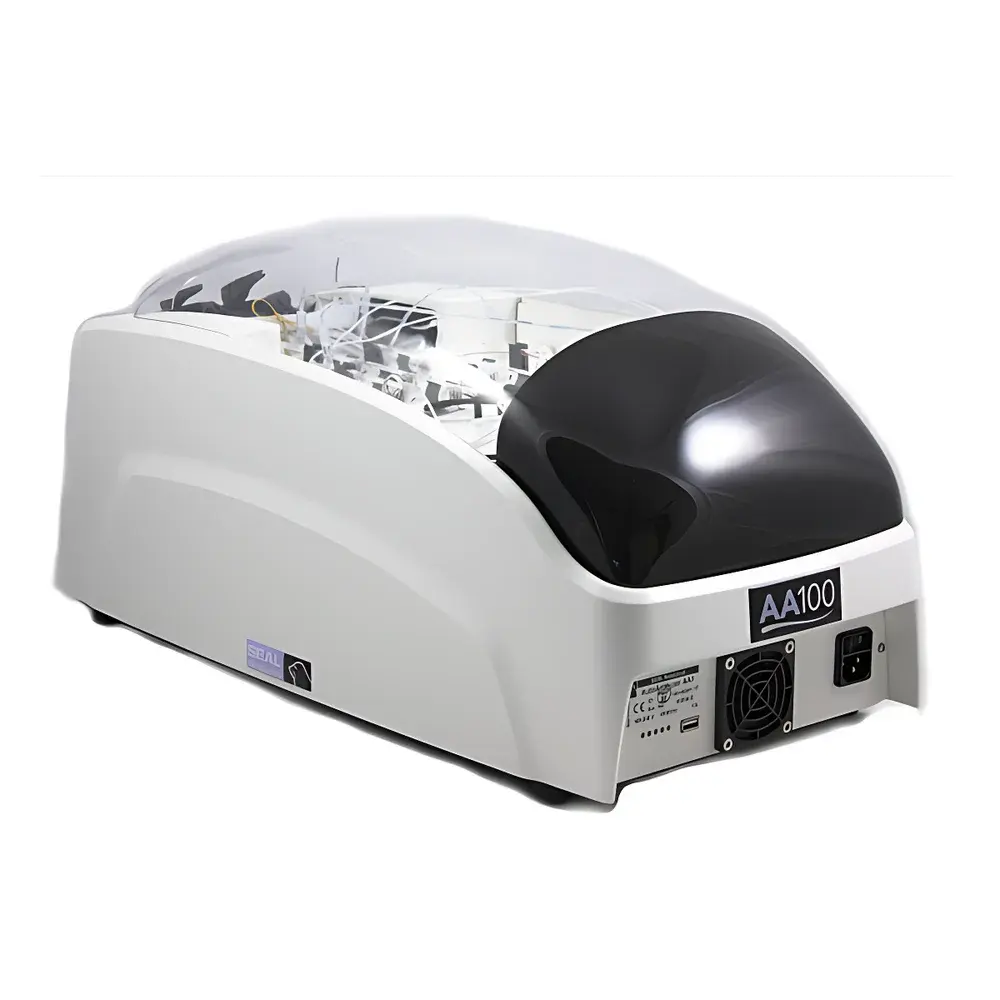
SEAL AA100 Continuous Flow Analyzer
| Brand | SEAL |
|---|---|
| Origin | Germany |
| Model | AA100 |
| Product Type | Continuous Flow Analyzer |
| Wavelength Range | 25–1000 nm |
| Sample Capacity | Configurable (via rotary autosampler) |
| Reagent Positions | Unlimited (modular reagent rack support) |
| Cuvette Path Length | 10 mm |
| Light Source | High-Stability LED |
Overview
The SEAL AA100 Continuous Flow Analyzer is a compact, integrated benchtop system engineered for high-precision, routine colorimetric and photometric analysis in environmental, food & beverage, pharmaceutical, and industrial quality control laboratories. It operates on the classical continuous flow analysis (CFA) principle—based on segmented flow with air bubble separation—where samples and reagents are propelled synchronously through chemically inert PTFE tubing by precision peristaltic pumping. Air segmentation ensures discrete, reproducible reaction zones within glass or quartz coils, enabling controlled residence time, complete mixing via laminar flow, and quantitative derivatization prior to detection. The system integrates an LED-based digital photometer with thermally stabilized optics, delivering stable baseline performance across the full 25–1000 nm spectral range. Unlike flow injection analysis (FIA), CFA provides superior precision for low-concentration analytes due to inherent signal averaging over segmented peaks and minimized dispersion effects—making the AA100 particularly suited for regulatory-compliant water, wastewater, and food matrix analysis where repeatability and trace-level accuracy are critical.
Key Features
- Monolithic modular architecture: Pump manifold, chemistry coil module, detector, and temperature-controlled reaction zone are co-located in a single footprint (< 0.5 m²), minimizing carryover and thermal drift.
- High-fidelity LED photometry: Solid-state light source with narrow spectral bandwidth, calibrated against NIST-traceable standards; enables long-term intensity stability (> 12 months without recalibration under GLP conditions).
- Programmable heating block: Software-controlled Peltier-based heating (30–105 °C, ±0.3 °C uniformity) for digestion, diazotization, or enzymatic steps—fully synchronized with sample introduction and peak acquisition.
- Rotary autosampler with live-load capability: 40–160 position capacity (configurable); supports on-the-fly vial insertion during active runs without interrupting analysis sequence or data continuity.
- Multi-speed peristaltic pump: 12-channel pump head with individually adjustable roller speed (0.1–100 rpm), enabling independent flow optimization for reagents, standards, and wash solutions.
- Chemistry module compatibility: Standardized 2-mm ID glass or fluoropolymer reaction coils; optional UV-transparent quartz cells for low-wavelength applications (e.g., nitrate at 220 nm).
Sample Compatibility & Compliance
The AA100 is validated for aqueous matrices including drinking water (GB/T 5750-2023), natural mineral water (GB 8538-2022), municipal and industrial wastewater, seawater (HY-T 147.1-2013), wine must, dairy extracts, and pharmaceutical dissolution media. Its segmented-flow design inherently suppresses inter-sample contamination and matrix-induced spectral interference—critical for complex samples like digested sludge or protein-rich milk homogenates. Method compliance includes HJ 665-2013 (ammonia-N), HJ 667-2013 (total nitrogen), HJ 670-2013 (phosphate), and SL/T 788-2019 (multi-analyte CFA panels). All instrument control, data acquisition, and report generation adhere to ALCOA+ principles; audit trails, electronic signatures, and user-access hierarchies meet FDA 21 CFR Part 11 requirements when deployed with SEAL’s optional compliant software package.
Software & Data Management
SEAL’s Analytik software (v5.2+) provides method-driven workflow automation—from method loading and calibration curve generation (linear, quadratic, or spline interpolation) to real-time peak integration, outlier rejection, and QC flagging (e.g., %RSD >5%, blank drift >0.005 AU). Raw absorbance-time chromatograms are stored in vendor-neutral .csv and .dx format; metadata (instrument parameters, reagent lot numbers, operator ID, environmental logs) is embedded per ICH M7 guidelines. Batch export supports LIMS integration via ASTM E1394-compliant interface. Software validation documentation (IQ/OQ/PQ protocols) and 21 CFR Part 11 configuration files are supplied with each system.
Applications
The AA100 delivers validated performance across regulated and research-driven applications: total phosphorus and orthophosphate in eutrophication monitoring; cyanide and phenol speciation in industrial effluent compliance; nitrate/nitrite/ammonia tri-panel analysis for wastewater nitrification tracking; sulfide and COD in anaerobic digestate; free/total SO₂ in enological QA; vitamin C and organic acids in juice stability studies; alkaline phosphatase in raw milk pasteurization verification; and antibiotic residues (e.g., amoxicillin, ampicillin) in pharmaceutical intermediate testing. Its modularity allows rapid reconfiguration between EPA, ISO, and national standard methods without hardware modification.
FAQ
What distinguishes continuous flow analysis (CFA) from flow injection analysis (FIA) on the AA100?
CFA uses air segmentation to create discrete, reproducible reaction zones with defined residence times—ideal for slow reactions (e.g., color development >60 s) and regulatory methods requiring high precision (RSD <2%). FIA relies on dispersion gradients and is better suited for fast kinetics.
Can the AA100 perform digestion steps inline?
Yes—integrated Peltier-heated digestion coils (up to 105 °C) support persulfate oxidation for total phosphorus, UV/persulfate for total nitrogen, and acid hydrolysis for bound cyanide—all programmable within a single method.
Is method transfer from legacy SEAL systems supported?
Full backward compatibility exists with SEAL AQ2, AutoAnalyzer 3, and QuAAtro methods—including coil geometry definitions, timing sequences, and calibration tables—via automated import wizard.
What maintenance intervals are recommended for GLP compliance?
Peristaltic pump tubing replacement every 3 months (or 500 h runtime), LED intensity verification quarterly, and photometer wavelength calibration annually using certified holmium oxide filters.
Does the system support unattended overnight operation?
Yes—autosampler queue persistence, power-fail recovery, and automatic shutdown after final sample ensure 24/7 batch processing without manual intervention.





