
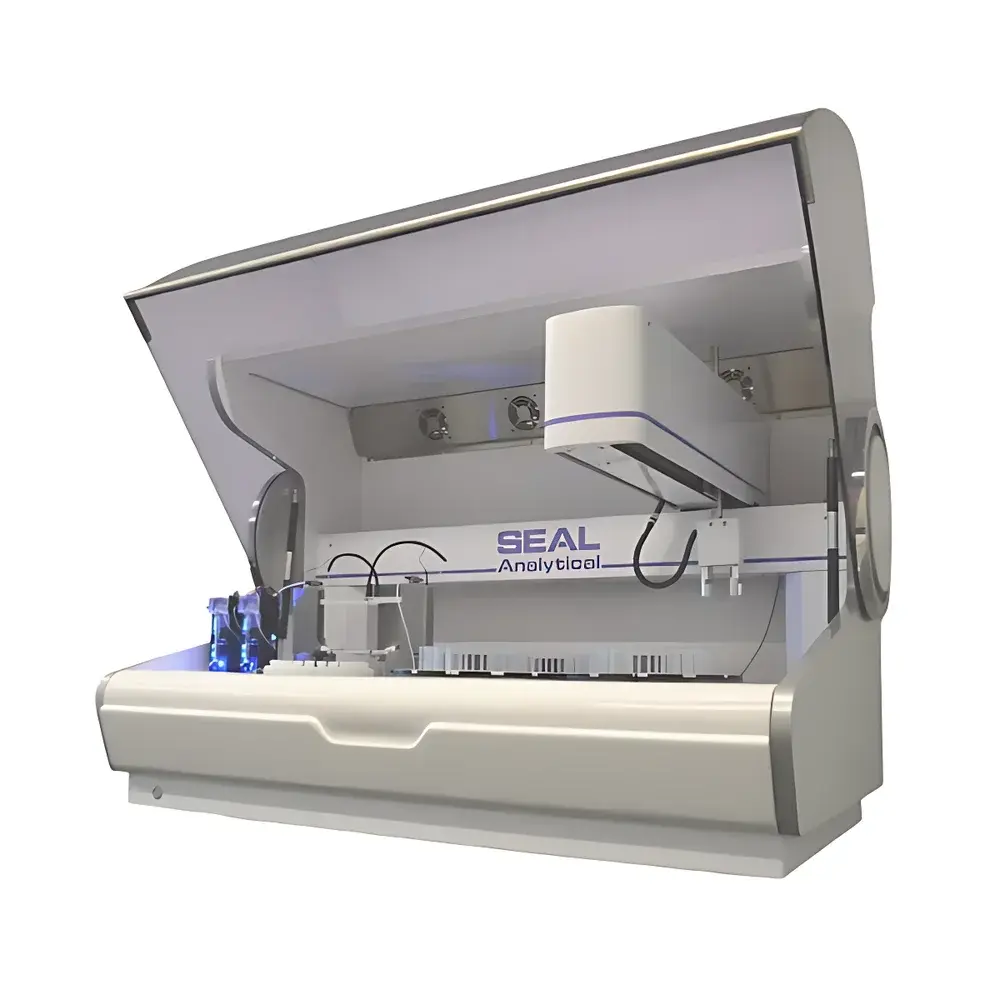
SEAL AQ700 Discrete Chemical Analyzer
| Brand | SEAL |
|---|---|
| Origin | USA |
| Model | AQ700 |
| Instrument Type | Laboratory Water Quality Analyzer |
| Analytes | Ammonium, Nitrate, Nitrite, Chloride, Orthophosphate, Sulfate, Silicate, Hexavalent Chromium, Fluoride, Total Alkalinity, Total Hardness, Calcium, Magnesium, Iron, Ferrous Iron, Manganese, Aluminum |
| Compliance | ISO 15923-1 & ISO 15923-2 |
| Optical Cell | Quartz, 1 cm pathlength (optional extended pathlength available) |
| Sample Handling | 4 robotic arms, 4 sample trays, programmable sample addition during run |
| Reagent Management | Cooled and uncooled reagent positions, up to 10 working standards per calibration curve |
| Detection Principle | Fixed-position photometric absorbance measurement in static quartz cuvette |
| Reaction Control | Programmable incubation time (seconds to minutes), bubble-free segmented reaction simulation |
| Carryover Prevention | Probe external-wall washing during vertical motion, post-measurement deep-cuvette cleaning |
| Throughput | High-capacity unattended operation (overnight, multi-shift) |
Overview
The SEAL AQ700 Discrete Chemical Analyzer is a high-throughput, benchtop analytical platform engineered for rigorous environmental water quality laboratories. It implements discrete analysis — a methodology standardized under ISO 15923-1 and ISO 15923-2 — wherein each sample and reagent aliquot is handled individually in dedicated reaction vessels, eliminating the inherent dispersion and dilution artifacts of continuous flow systems. Unlike clinical analyzers adapted for environmental use, the AQ700 was conceived from first principles to address matrix complexity in natural waters, wastewater, and soil leachates. Its core architecture features four synchronized robotic arms and four independently indexed sample trays, enabling true walk-away operation over extended periods — including overnight and multi-shift runs — without manual intervention. The system executes fully automated standard preparation, dynamic range extension via on-board dilution, and real-time sample injection even after method initiation. All reactions occur in thermally stable, optically inert quartz reaction wells, followed by transfer to a fixed-position, static quartz cuvette (standard 1 cm pathlength, with extended-path options for enhanced sensitivity). This stationary optical configuration ensures consistent light-path geometry, minimizes mechanical drift, and delivers superior signal-to-noise ratio and long-term photometric stability.
Key Features
- Four independent robotic arms for parallel sample aspiration, reagent dispensing, mixing, and product transfer — significantly reducing cycle time per test
- Four motorized sample trays supporting >1,000 sample positions (configurable); tray indexing optimized for random-access sampling
- Static quartz cuvette with fixed optical alignment: eliminates variability from cuvette movement, scratching, or inter-cuvette optical differences
- Integrated probe washer: cleans external needle surfaces during vertical travel to prevent cross-contamination between samples
- Post-absorbance deep-cuvette cleaning protocol: ensures zero carryover between measurements, validated per ISO 15923 compliance requirements
- Dual reagent storage zones: temperature-controlled (4–10 °C) and ambient compartments accommodate thermolabile and stable reagents simultaneously
- On-board calibration suite: supports up to 10 working standards per curve; automatic serial dilution and standard addition capability
- Programmable reaction kinetics: incubation times adjustable from 5 seconds to 60 minutes, enabling full equilibrium attainment for slow-reacting analytes (e.g., silicate, total alkalinity)
- Ultra-low reagent consumption: typically 50–150 µL per test, minimizing operational cost and hazardous waste generation
- True blank correction mode: measures and subtracts native sample matrix absorbance prior to reagent addition, critical for turbid or colored environmental matrices
Sample Compatibility & Compliance
The AQ700 is validated for analysis of raw water, drinking water, surface water, wastewater effluents, industrial discharges, and soil extraction solutions (e.g., TCLP, SPLP). It meets the methodological requirements of ISO 15923-1 (ammonium, nitrate, nitrite, chloride, orthophosphate, sulfate, silicate) and ISO 15923-2 (hexavalent chromium, fluoride, total alkalinity, total hardness, calcium, magnesium, iron, ferrous iron, manganese, aluminum). Its discrete architecture inherently supports heterogeneous sample types within a single run — e.g., low-conductivity rainwater alongside high-TDS brine — without recalibration or physical hardware changes. All fluidic pathways are constructed from chemically resistant materials (e.g., PTFE, quartz, borosilicate glass), ensuring compatibility with aggressive reagents such as acidic persulfate digests or strong oxidants used in chromium(VI) determination. The system is designed to support GLP-compliant workflows, with audit-trail-enabled software logging all user actions, method changes, calibration events, and maintenance records.
Software & Data Management
AQ700 operates under SEAL’s proprietary AQUAsoftware v8.x, a Windows-based application compliant with FDA 21 CFR Part 11 requirements for electronic records and signatures. The interface provides full method editor functionality: users define reaction sequences, timing parameters, dilution schemes, and calibration logic without scripting. Real-time monitoring includes live absorbance traces, error flagging (e.g., air bubble detection, insufficient volume), and predictive maintenance alerts. Data export supports ASTM E1384-compliant .csv and .xlsx formats, as well as direct LIMS integration via HL7 and ODBC protocols. All raw photometric data, intermediate calculations, and QC metrics (e.g., %RSD of replicates, spike recovery, calibration drift) are retained with immutable timestamps. Software validation packages (IQ/OQ/PQ documentation) are available for regulated laboratories requiring GMP or EPA-certified reporting.
Applications
The AQ700 serves as the primary analytical engine in accredited environmental testing labs performing routine compliance monitoring under NPDES, Clean Water Act, and EU WFD directives. Its robustness enables reliable quantification of nutrients (N, P) in eutrophication studies, trace metals (Cr(VI), Mn, Fe) in groundwater plume characterization, and multicomponent hardness/alkalinity profiling for industrial pretreatment verification. Research applications include long-term trend analysis of silicate flux in estuarine systems, speciation of iron redox states in anoxic sediments, and high-frequency monitoring of nitrate dynamics in agricultural runoff. Its ability to handle variable sample volumes (0.1–5.0 mL), accommodate custom chemistries (e.g., EPA Method 350.1 adaptations), and maintain precision across wide concentration ranges (e.g., 0.005–50 mg/L NO₃⁻) makes it suitable for both regulatory reporting and method development.
FAQ
Does the AQ700 require daily maintenance?
Routine maintenance is minimal: daily probe wash validation, weekly reagent line priming, and monthly optical alignment verification. No lamp replacement or cuvette polishing is required during normal operation.
Can the AQ700 be integrated into an existing LIMS?
Yes — native ODBC and HL7 interfaces support bidirectional data exchange with major LIMS platforms, including Thermo Fisher SampleManager, LabVantage, and STARLIMS.
Is method validation support provided for EPA or ISO compliance?
SEAL supplies comprehensive validation templates aligned with ISO/IEC 17025, including LOD/LOQ determination protocols, precision/recovery studies, and matrix interference assessments specific to environmental water matrices.
What is the typical throughput for a 17-analyte panel?
At full capacity with parallel processing, the AQ700 achieves ~120–180 samples per 24-hour unattended run, depending on reaction kinetics and calibration frequency.
Are consumables proprietary or third-party compatible?
All fluidic components (cuvettes, probes, tubing) are SEAL-specified but non-proprietary; certified alternatives meeting dimensional and material specifications (ASTM F2150, ISO 8536) are supported.







