
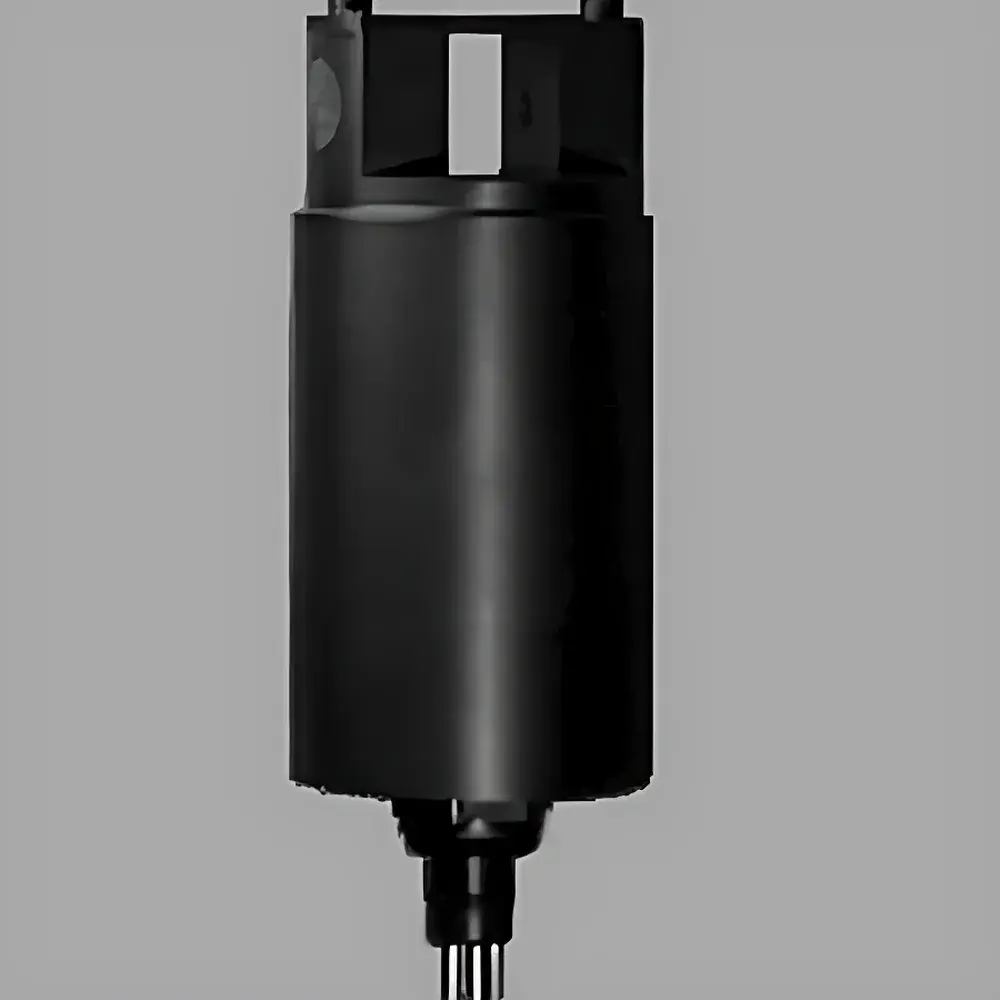
Seapoint SCF Chlorophyll Fluorescence Sensor
| Brand | Seapoint |
|---|---|
| Model | SCF |
| Origin | USA |
| Depth Rating | 6000 m |
| Excitation Wavelength | 470 nm |
| Emission Wavelength | 685 nm |
| Detection Limit | 0.02 µg/L |
| Output | 0–5.0 VDC |
| Response Time Constant | 0.1 s |
| Power Supply | 8–20 VDC, Avg. 15 mA, Max. 27 mA |
| Operating Temperature | 0–65 °C |
| Housing Material | ABS Plastic with Epoxy Underwater Connector (Push-Type AG-306/206) |
| Sensitivity Ranges | 1× (0.033 V/µg/L, 0–150 µg/L), 3× (0.1 V/µg/L, 0–50 µg/L), 10× (0.33 V/µg/L, 0–15 µg/L), 30× (1.0 V/µg/L, 0–5 µg/L) |
| Temperature Coefficient | <0.2 %/°C |
| Net Weight | 1000 g |
| Sensing Volume | 340 mm³ |
| Compatible With | Standard turbidity and fluorescence sensor interfaces |
Overview
The Seapoint SCF Chlorophyll Fluorescence Sensor is a precision optical instrument engineered for in-situ, real-time quantification of chlorophyll a concentration in aquatic environments. Based on the principle of pulse-modulated fluorometry, the SCF employs a 470 nm blue LED excitation source coupled with a narrow-band excitation filter to selectively energize chlorophyll a molecules in phytoplankton. The resultant red fluorescence emission at ~685 nm is isolated via a high-rejection long-pass emission filter and detected by a low-noise silicon photodiode. A synchronous demodulation circuit rejects ambient light interference—including solar radiation and artificial illumination—enabling stable operation in sunlit surface waters, turbid estuaries, and deep-ocean settings up to 6000 meters. Its linear voltage output (0–5.0 VDC) is directly proportional to chlorophyll a concentration across four user-selectable gain ranges, supporting both low-biomass oligotrophic systems and high-chlorophyll bloom conditions without signal saturation or manual recalibration.
Key Features
- Ultra-low power consumption: average current draw of 15 mA at 8–20 VDC, optimized for long-term deployment on battery-, solar-, or mooring-powered platforms
- Full-depth rated housing: titanium-reinforced ABS polymer construction with epoxy-sealed AG-306/206 push-type underwater connector, certified for continuous operation at 6000 m (19,685 ft)
- Optical interference rejection: integrated synchronous detection architecture eliminates cross-talk from ambient light, enabling reliable measurements under variable irradiance conditions
- Configurable flow-through operation: optional closed-cap assembly permits integration with external peristaltic or centrifugal pumps for controlled sample delivery and biofouling mitigation
- Four programmable sensitivity ranges: selected via two digital control lines (TTL-compatible), allowing dynamic adaptation to site-specific biomass gradients without hardware modification
- Thermally stable electronics: temperature coefficient <0.2 %/°C ensures minimal drift across the full operational range (0–65 °C)
- Standardized analog interface: 0–5 VDC output compatible with Campbell Scientific CR series, Onset HOBO, YSI EXO, and other industry-standard data loggers
- Minimal zero-point drift: factory-calibrated offset voltage remains stable over time; no field adjustment required under normal operating conditions
Sample Compatibility & Compliance
The SCF is designed for direct immersion in natural freshwater, marine, and brackish water matrices. Its open-sensing configuration allows passive diffusion-based measurement in static or slow-moving water columns, while the closed-cap variant supports active sampling in high-flow or sediment-laden environments. The sensor meets ISO 10260:2021 guidelines for in vivo chlorophyll a fluorometric analysis and complies with ASTM D3731–22 for field-deployable optical water quality sensors. Its analog output architecture supports traceable calibration against NIST-traceable chlorophyll a standards (e.g., Sigma-Aldrich C6135), and its fixed optical path geometry ensures reproducible inter-unit performance across multi-sensor arrays used in monitoring networks. No reagents, consumables, or optical fluids are required—eliminating maintenance dependencies and reducing total cost of ownership.
Software & Data Management
The SCF operates as a stand-alone analog transducer and requires no embedded firmware or onboard software. Its voltage output is digitized and timestamped by external data acquisition systems supporting 12–16 bit resolution. When integrated into compliant environmental monitoring platforms, raw voltage values are converted to chlorophyll a concentration (µg/L) using factory-provided calibration coefficients stored in metadata files. For GLP/GMP-aligned deployments, users may configure audit trails within compatible logging software (e.g., Campbell LoggerNet v5.0+, AquaMonitor Suite) to record calibration history, sensor ID, deployment location, and environmental context. While the SCF itself does not implement FDA 21 CFR Part 11 electronic signature functionality, its deterministic analog output and stable calibration profile support validation protocols required for regulatory reporting under EPA Method 445.0 and EU WFD Annex V monitoring frameworks.
Applications
- Long-term moored observatories and autonomous profiling floats (e.g., Argo, SOCCOM)
- Real-time algal bloom early warning systems in reservoirs, lakes, and coastal zones
- Vertical profiling of phytoplankton distribution in stratified water columns
- Integration into multi-parameter water quality sondes for wastewater effluent monitoring
- Calibration and validation of satellite-derived ocean color products (e.g., MODIS, Sentinel-3 OLCI)
- Ecological research on nutrient limitation, photosynthetic efficiency, and community succession
- Regulatory compliance monitoring under national water framework directives and drinking water source protection programs
FAQ
What is the minimum detectable chlorophyll a concentration?
The SCF achieves a limit of detection of 0.02 µg/L under optimal signal-to-noise conditions, verified using serial dilutions of spectrophotometrically standardized chlorophyll a solutions.
Can the SCF be deployed in ice-covered or highly turbid waters?
Yes—the sensor’s ambient light rejection capability and pressure-rated housing enable reliable operation beneath seasonal ice cover and in suspended-sediment concentrations up to 1000 NTU, provided the sensing window remains optically accessible.
Is factory calibration traceable to international standards?
Yes—each unit is calibrated against NIST-traceable chlorophyll a reference materials, and calibration certificates include uncertainty budgets per ISO/IEC 17025 requirements.
How often is recalibration recommended?
Annual recalibration is advised for regulatory applications; biennial verification suffices for research-grade deployments where drift is monitored via in-field reference checks.
Does the SCF require anti-fouling measures?
While the sensor exhibits inherent resistance to biofilm accumulation due to its non-reactive ABS housing and low-energy excitation, periodic mechanical cleaning or copper-alloy guard sleeves are recommended for deployments exceeding six months in eutrophic environments.







