
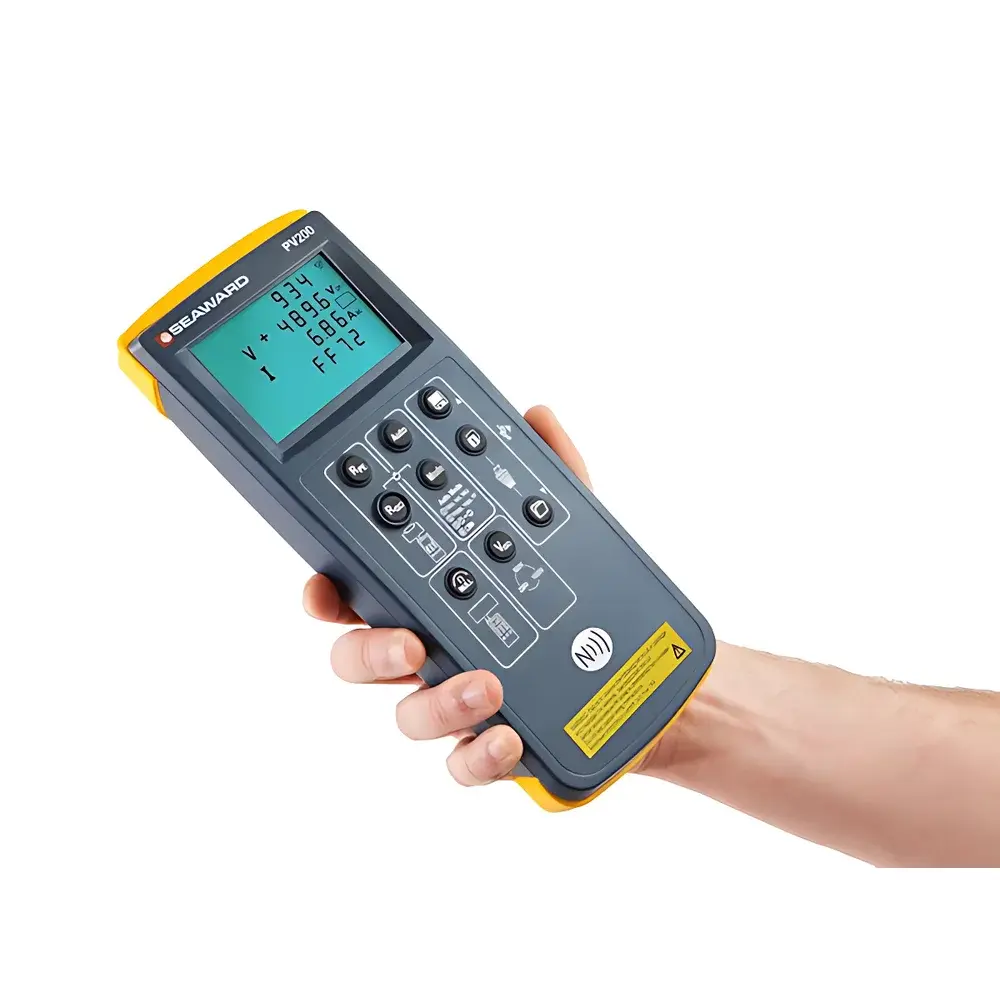
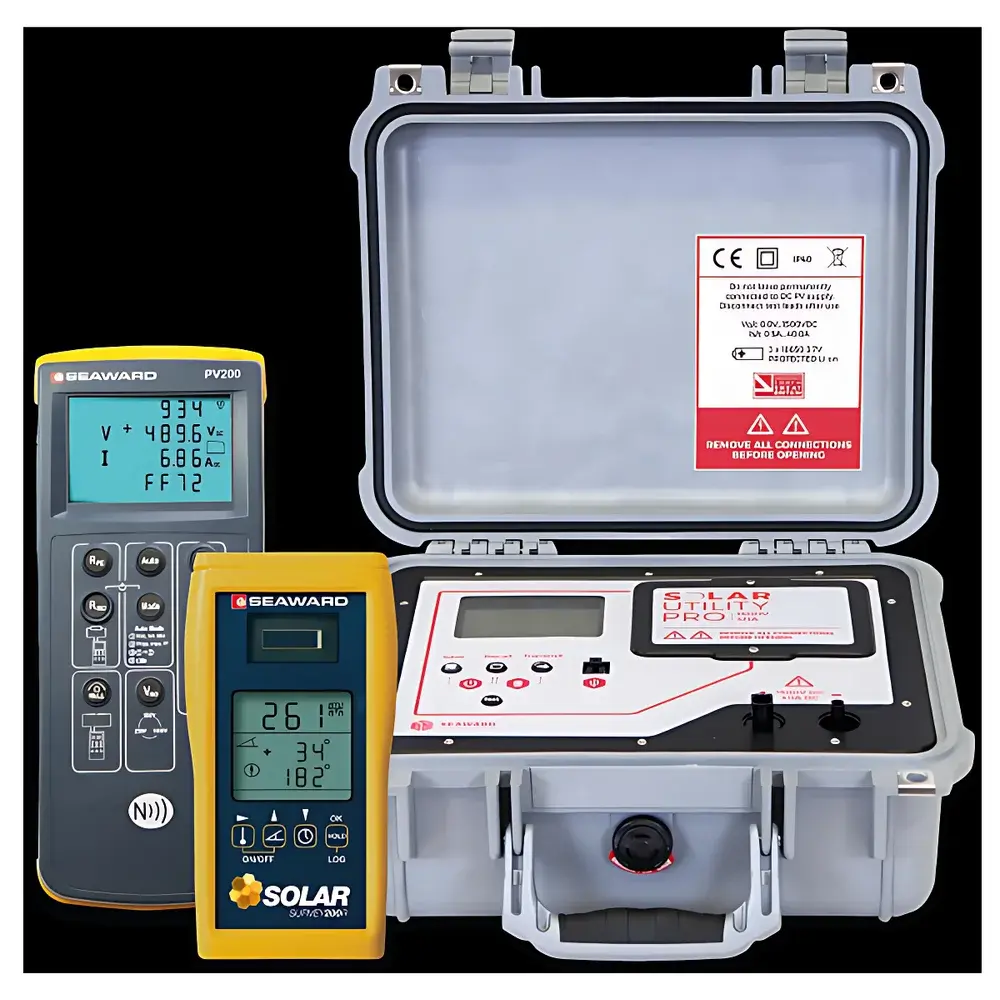
Seaward PV200 Portable I-V Curve Tester for Photovoltaic Systems
| Brand | Seaward |
|---|---|
| Origin | United Kingdom |
| Model | PV200 |
| Automation Level | Fully Automatic |
| Effective Test Area | 1 m² (per module or string) |
| Voltage Measurement Accuracy | ±1% of reading |
| Current Measurement Accuracy | ±1% of reading |
Overview
The Seaward PV200 is a field-deployable, fully automated I-V curve tracer engineered specifically for photovoltaic (PV) system commissioning, performance verification, and fault diagnostics. It operates on the fundamental principle of dynamic load sweeping—applying a controlled variable resistance across the PV device under test (DUT) while simultaneously sampling voltage and current at high temporal resolution to reconstruct the complete current-voltage characteristic curve. Designed in strict alignment with international photovoltaic testing standards—including IEC 62446-1 (grid-connected system acceptance testing) and IEC 61829 (crystalline silicon PV array I-V curve measurement)—the PV200 delivers traceable, repeatable, and metrologically sound data essential for technical due diligence, warranty validation, and operational benchmarking.
Key Features
- Fully automatic single-button operation: initiates full I-V sweep, calculation of key parameters (Voc, Isc, Vmp, Imp, Pmax, FF, Rs, Rsh), and insulation resistance (IR) test in under 15 seconds.
- Integrated high-contrast sunlight-readable LCD display with real-time graphical overlay of measured I-V and P-V curves, enabling immediate visual assessment of curve shape anomalies.
- Onboard STC normalization engine: when paired with the Seaward Solar Surveyor 200R pyranometer (via analog or Bluetooth interface), irradiance, cell temperature, and ambient conditions are captured to convert raw measurements to Standard Test Conditions (1000 W/m², 25 °C, AM1.5G) per IEC 61829 Annex A.
- NFC-enabled wireless data transfer to Android devices running the PVMobile application—no cables, no drivers, no configuration required.
- Ruggedized IP65-rated enclosure with integrated carrying handle and industrial-grade terminals compatible with MC4, T4, and bare-wire connections for rapid deployment on rooftops, ground-mount arrays, or manufacturing lines.
- Compliance-ready reporting: generates PDF reports with embedded metadata (timestamp, GPS coordinates, operator ID, environmental conditions) supporting ISO/IEC 17025 documentation requirements and internal QA/QC workflows.
Sample Compatibility & Compliance
The PV200 supports direct connection to individual PV modules (monocrystalline, polycrystalline, thin-film) and series-connected strings up to 1500 V DC system voltage. Its maximum measurable current range (0–15 A standard; optional 0–30 A) accommodates most commercial and utility-scale crystalline silicon configurations. All electrical safety functions—including open-circuit detection, reverse-polarity warning, and overvoltage cutoff—are implemented in accordance with IEC 61000-4-5 (surge immunity) and IEC 61010-1 (safety requirements for electrical equipment). The instrument is CE-marked, UKCA-certified, and conforms to EN 61000-6-3 (EMC emission limits) and EN 61000-6-2 (immunity). Its measurement uncertainty budget is validated against NPL-traceable reference cells and calibrated shunts per ISO/IEC 17025-accredited procedures.
Software & Data Management
Data acquisition and post-processing are supported by two complementary software platforms: PVMobile (Android-based field application) and SolarCert Elements (Windows desktop suite). PVMobile provides real-time visualization, multi-curve overlay comparison (e.g., measured vs. nameplate, or before/after cleaning), and automated anomaly flagging based on deviation thresholds (e.g., >5% Pmax loss, FF < 0.70, or abnormal knee-point morphology). SolarCert Elements enables advanced regression analysis, long-term performance trending (with optional cloud sync), and generation of audit-ready reports compliant with IEC 62446-1 Clause 6.3 documentation requirements. Both applications support 21 CFR Part 11-compliant user authentication, electronic signatures, and immutable audit trails—critical for GMP-aligned PV manufacturing QA labs and third-party certification bodies.
Applications
- Pre-commissioning verification of new PV installations per IEC 62446-1 Section 6.2.
- Routine performance monitoring of operating plants to detect degradation trends, soiling losses, or mismatch effects.
- Root-cause diagnostics of underperforming strings—identifying partial shading, hot spots, bypass diode failure, PID, or interconnect corrosion via curve shape interpretation.
- Factory acceptance testing (FAT) and quality control in PV module production lines.
- Independent technical due diligence (TDD) for project financing and insurance underwriting.
- Educational use in renewable energy engineering curricula for hands-on characterization of solar cell physics.
FAQ
Does the PV200 require external power during field testing?
No—the instrument is powered by an integrated rechargeable Li-ion battery rated for ≥200 I-V sweeps per charge, eliminating dependency on grid or generator sources.
Can the PV200 measure temperature-dependent parameters such as NOCT or TC coefficients?
While it does not directly compute TC values, the PV200 records module backsheet temperature (via optional PT100 probe input) and uses this with irradiance data to enable post-hoc temperature correction and NOCT estimation in SolarCert Elements.
Is firmware update capability available over-the-air?
Yes—firmware updates are delivered via USB or microSD card; future versions will support Bluetooth OTA updates through PVMobile.
How is measurement traceability maintained across calibration intervals?
Each unit ships with a UKAS-accredited calibration certificate (valid for 12 months); calibration intervals follow ISO/IEC 17025-recommended practices and may be extended based on usage logs and intermediate verification checks using reference modules.
Does the PV200 support export to common SCADA or asset management platforms?
Yes—CSV and XML exports are natively supported; API integration with platforms such as Solar-Log, PowerTrack, and Schneider Electric EcoStruxure is available via certified middleware partners.






