
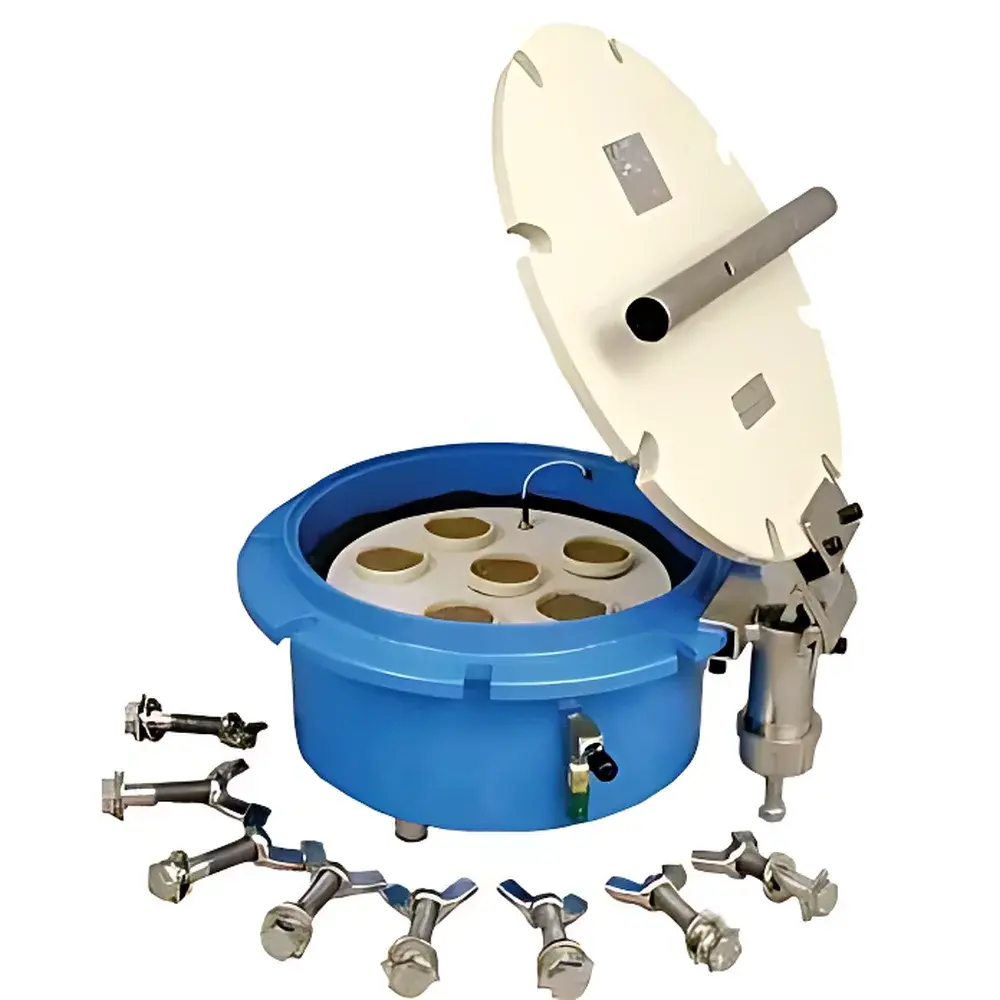
SEC 1500F1 and 1600 Pressure Membrane Extractors for Soil Water Retention Characterization
| Brand | SEC (USA) |
|---|---|
| Origin | USA |
| Model | 1500F1 (0–15 bar), 1600 (0–5 bar) |
| Chamber Dimensions | 1500F1 — 10 cm H × 30 cm ID |
| Ceramic Disc Capacity | Up to 4 per chamber |
| Power Supply | 110 V / 230 V AC (for 0500 series compressor option) |
| Operating Pressure Range | 0.5–15 bar (ceramic discs) |
| Compliance | ASTM D422, ISO 11277, USDA NRCS Soil Survey Laboratory Methods Manual |
Overview
The SEC 1500F1 and 1600 Pressure Membrane Extractors are precision-engineered laboratory instruments designed for the quantitative determination of soil water retention curves (SWRC) — a foundational parameter in vadose zone hydrology, agricultural science, environmental risk assessment, and geotechnical engineering. These extractors operate on the principle of controlled-pressure membrane filtration: saturated soil samples are placed atop porous ceramic or cellulose membranes within a sealed pressure chamber; application of regulated gas pressure (typically nitrogen or compressed air) forces matrix-held water through the membrane while retaining soil solids. By measuring gravimetric or volumetric water loss across a series of discrete, calibrated pressures (e.g., 0.1, 0.3, 1, 3, 5, 15 bar), users generate high-fidelity soil moisture characteristic data compliant with international standards including ASTM D422 (particle size analysis context), ISO 11277 (soil physical properties), and USDA NRCS protocols. The 1500F1 model targets the agriculturally critical range (0–15 bar), covering matric potentials from field capacity to permanent wilting point; the 1600 model focuses on low-pressure applications (0–5 bar), ideal for coarse-textured soils, sediments, and initial drainage characterization.
Key Features
- Modular dual-chamber design: The 1500F1 accommodates up to four 15-bar ceramic discs simultaneously, enabling parallel analysis of up to 48 soil cores (1 cm height), 24 cores (3 cm), or 12 cores (6 cm) per run — significantly increasing throughput without compromising reproducibility.
- Robust stainless-steel pressure vessel construction: 1500F1 chamber dimensions — 10 cm height × 30 cm internal diameter; 1600 chamber — 22 cm height × 30 cm internal diameter — both engineered for uniform pressure distribution and long-term corrosion resistance under repeated pressurization cycles.
- Interchangeable ceramic disc system: Compatible with SEC’s globally standardized 0675-series ceramic discs (0.5–15 bar), each individually tested for gas permeability and hydraulic flow consistency prior to shipment. High-flow variants (e.g., 0675B0.5M2, 0675B01M3) support rapid equilibration in low-suction regimes.
- Integrated sealing architecture: Precision-machined O-ring grooves, torque-specification PM hinges, and calibrated clamping bolts ensure leak-tight operation at rated pressures — validated per ISO 5208 leakage class A requirements.
- Flexible pressure sourcing: Supports both compressed-air (via SEC 0500-series oil-lubricated compressors, 295 psi max) and high-pressure N₂ cylinder (up to 3200 psi) configurations, with dedicated control panels (0700G2, 0700CG23F1, 0750-series) featuring inline filtration, dual-stage regulation, analog test gauges, and bypass valves for fine-grained pressure ramping and stabilization.
Sample Compatibility & Compliance
The 1500F1 and 1600 systems accept standard undisturbed soil cores (e.g., 5.7 cm diameter × variable height) mounted in reusable aluminum sample rings (model 1093). Optional height-adjustable cylindrical sleeves and custom-height sample holders extend compatibility to structured clays, biochar-amended substrates, and heterogeneous landfill cover materials. All configurations maintain strict adherence to GLP documentation requirements: pressure setpoints, equilibration times, and mass measurements are traceable via external balance integration. Data generated satisfies input criteria for HYDRUS-1D modeling, UNSODA database submission, and regulatory reporting under EPA SW-846 Method 9070A (soil moisture release) and EU Council Directive 2009/128/EC (sustainable use of pesticides — soil water holding capacity assessment).
Software & Data Management
While the extractors operate as stand-alone benchtop instruments, SEC provides optional digital logging interfaces compatible with LabVIEW™ and MATLAB® via 4–20 mA or RS-232 outputs from third-party pressure transducers and analytical balances. The 0700CG23F1 and 0750CG23F1 control panels include analog gauge readouts with ±0.5% full-scale accuracy, supporting manual data capture aligned with FDA 21 CFR Part 11-compliant lab notebooks. For automated workflows, users integrate SEC-compatible ceramic disc holders with certified analytical balances (e.g., Mettler Toledo XP series) and spreadsheet-based templates pre-formatted for van Genuchten parameter fitting (θ(ψ) = θᵣ + (θₛ − θᵣ) / [1 + (α|ψ|)ⁿ]ᵐ), ensuring audit-ready metadata retention including operator ID, ambient temperature/humidity, and calibration certificate numbers.
Applications
- Agricultural research: Quantifying plant-available water capacity (PAWC), irrigation scheduling thresholds, and root-zone moisture dynamics across soil series.
- Environmental remediation: Characterizing capillary barrier performance in landfill final covers and evaluating leachate migration potential in unsaturated zones.
- Geotechnical engineering: Supporting slope stability analysis via effective stress calculations derived from measured matric suction profiles.
- Climate modeling: Providing boundary condition inputs for regional hydrological models simulating drought resilience and infiltration-runoff partitioning.
- Material science: Evaluating water retention behavior of engineered soils, green roof substrates, and mine reclamation amendments.
FAQ
What pressure sources are compatible with the 1500F1 and 1600 systems?
Both models support compressed air (via SEC 0500-series compressors) and high-purity nitrogen cylinders. Compressor-based setups require the 0700G2 or 0700CG23F1 control panel; cylinder-based configurations use the 0750-series panel with integrated high-pressure regulators.
Are ceramic discs included with the base instrument purchase?
No — ceramic discs (e.g., 0675B15M1 for 15 bar, 0675B05M1 for 5 bar) are ordered separately. Each disc is factory-tested for gas permeability and hydraulic conductivity consistency, with full traceability documentation provided.
Can the same pressure control panel serve both 1500F1 and 1600 units?
Yes — the 0700CG23F1 multi-range panel is specifically engineered for concurrent operation of 1500F1 (0–15 bar) and 1600 (0–5 bar) extractors, incorporating mercury micro-regulators (0769G1, user-supplied) for sub-bar precision.
What maintenance is required for long-term reliability?
Annual O-ring replacement, quarterly calibration of pressure gauges against NIST-traceable standards, and biannual lubrication of 0500-series compressors using SAE 75W–90 gear oil (ISO 220) are recommended. Ceramic discs should be cleaned ultrasonically in dilute HCl after each use and re-tested for flow integrity every 50 cycles.
Is training or method validation support available?
SEC provides comprehensive SOP documentation aligned with ASTM D3385 and ISO 14246, plus remote application engineering support for method development, troubleshooting, and audit preparation — including assistance with 21 CFR Part 11 electronic record validation protocols.



