
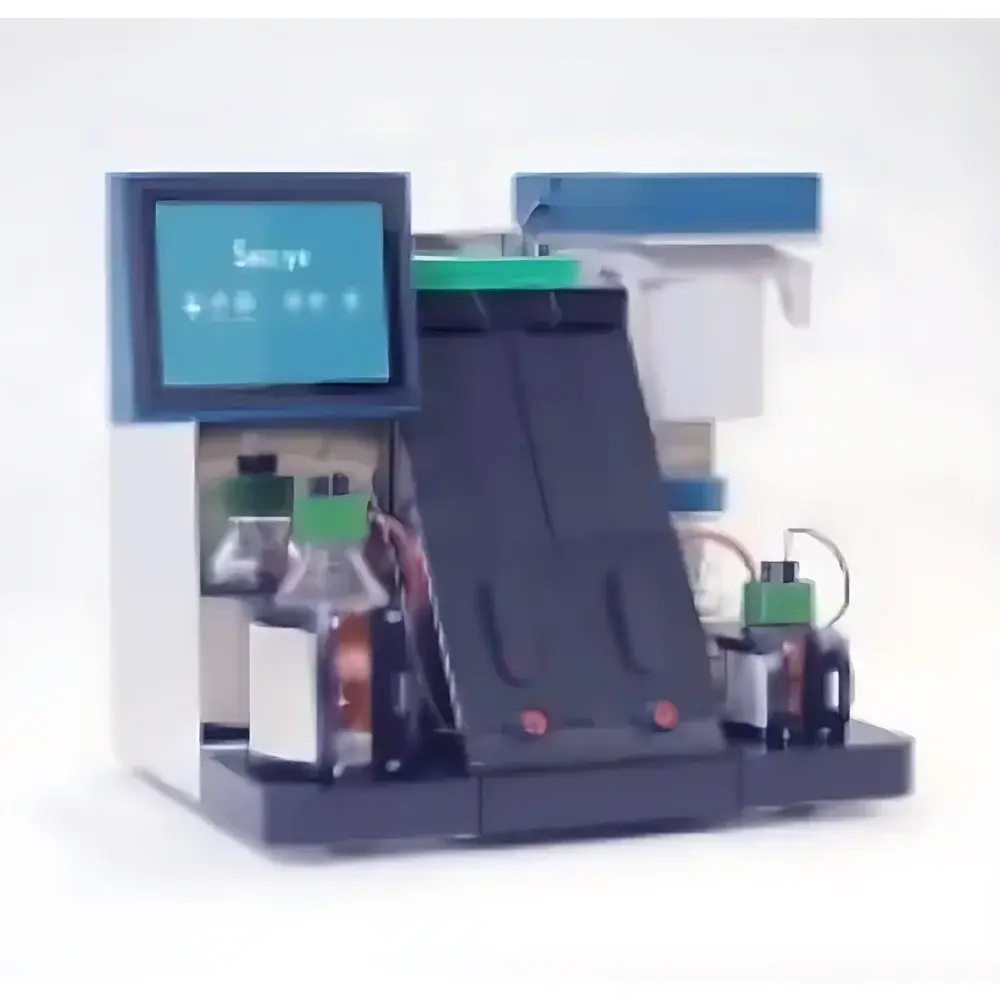
Secoya SCT-LAB Microfluidic Tubular Continuous Crystallizer
| Brand | SCT |
|---|---|
| Origin | Belgium |
| Manufacturer Type | Authorized Distributor |
| Origin Category | Imported |
| Model | SCT-LAB |
| Pricing | Upon Request |
Overview
The Secoya SCT-LAB Microfluidic Tubular Continuous Crystallizer is an engineered platform for controlled, reproducible nucleation and crystal growth of small organic and inorganic molecules under continuous flow conditions. Based on microfluidic mixing and precisely regulated thermal gradients, the system implements a Couette-type laminar flow environment within tubular reactors to achieve rapid supersaturation generation—enabling deterministic control over polymorphic outcome, particle size distribution (PSD), and crystallization kinetics. Designed for early-phase solid-form screening and process development in pharmaceutical R&D, the SCT-LAB bridges the gap between high-throughput batch screening and scalable continuous manufacturing. Its architecture supports both cooling crystallization and antisolvent addition protocols within a single instrument footprint, eliminating cross-platform method translation risks and preserving critical process parameters (CPPs) during scale-up.
Key Features
- Integrated dual-temperature control: Independent regulation of solution (25–85 °C), antisolvent (5–85 °C), and reactor jacket (0–75 °C) enables precise supersaturation tuning across diverse thermodynamic pathways.
- Modular microfluidic mixer inserts: Six interchangeable mixing geometries—optimized for diffusion-limited antisolvent dispersion or rapid convective cooling—allow systematic investigation of mixing intensity, residence time distribution, and local supersaturation profiles.
- Compact benchtop footprint (45 × 45 × 45 cm) with full containment compatibility: Certified for operation inside standard fume hoods, isolators, and closed gloveboxes per ISO 14644-1 Class 5/7 environments.
- Low-volume operational range: Solution injection volumes from 1–20 mL per experiment; total reactor volume 100 mL (heated/stirred); antisolvent reservoir 250 mL (temperature-controlled).
- Flow rate precision: Peristaltic and syringe pump-driven delivery with programmable flow rates from 1–50 mL/min, supporting both laminar and transitional flow regimes relevant to industrial crystallizer design.
- Seven reactor configurations available: Including coiled-tube, straight-tube, and segmented-flow variants—each validated for specific nucleation mechanisms (e.g., primary vs. secondary nucleation dominance) and PSD targeting (1–400 µm with CV < 15%).
Sample Compatibility & Compliance
The SCT-LAB accommodates APIs, excipients, and inorganic salts commonly processed under ICH Q5A–Q5E and USP guidelines. It supports BCS Class II and IV compounds requiring tight control over solubility-limited crystallization behavior. All wetted components are constructed from chemically resistant 316L stainless steel, PTFE, and sapphire—validated for cleaning validation per ASTM E3106-18 and compatible with common cleaning agents (e.g., ethanol, IPA, NaOH). The system meets CE marking requirements (2014/30/EU EMC Directive, 2014/35/EU LVD) and operates within GLP-compliant laboratories when paired with 21 CFR Part 11–enabled software modules (available as optional add-on).
Software & Data Management
Instrument control and data acquisition are managed via Secoya’s SCT Control Suite—a Windows-based application supporting real-time monitoring of temperature, flow rate, pressure, and residence time. Experimental metadata (e.g., supersaturation ratio, nucleation onset time, induction period) is automatically logged with UTC timestamps and user-defined annotations. Raw datasets export to CSV, HDF5, or MATLAB-compatible formats for downstream analysis using MATLAB, Python (NumPy/Pandas), or commercial tools like JMP or SIMCA. Audit trails, electronic signatures, and role-based access control are available through optional GxP-compliant firmware extension, enabling compliance with FDA 21 CFR Part 11 and EU Annex 11 requirements.
Applications
- Polymorph screening and kinetic trapping of metastable forms
- Determination of operational robustness windows (e.g., supersaturation tolerance, cooling ramp sensitivity)
- Quantification of nucleation induction time and secondary nucleation order
- Parameter mapping for Design Space definition per ICH Q8(R2)
- Seamless technology transfer from lab-scale screening (SCT-LAB) to pilot-scale (SCT-Pilot) and production-scale (SCT-Industrial) platforms
- Crystallization process validation for regulatory submissions (e.g., NDA, MAA) requiring mechanistic understanding of particle attributes
FAQ
Can the SCT-LAB be used for both cooling and antisolvent crystallization on the same instrument?
Yes. The system integrates independently controlled heating/cooling zones and interchangeable mixer inserts to support either protocol without hardware modification.
What is the minimum sample volume required for a single experiment?
As low as 1 mL of saturated solution, minimizing API consumption during early-stage screening.
Is the reactor geometry scalable to production volumes?
Yes. All seven reactor designs follow geometric and dynamic similarity principles validated against pilot-scale units (SCT-Pilot, 2–5 L/h), ensuring consistent dimensionless numbers (e.g., Reynolds, Damköhler, Péclet) across scales.
Does the system support automated parameter sweeps?
Yes. The SCT Control Suite allows scripting of multi-variable experiments—including simultaneous variation of temperature gradient, flow ratio, and residence time—with full data synchronization.
Are cleaning procedures documented and validated?
Standard operating procedures (SOPs) for CIP (Clean-in-Place) are provided, including rinse efficiency verification methods aligned with EMA/CHMP/Q5C guidance.





