
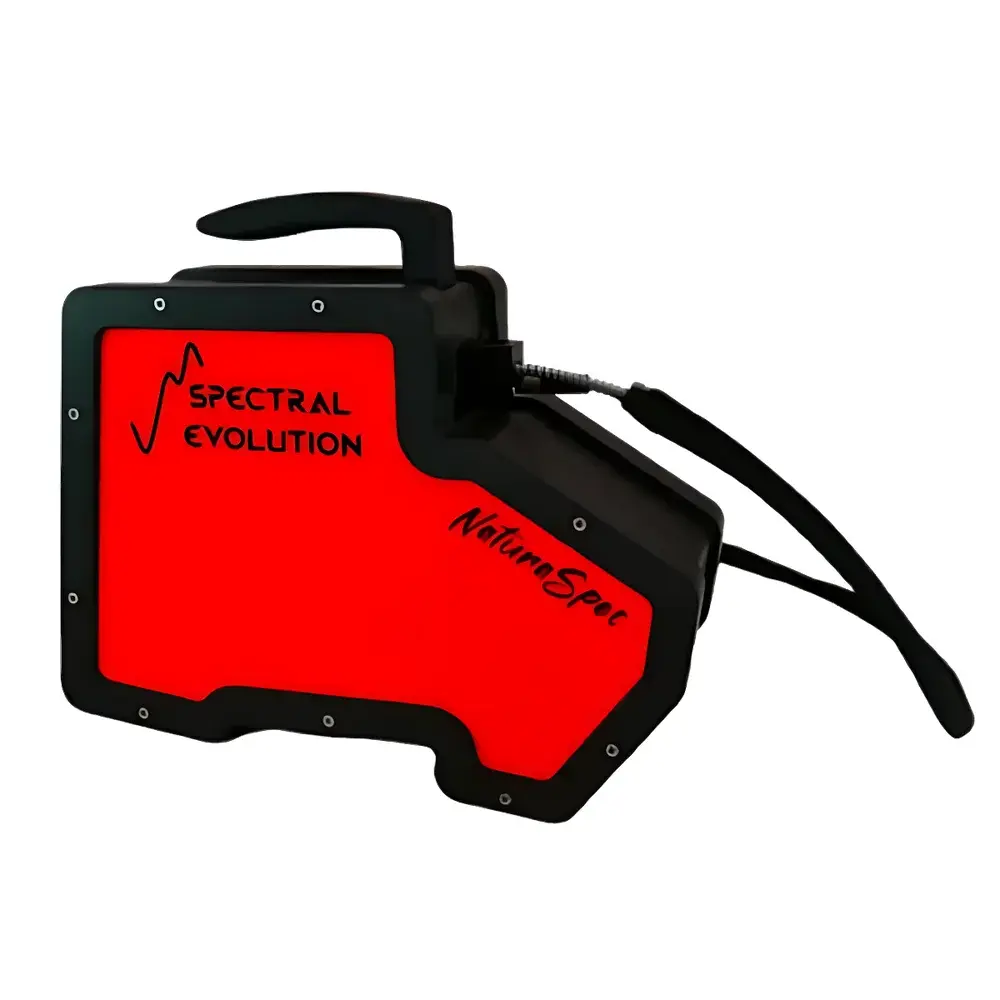
SEI NaturaSpec High-Resolution Field Spectroradiometer
| Brand | SEI |
|---|---|
| Origin | USA |
| Distributor Type | Authorized Distributor |
| Import Status | Imported |
| Model | NaturaSpec |
| Spectral Range | 350–2500 nm |
| Detector | Dual-cooled InGaAs (SWIR1 & SWIR2) + UV-enhanced Si linear array |
| Resolution | 2.8 nm @ 700 nm |
| ENL | 0.3×10⁻⁹ W/cm²/nm/sr @ 700 nm |
| Detectors | 1024-pixel UV-enhanced Si (350–1000 nm), two 512-pixel thermoelectrically cooled InGaAs arrays (1000–1700 nm and 1700–2500 nm) |
| Weight | ~5.7 kg |
| Power | Rechargeable Li-ion battery |
Overview
The SEI NaturaSpec High-Resolution Field Spectroradiometer is a rigorously engineered, portable field instrument designed for quantitative spectral measurement in Earth observation, environmental monitoring, and geoscience applications. It operates on the principle of dispersive spectroscopy using precision holographic gratings and optimized optical path design—eliminating moving parts to ensure mechanical stability and long-term calibration integrity. Its extended spectral coverage from 350 nm to 2500 nm spans the full ultraviolet–visible–near-infrared–shortwave infrared (UV–VIS–NIR–SWIR) region, enabling simultaneous characterization of electronic transitions, vibrational overtones, and fundamental molecular absorptions. The instrument is specifically configured for high-fidelity radiometric and reflectometric measurements under variable ambient conditions, with rigorous attention to stray light suppression, thermal drift compensation, and detector linearity correction.
Key Features
- Triple-detector architecture: A 1024-pixel UV-enhanced silicon linear array (350–1000 nm), paired with two independently cooled 512-pixel InGaAs detectors—one optimized for 1000–1700 nm (SWIR1), the other for 1700–2500 nm (SWIR2)—ensures seamless spectral continuity and optimal quantum efficiency across the full range.
- High spectral resolution: Achieves 2.8 nm FWHM at 700 nm, 8 nm at 1500 nm, and 6 nm at 2100 nm—engineered to resolve narrow absorption features critical for mineralogical identification (e.g., Al–OH, Fe³⁺, Mg–OH bands) and vegetation pigment analysis (e.g., chlorophyll-a, carotenoid, anthocyanin signatures).
- Low-noise performance: Thermoelectric cooling (−10 °C stabilized) of both InGaAs arrays reduces dark current and enables low-equivalent noise radiance (ENL) values: 0.3×10⁻⁹ W/cm²/nm/sr @ 700 nm; 0.1×10⁻⁹ W/cm²/nm/sr @ 1500 nm; 2.5×10⁻⁹ W/cm²/nm/sr @ 2100 nm—supporting high signal-to-noise ratio (SNR > 1000:1) even under low-light field conditions.
- Robust field operation: Fully integrated lithium-ion battery system provides ≥4 hours continuous operation; ruggedized aluminum housing meets IP54 ingress protection; built-in GPS, inclinometer, and ambient light sensor enable synchronized metadata tagging per acquisition.
- Zero-moving-part optical design: Utilizes fixed holographic gratings and fiber-coupled fore-optics—eliminating mechanical wear, reducing sensitivity to vibration, and ensuring measurement repeatability over extended deployment cycles.
Sample Compatibility & Compliance
The NaturaSpec is optimized for non-contact, non-destructive spectral characterization of natural and engineered surfaces—including soils, vegetation canopies, rock outcrops, snow/ice, water bodies, and calibration targets (e.g., Spectralon®, BaSO₄). Its radiometric calibration traceability follows NIST-traceable protocols, with factory calibration performed against standard lamps (FEL, QTH) and calibrated reference panels. The system supports ASTM E275, ISO 9050, and USGS Spectral Library-compliant measurement workflows. Data acquisition and processing comply with GLP principles; raw spectra include embedded calibration coefficients, temperature logs, and integration time metadata—enabling full auditability per FDA 21 CFR Part 11 requirements when used in regulated environmental or agricultural research contexts.
Software & Data Management
The bundled SpectraView Pro software provides a validated, cross-platform (Windows/macOS) interface for real-time spectral acquisition, radiometric correction, geometric normalization, and BRDF-aware reflectance calculation. It supports automated exposure optimization via dynamic integration time adjustment, dark current subtraction, and pixel-by-pixel nonlinearity correction. Export formats include ENVI-compatible BIL/BIP, ASCII (.csv), and HDF5—with embedded metadata conforming to ISO 19115 and CF-1.6 conventions. Batch processing modules enable standardized atmospheric correction (using MODTRAN-based lookup tables), spectral angle mapper (SAM) classification, and derivative analysis (1st/2nd order). All software updates, calibration files, and spectral libraries are distributed via secure HTTPS with SHA-256 checksum verification.
Applications
- Ground-truth validation of airborne and satellite hyperspectral sensors (e.g., AVIRIS-NG, PRISMA, EnMAP), including vicarious calibration and point-spread function characterization.
- Mineral identification and alteration mapping via diagnostic absorption feature analysis (e.g., kaolinite, smectite, jarosite, goethite) in exploration geology and mine waste monitoring.
- Quantitative vegetation biophysical parameter retrieval—including LAI, chlorophyll content, water stress indices (NDWI, PRI), and nitrogen status—aligned with ESA Sentinel-2 and NASA Landsat spectral bands.
- Soil organic carbon estimation, salinity assessment, and heavy metal contamination screening using SWIR spectral signatures (C–H, O–H, N–H combination bands).
- CIE color space computation (XYZ, L*a*b*, u’v’) for material aging studies, cultural heritage pigment analysis, and agricultural product quality grading.
FAQ
Is the NaturaSpec calibrated traceable to NIST standards?
Yes—each unit ships with a NIST-traceable radiometric calibration certificate, including wavelength accuracy verification (< ±0.2 nm) and responsivity curves across all three detector segments.
Can the instrument operate in direct sunlight without saturation?
Yes—the auto-exposure algorithm dynamically adjusts integration time from 1 ms to 10 s, and the dual-gain electronics prevent clipping in high-irradiance scenarios typical of midday solar measurements.
What spectral data formats are supported for export?
Raw and processed spectra export to ENVI BIL, CSV, HDF5, and XML metadata containers—all compliant with FAIR data principles and interoperable with ENVI, Python (spectral, scikit-learn), and R (hyperSpec) ecosystems.
Does the system support external triggering or synchronization with UAV platforms?
Yes—via TTL trigger input (BNC) and RS-232/USB-C serial interface; compatible with common UAV telemetry systems for geo-referenced push-broom acquisition.
How often is recalibration recommended for field-deployed units?
Annual recalibration is recommended for radiometric accuracy maintenance; field validation using certified reference panels is advised before each major campaign.




