
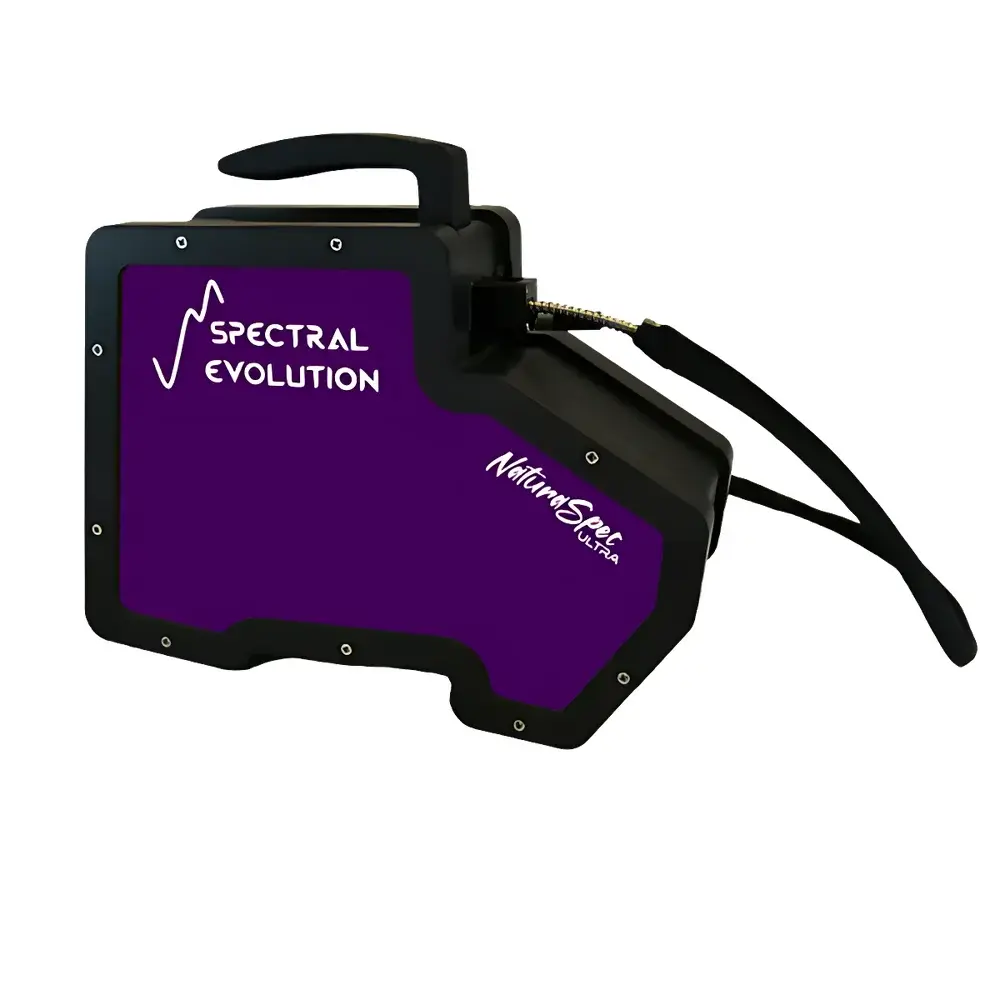
SEI NaturaSpec Ultra High-Resolution Field Spectroradiometer
| Brand | SEI |
|---|---|
| Origin | USA |
| Distributor Type | Authorized Distributor |
| Import Status | Imported |
| Model | NaturaSpec Ultra |
| Spectral Range | 350–2500 nm |
| Detector Configuration | UV-enhanced Si (1024-pixel, TE-cooled, VIS-NIR), InGaAs (512-pixel, TE-cooled, SWIR1), Extended InGaAs (512-pixel, TE-cooled, SWIR2) |
| Spectral Resolution | 1.5 nm @ 700 nm |
| NER (1.2 m fiber) | 0.4×10⁻¹⁰ W/cm²/nm/sr @ 400 nm |
| Dimensions | 31.5 × 22.1 × 11.2 cm |
| Weight | 5.5 kg |
Overview
The SEI NaturaSpec Ultra High-Resolution Field Spectroradiometer is a laboratory-grade, portable spectroradiometric system engineered for rigorous terrestrial remote sensing and in situ spectral characterization. Operating across the full solar-reflective range—from ultraviolet-visible through shortwave infrared (350–2500 nm)—it employs a triple-detector architecture with thermoelectrically cooled linear array sensors to deliver industry-leading spectral resolution and radiometric stability in field-deployable form. Unlike scanning monochromator-based systems or single-detector spectrometers, the NaturaSpec Ultra utilizes fixed grating optics with no moving parts, eliminating mechanical drift and enabling consistent calibration traceability across extended measurement campaigns. Its design adheres to fundamental principles of absolute radiance and reflectance measurement, supporting bidirectional reflectance distribution function (BRDF) studies, spectral library development, and validation of airborne and satellite sensor data. The instrument is optimized for quantitative analysis where fine spectral features—such as chlorophyll absorption edges near 680 nm, cellulose and lignin absorption bands at 2000–2200 nm, or diagnostic mineral absorption features near 2200–2350 nm—are critical to material identification and classification.
Key Features
- Triple-sensor optical path with simultaneous spectral acquisition: UV-enhanced silicon (VIS-NIR), standard InGaAs (SWIR1), and extended-range InGaAs (SWIR2), each independently TE-cooled to −10 °C for dark-current suppression and long-term signal stability.
- No moving optical components: Fixed-grating spectrograph architecture ensures mechanical robustness, resistance to vibration-induced misalignment, and suitability for transport across rugged terrain or airborne platforms.
- Integrated electronic shutter and automated exposure optimization: Eliminates manual gain/duration tuning; dynamically adjusts integration time per spectral region to prevent saturation while maximizing signal-to-noise ratio (SNR).
- Full dark-current subtraction workflow: Onboard dark reference capture is triggered automatically prior to each sample scan, ensuring accurate radiometric correction without user intervention.
- Portable form factor (5.5 kg) with integrated battery support and low-power consumption: Enables >6 hours of continuous operation in standalone mode, compatible with external 12 V DC sources for extended deployments.
- GPS-enabled tablet interface: Real-time geotagging of spectral measurements using NMEA 0183-compliant GNSS receivers; supports WGS84 coordinate embedding directly into spectral metadata (ISO 19115-compliant).
Sample Compatibility & Compliance
The NaturaSpec Ultra is validated for direct measurement of natural surface targets—including vegetation canopies, bare soils, rock outcrops, snow/ice, and man-made materials—under ambient illumination conditions. Its high-fidelity spectral response enables compliance with established protocols for field spectroscopy, including ASTM E275-22 (Standard Practices for Describing and Measuring Performance of UV–VIS–NIR Spectrophotometers), ISO 17123-7:2020 (Optics and photonics — Field procedures for testing geodetic and surveying instruments — Part 7: Spectroradiometers), and NASA’s AVIRIS-NG calibration traceability framework. All factory calibrations are performed against NIST-traceable standards (e.g., FEL lamps, calibrated integrating spheres), and spectral irradiance/reflectance data output conforms to the Spectral Data Exchange Format (SPEX) v2.1. Instrument firmware and data acquisition software support audit trails and electronic signatures required under GLP and ISO/IEC 17025 environments.
Software & Data Management
The NaturaSpec Ultra operates via SEI’s SpectraView Pro software suite, a Windows-based application designed for scientific spectral acquisition, real-time visualization, and post-processing. It provides raw DN-to-radiance conversion using stored calibration coefficients, supports custom ROI definition for spectral averaging, and exports data in multiple interoperable formats: ASCII (.csv), ENVI .hdr/.sli, and HDF5 (with embedded metadata). The software implements automatic spectral stitching across detector boundaries with sub-pixel registration and spectral bandpass overlap correction. For regulatory compliance, SpectraView Pro includes 21 CFR Part 11–compliant user access control, electronic logbook functionality, and immutable data archiving options. Raw spectra are timestamped, georeferenced, and annotated with environmental parameters (ambient temperature, relative humidity, solar zenith angle) when connected to optional external sensors.
Applications
- Vegetation biophysical parameter retrieval: Leaf area index (LAI), chlorophyll content, water stress indices (NDWI, PRI), and nitrogen concentration modeling using narrowband spectral derivatives.
- Soil property mapping: Organic carbon estimation, iron oxide quantification, clay mineral discrimination (kaolinite, smectite, illite), and salinity assessment via diagnostic absorption features.
- Mineralogical identification: Discrimination of hydroxyl-bearing minerals (e.g., clays, serpentine), carbonates, sulfates, and Fe/Mn oxides based on overtone and combination bands in the SWIR region.
- Calibration/validation of Earth observation missions: Ground-truth support for Sentinel-2, Landsat 9, PRISMA, EnMAP, and upcoming SBG (Surface Biology and Geology) mission requirements.
- Forensic geolocation and material attribution: Spectral fingerprinting of construction materials, paints, and debris for environmental forensics and cultural heritage documentation.
FAQ
What spectral calibration standards are used during factory calibration?
All NaturaSpec Ultra units undergo radiometric calibration using NIST-traceable FEL-standard lamps and reflectance calibration with Spectralon® reference panels certified to ±0.5% reflectance uncertainty across 350–2500 nm.
Is the instrument suitable for underwater or aquatic reflectance measurements?
While primarily designed for above-water terrestrial use, the NaturaSpec Ultra can be deployed with a waterproof housing and fiber-optic probe for shallow-water benthic reflectance profiling; however, water-column correction requires ancillary in situ absorption/scattering measurements.
How is spectral alignment maintained between the three detector modules?
Spectral registration is achieved through factory-measured pixel-to-wavelength mapping functions for each detector, combined with hardware-level synchronization of integration timing and onboard dark-reference normalization to minimize inter-sensor radiometric offset.
Can the system operate unattended for long-term monitoring?
Yes—the instrument supports scheduled autonomous acquisitions via USB or Ethernet trigger; however, long-term field deployment requires external power management and environmental enclosure to maintain detector thermal stability and optical window cleanliness.
Does the software support batch processing of large spectral libraries?
SpectraView Pro includes a command-line interface (CLI) module for scripting-based batch calibration, atmospheric correction (using MODTRAN-derived look-up tables), and statistical classification (e.g., PLSR, SVM) across thousands of spectra.





