
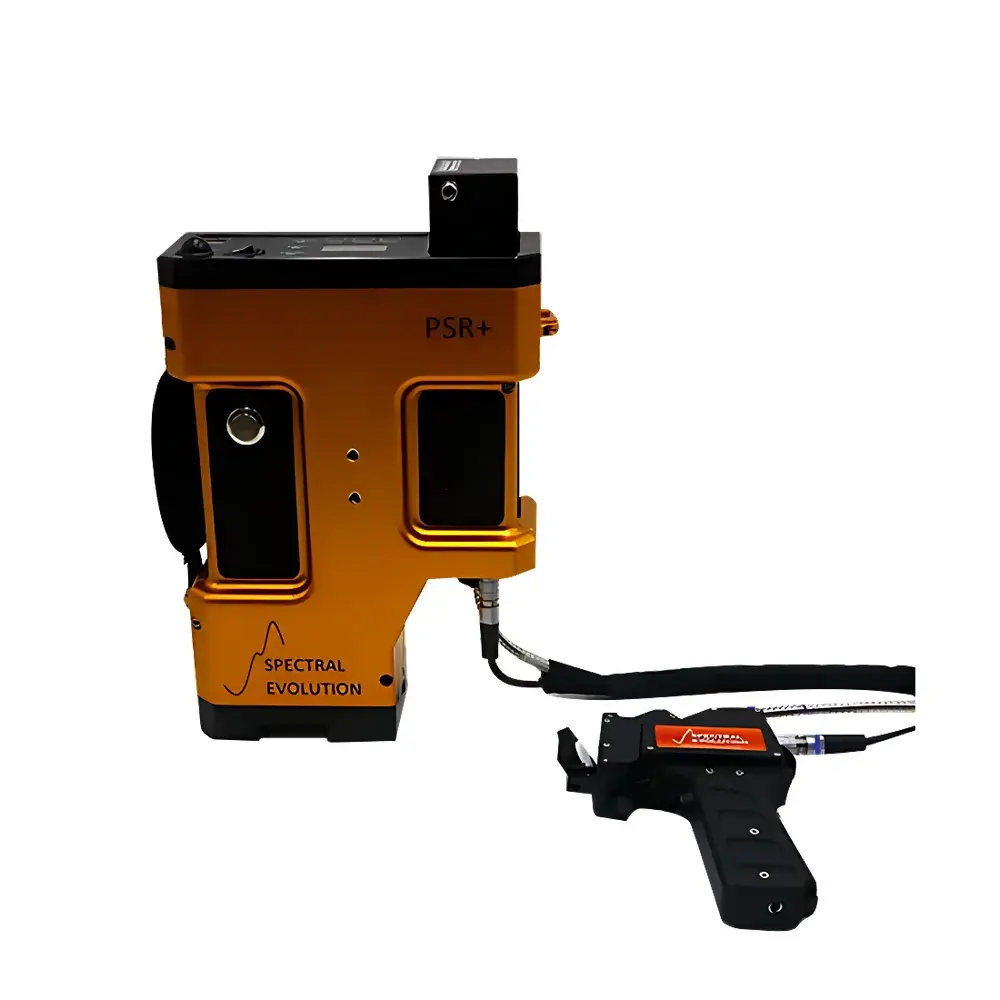
SEI PSR+ Ultra-Portable Field Spectroradiometer
| Brand | SEI |
|---|---|
| Origin | USA |
| Manufacturer Status | Authorized Distributor |
| Product Origin | Imported |
| Model | PSR+ |
| Spectral Range | 350–2500 nm |
| Spectral Resolution | 2.8 nm @ 700 nm |
| Weight (instrument only) | 3.5 kg |
| Weight (with battery) | 3.6 kg |
| Internal Memory Capacity | 1000 spectra |
| Power Supply | Two rechargeable Li-ion batteries, 7.4 V |
Overview
The SEI PSR+ Ultra-Portable Field Spectroradiometer is a high-performance, field-deployable spectroradiometric instrument engineered for rigorous outdoor reflectance and radiance measurements across the solar reflective spectral region. Based on a fixed-optics, fore-optics dispersive architecture—eliminating moving gratings or scanning mechanisms—the PSR+ delivers exceptional optical stability, long-term measurement reproducibility, and high signal-to-noise ratio (SNR) under variable environmental conditions. Its core measurement principle relies on dual-beam, calibrated spectral sampling using thermoelectrically stabilized silicon (350–1000 nm) and InGaAs (900–2500 nm) detector arrays, enabling simultaneous acquisition across the full 350–2500 nm range with seamless spectral stitching. Designed specifically for terrestrial remote sensing applications, the PSR+ meets the operational demands of field scientists requiring rapid, repeatable, and metrologically traceable spectral data without reliance on external computing infrastructure.
Key Features
- Ultra-lightweight ergonomic design: Instrument-only mass of 3.5 kg; total operational weight of 3.6 kg with integrated battery pack—optimized for single-operator mobility during extended field campaigns.
- Fixed-optics fore-optics configuration: No internal moving parts ensures mechanical robustness, minimal alignment drift, and immunity to vibration-induced spectral artifacts—critical for vehicle-mounted or handheld deployment.
- Integrated laser targeting system: Co-aligned visible laser diode enables precise spatial registration of measurement footprints on heterogeneous targets (e.g., vegetation canopies, mineral outcrops, water surfaces).
- Intelligent onboard acquisition: Automatic shutter control, exposure time optimization, and dark-current subtraction executed in real time—no user intervention required for routine calibration or measurement sequences.
- Standalone operation capability: Built-in 1000-spectrum non-volatile memory and intuitive front-panel interface allow fully autonomous data collection; optional Android-based PDA integration provides enhanced visualization and metadata tagging.
- Thermally stabilized dual-detector architecture: Si CCD (UV-VIS-NIR) and extended-range InGaAs (SWIR) arrays operate under active temperature regulation to minimize thermal noise and ensure spectral fidelity across diurnal temperature swings.
Sample Compatibility & Compliance
The PSR+ is compatible with reflective and radiance-based sampling geometries including contact probe, cosine receptor, fiber-coupled leaf clip, and tripod-mounted nadir-viewing configurations. It supports standardized field protocols aligned with ASTM E275, ISO 17123-8, and CEOS/CEOS-EO guidelines for ground truth spectral validation. Data output conforms to ENVI-compatible BIL format with embedded wavelength calibration tables and radiometric coefficients traceable to NIST-traceable standards. The instrument’s firmware and data handling workflow support audit-ready metadata logging—including GPS timestamp, operator ID, atmospheric pressure, and ambient temperature—facilitating GLP-compliant reporting and regulatory submissions (e.g., USDA CropScape validation, USGS Mineral Resources Program QA/QC frameworks).
Software & Data Management
Data acquisition and post-processing are supported via SEI’s SpectraView™ v4.x software suite (Windows/macOS), which includes spectral smoothing, atmospheric correction (using MODTRAN-derived look-up tables), spectral index calculation (e.g., NDVI, PRI, NDWI, MSAVI2), and batch export to CSV, HDF5, or GeoTIFF formats. Raw spectra include full calibration metadata compliant with NASA’s SPECCHIO schema and FAIR data principles. For regulated environments, optional 21 CFR Part 11-compliant module enables electronic signatures, role-based access control, and immutable audit trails—meeting FDA, EPA, and ISO/IEC 17025 laboratory accreditation requirements.
Applications
- Agricultural Monitoring: Leaf-level reflectance profiling for chlorophyll content estimation, water stress detection, and phenological stage classification.
- Mineral Exploration: Identification and mapping of hydroxyl-bearing minerals (e.g., clays, micas) and iron oxides via diagnostic absorption features in the SWIR region (1900–2200 nm).
- Inland & Coastal Water Quality: Quantification of suspended solids, chlorophyll-a concentration, and CDOM (colored dissolved organic matter) through continuum-removed reflectance analysis.
- Soil Characterization: Discrimination of soil organic carbon, clay content, and iron oxide abundance using multivariate regression models trained on PSR+-acquired reference libraries.
- Calibration/Validation of Airborne & Spaceborne Sensors: High-accuracy ground reference measurements supporting Sentinel-2, Landsat 9, PRISMA, and ECOSTRESS L1B/L2A product validation.
FAQ
What spectral calibration standards are used for factory certification?
All PSR+ units undergo end-to-end radiometric and spectral calibration using NIST-traceable tungsten-halogen and deuterium lamps, coupled with certified reflectance standards (e.g., Spectralon® 99% and 50% panels). Calibration reports include uncertainty budgets per ISO/IEC 17025 Annex A.3.
Is the PSR+ compatible with third-party GPS or IMU modules?
Yes—the instrument features a serial RS-232 port and TTL-sync interface for hardware synchronization with external GNSS receivers (e.g., u-blox ZED-F9P) and inertial measurement units, enabling georeferenced spectral cube generation.
Can raw spectra be exported without proprietary software?
Yes—binary .SPC files contain ASCII header metadata and IEEE-754 floating-point spectral arrays; open-source Python libraries (e.g., seispec, pyradiance) provide direct parsing and conversion tools.
How often is recalibration recommended?
Annual recalibration is advised for ISO/IEC 17025 compliance; however, field-based dark/light reference checks every 2–4 hours during intensive campaigns maintain measurement integrity between formal calibrations.
Related Products



