
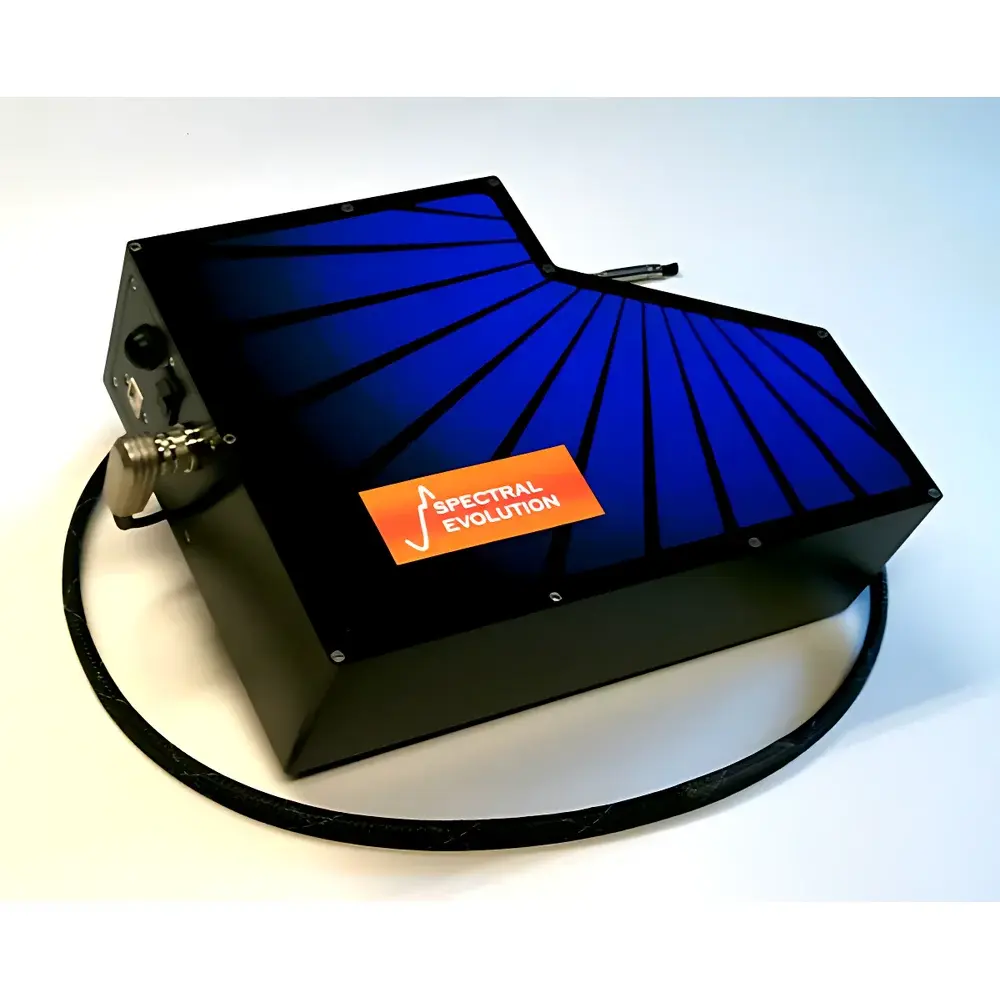
SEI SR Series Portable Field Spectroradiometer
| Brand | SEI |
|---|---|
| Origin | USA |
| Distributor Type | Authorized Distributor |
| Import Status | Imported |
| Model | SR Series |
| Price Range | USD 85,000 – 215,000 |
| Spectral Range | 280–2500 nm |
| Resolution | 4 nm @ 700 nm |
Overview
The SEI SR Series Portable Field Spectroradiometer is a high-precision, field-deployable spectroradiometric instrument engineered for quantitative spectral measurement across the ultraviolet, visible, and shortwave infrared (UV-VIS-SWIR) domains. Based on fiber-optic coupled CCD/InGaAs detector architecture, it employs dual or triple grating monochromators and thermoelectrically stabilized detectors to ensure spectral fidelity and radiometric stability under variable environmental conditions. The system operates on the principle of dispersed spectral irradiance measurement—capturing absolute radiance, irradiance, reflectance, and transmittance via calibrated optical paths and NIST-traceable factory calibration. Designed for outdoor and laboratory-based geophysical and material characterization workflows, the SR Series supports ASTM E275, ISO 9050, USP , and IEC 60904-9 compliant solar simulator classification (Class A/B/C), making it a reference-grade tool for photovoltaic QA/QC, remote sensing validation, and environmental spectral monitoring.
Key Features
- NIST-traceable factory calibration for spectral radiance and irradiance—certified per NIST SRM 2020, 2030, and 2065a standards, with full uncertainty budget documentation provided
- Integrated auto-exposure algorithm that dynamically optimizes integration time (1–1000 ms for SR-3501; 1–50 ms for SR-1901PT) based on input signal level, eliminating manual gain adjustment
- Real-time dark current subtraction using synchronized shutter-controlled dark reference acquisition
- Modular optical configuration: interchangeable fore-optics including cosine-corrected diffusers (2π sr), collimating lenses, and fiber-coupled integrating spheres (optional)
- Ruggedized aluminum chassis with IP54-rated enclosure, operational at -10°C to +50°C ambient temperature and up to 85% non-condensing humidity
- Battery-powered operation (integrated Li-ion, 8 hr typical runtime) with USB-C and Ethernet interfaces for field data logging and remote control
Sample Compatibility & Compliance
The SR Series accommodates diverse measurement geometries—including hemispherical irradiance (via cosine receptor), directional reflectance (with bi-directional goniometer interface), and transmittance (using transmission stage kits). It complies with key international standards for spectral measurement integrity: ASTM E275 (description of filters and spectrophotometers), ASTM G173-03 (reference solar spectral irradiance), ISO 17025:2017 (calibration laboratory competence), and IEC 60904-9:2020 (classification of solar simulators). All delivered calibration certificates include measurement uncertainty statements aligned with EURACHEM/CITAC Guide CG4 and comply with FDA 21 CFR Part 11 requirements for electronic records and signatures when used in regulated GLP/GMP environments.
Software & Data Management
The bundled SpectraSuite Pro software (v5.3+) provides full instrument control, real-time spectral visualization, batch processing, and report generation. It supports automated compliance workflows—including AM1.5G spectral match evaluation (per IEC 60904-9 Annex B), spatial uniformity mapping (via raster scan integration), and temporal stability trending (RMS deviation over 100+ pulses). Raw data is exported in IEEE-compliant .spc and ASCII formats; metadata embedding follows ISO 19115 geospatial tagging conventions. Audit trails, user access controls, and electronic signature capability are enabled for 21 CFR Part 11 compliance. Optional Python and MATLAB SDKs allow integration into custom QA automation pipelines.
Applications
- Solar simulator classification (A/B/C) and spectral mismatch factor (MMF) calculation for PV module certification labs
- Field validation of hyperspectral satellite and UAV sensor calibration targets (e.g., BaSO₄ panels, Spectralon® references)
- Crop phenotyping via vegetation indices (NDVI, PRI, MCARI) derived from canopy reflectance spectra
- Mineral identification and alteration mapping in geological surveys using diagnostic SWIR absorption features (e.g., Al-OH, Mg-OH, Fe³⁺ bands)
- Industrial lighting quality assessment—CRI, TM-30 metrics, and melanopic daylight efficacy ratio (DLER) computation
- Pharmaceutical film coating uniformity analysis through NIR reflectance profiling (1000–1900 nm)
- Ocean color remote sensing ground truthing—remote sensing reflectance (Rrs) derivation using above-water protocols (NASA SeaBASS-compliant)
FAQ
What spectral calibration standards are used during factory calibration?
All SR Series instruments undergo primary calibration against NIST Standard Reference Materials (SRMs) 2020 (deuterium lamp), 2030 (tungsten halogen), and 2065a (diffuse reflectance standard), with secondary transfer via calibrated reference lamps traceable to NIST’s Spectral Irradiance Calibration Facility.
Can the SR-1901PT be used for continuous-wave (CW) light source characterization?
Yes—the SR-1901PT supports both pulsed and CW operation modes; its 1–50 ms minimum integration time and TTL trigger synchronization make it suitable for flash-lamp, LED, and laser-based sources requiring pulse-resolved spectral capture.
Is spectral stray light correction applied in real time?
Stray light compensation is implemented post-acquisition using instrument-specific polynomial correction matrices derived from monochromator linearity tests per ISO 17025 Annex C; raw uncorrected data is also available for research-grade reprocessing.
Does the system support GPS-synchronized spectral logging?
When paired with an external GNSS receiver (e.g., u-blox ZED-F9P), SpectraSuite Pro logs georeferenced spectral metadata (latitude, longitude, altitude, UTC timestamp) compliant with ISO 19115-2 for Earth observation data interchange.
How often is recalibration recommended?
SEI recommends annual radiometric recalibration for ISO 17025-compliant use; wavelength calibration verification should be performed quarterly using internal Hg/Ar emission lines or external spectral line sources.





