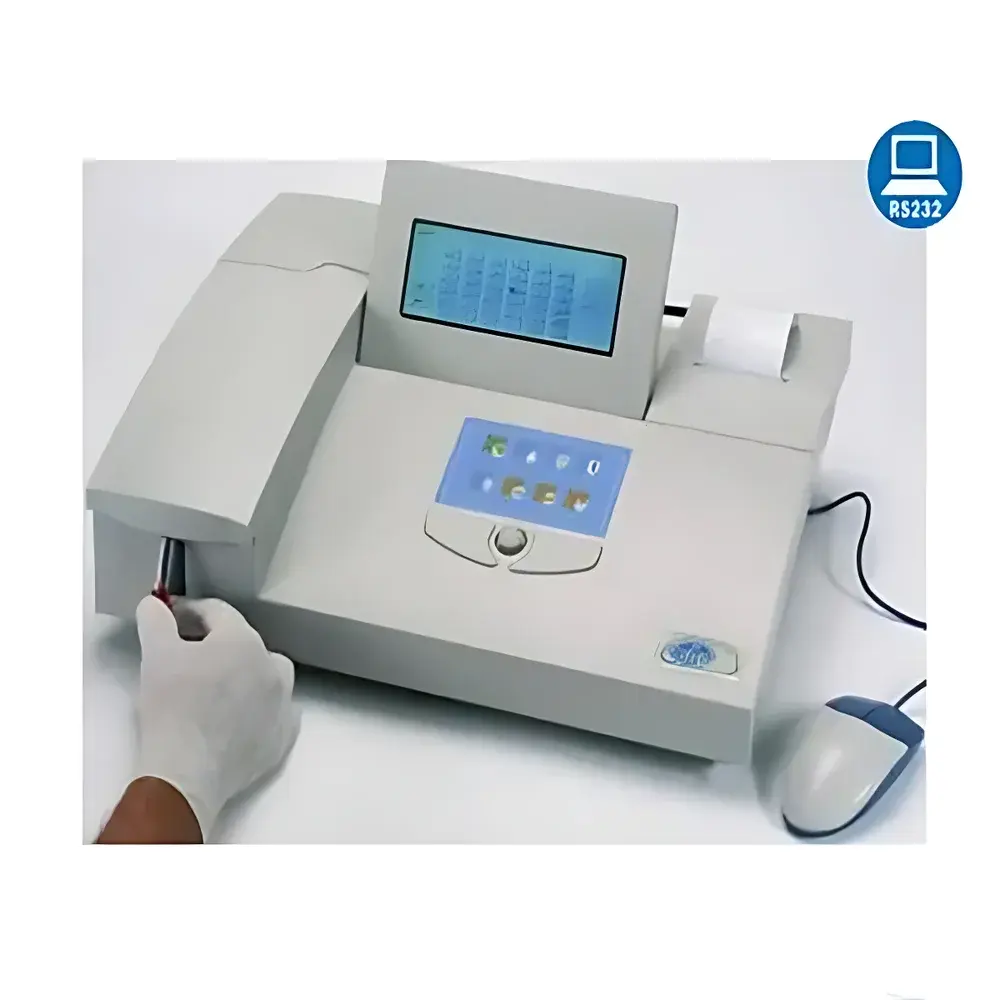
Selecta PhotometerS-2000 Semi-Automatic Clinical Photometer
| Brand | Selecta |
|---|---|
| Origin | Spain |
| Model | PhotometerS-2000 |
| Measurement Principle | Continuous Flow (Flow-Through Cuvette System) |
| Detection Reagents | Selecta-branded clinical reagent kits |
| Optical System | Dual-wavelength solid-state photodiode detector with 7 fixed interference filters (340, 405, 500, 546, 578, 620, 670 nm) |
| Bandwidth | 10 nm |
| Cuvette Volume | 30 µL |
| Absorbance Range | 0.000–2.500 ABS |
| Display Resolution | 0.001 ABS |
| Computational Resolution | 0.0001 ABS |
| Temperature Control | Peltier-heated sample holder (setpoints: 25 °C, 30 °C, 37 °C |
| Light Source | 6 V / 10 W tungsten-halogen lamp |
| Lamp Life-Saving Mode | Yes |
| Display | 640 × 240 pixel LCD, 256-color graphics |
| Data Interface | RS-232 serial port |
| Ambient Operating Conditions | 15–32 °C, ≤85% RH (non-condensing) |
| Internal Storage | Up to 134 assay methods, 1000 patient results |
| Preloaded Methods | 47 most common clinical assays (e.g., cholesterol, glucose, serum iron, LDH, AST, urea) |
| Curve Fitting Algorithms | Endpoint, Kinetic, Linear Regression, Multi-Point Calibration, Best-Fit Polynomial, Bichromatic Correction |
| Control Interface | Scroll wheel or external USB mouse |
| Dimensions (H×W×D) | 41.2 × 45.3 × 33 cm |
| Power Supply | 100–220 V AC, 50–60 Hz |
| Weight | 15 kg |
| Optional Accessory | BIO-BATH metal dry-block incubator (37 °C, 8-position, for 75 × 13 mm test tubes) |
Overview
The Selecta PhotometerS-2000 is a semi-automatic clinical photometer engineered for precision absorbance-based quantification in routine clinical laboratories. It operates on the continuous flow (flow-through cuvette) principle, where sample and reagent streams are merged within a precisely dimensioned optical path (30 µL quartz or disposable flow cell), enabling reproducible photometric measurements under controlled thermal and timing conditions. Unlike fully automated analyzers, the PhotometerS-2000 maintains operator involvement in pipetting and reagent loading—making it ideal for mid-volume labs requiring flexibility, method customization, and cost-effective operation without sacrificing analytical rigor. Its dual-wavelength optical architecture minimizes matrix interference and hemolysis-related artifacts, supporting both single- and bichromatic measurement protocols compliant with CLSI EP10 and ISO 15197 standards for clinical chemistry instrumentation.
Key Features
- Dual-wavelength photometry with seven fixed-bandpass interference filters (340, 405, 500, 546, 578, 620, 670 nm) and 10 nm bandwidth—optimized for common clinical enzyme and colorimetric assays.
- Peltier-regulated sample holder with selectable temperature setpoints (25 °C, 30 °C, 37 °C) and ±0.1 °C stability—ensuring kinetic assay reproducibility per CLSI EP05-A3 guidelines.
- High-resolution graphical LCD (640 × 240 pixels, 256 colors) with real-time kinetic trace visualization, calibration curve plotting, and QC charting.
- Six embedded curve-fitting algorithms: endpoint, kinetic rate, linear regression, multi-point calibration, best-fit polynomial, and bichromatic correction—supporting USP <857> and ICH Q2(R2) method validation requirements.
- Lamp life-saving function automatically reduces filament voltage during idle periods, extending halogen lamp service life beyond 1,000 hours.
- Integrated thermal printer with auto-labeling of sample ID, assay name, result, timestamp, and QC status—facilitating GLP-compliant record retention.
- RS-232 interface enables bidirectional data exchange with LIS/HIS systems and supports ASTM E1381/E1394 message formatting.
Sample Compatibility & Compliance
The PhotometerS-2000 accepts standard 13 mm diameter glass or plastic test tubes (including those used with the optional BIO-BATH dry-block incubator), as well as flow cells compatible with Selecta’s proprietary reagent kits. It is validated for use with human serum, plasma (EDTA, heparin, fluoride-oxalate), urine, and cerebrospinal fluid across 47 preconfigured assays—including cholesterol (CHOD-PAP), glucose (GOD-PAP), AST (IFCC), ALT (IFCC), urea (urease), creatinine (Jaffé), total protein (Biuret), and electrolytes via indirect ion-selective measurement. All onboard methods adhere to IFCC reference measurement system traceability principles where applicable and support internal QC monitoring per CLIA ’88 and ISO 15189:2022 clause 5.6. The instrument’s firmware includes audit trail functionality for method edits, calibration events, and result overrides—meeting FDA 21 CFR Part 11 requirements when paired with appropriate network authentication and electronic signature controls.
Software & Data Management
The embedded operating system provides password-protected user roles (Operator, Supervisor, Administrator) with configurable access rights to method editing, calibration, QC review, and data export. Up to 134 assay protocols—including custom-defined ones—can be stored locally, each with independent wavelength pairing, reaction delay, measurement interval, and blank subtraction logic. Patient results (up to 1,000 entries) are time-stamped and linked to QC runs; all data can be exported via RS-232 to CSV or HL7-formatted files. The system logs every critical event—including lamp activation cycles, temperature deviations >±0.3 °C, and filter position errors—with timestamps and operator IDs. Software updates are performed via secure USB flash drive using SHA-256 verified firmware packages.
Applications
The PhotometerS-2000 serves core functions in hospital core labs, reference laboratories, and point-of-care satellite facilities performing clinical chemistry, therapeutic drug monitoring, and basic hematological screening. Typical applications include enzymatic determination of liver function markers (ALT, AST, GGT, ALP), renal biomarkers (urea, creatinine), metabolic panels (glucose, cholesterol, triglycerides), iron metabolism (serum iron, TIBC), and cardiac markers (LDH, CK). Its kinetic capability supports lactate dehydrogenase (LDH) isoenzyme ratio analysis and alkaline phosphatase (ALP) bone/liver fractionation when coupled with electrophoretic separation. The BIO-BATH accessory enables rapid plasma separation at 37 °C—reducing turnaround time for STAT coagulation and electrolyte testing without centrifugation.
FAQ
Does the PhotometerS-2000 support two-point calibration for non-linear assays?
Yes—it implements multi-point calibration with up to 8 standards and applies best-fit polynomial or spline interpolation for assays exhibiting non-linearity, such as total bilirubin or uric acid.
Can third-party reagents be used with this instrument?
While optimized for Selecta-branded reagent kits, the system allows manual entry of extinction coefficients and calibration curves for validated third-party reagents—subject to full verification per CLSI EP15-A3.
Is the RS-232 interface compatible with modern Windows-based LIS systems?
Yes—drivers and configuration utilities are provided for Windows 10/11; communication uses standard ASCII protocol with configurable baud rate (9600–115200), parity, and stop bits.
What maintenance is required for the optical system?
No routine alignment is needed—the solid-state photodiode and fixed-filter design eliminates mechanical drift; only periodic cleaning of the flow cell window and lamp housing is recommended every 6 months.
How does the lamp life-saving mode affect photometric accuracy?
It reduces filament temperature during standby but maintains full thermal equilibrium within 15 seconds of assay initiation—no impact on absorbance linearity or repeatability (CV <1.2% at 1.0 ABS, n=20).